
I have; I bought this…

1923 Blackburne 350cc engine
Well, you know how it is. Christmas may come but once a year.. .but the chance to buy rare engines is sometimes only once in a lifetime. What you see here is a 1923 350cc Blackburne engine. I was offered it by a friend who was clearing some surplus parts. I thought the price was reasonable, reflecting the fact that the bottom-end needed some sorting and is not, strictly speaking, the correct one. The engine number reveals that the crankcases are from a 250cc side-valve not a 350cc ohv but they are exactly the same. I was able to replace out the big end and it is now A Lovely Thing.
So what’s it all about?
Well, Burney and Blackburne started out in 1912 making complete motorcycles on a very limited basis. Brothers Cecil and Alick Burney were enthusiasts and competition riders but preferred road trials to racing.
The bike they produced was aimed to provide reliability and comfort rather than speed. By 1915 their Blackburne looked like this:

My good old rusty but trusty 1915 Blackburne
The original 500cc side-valve engine was still driving the wheel by belt but now via a Sturmey Archer 3-speed gearbox. The same year a Brooklands racer with single-speed belt drive was proposed but never went beyond prototype stage owing to the unpleasantness kicking off in Europe. After the War, Blackburne 350s came second and third in the 1920 Junior TT, first place being taken by Cyril Williams on an AJS. Sounds good but in truth, even though the AJS had broken down and been pushed three miles to the finish, it was still nine minutes before the Blackburnes crossed the line.
TT stands for Tourist Trophy and the race was originally intended to be an endurance test for reliability of touring machines. Ideal for bikes of the Burney school. The AJS entries represented either The Future or a gloves-off cheat with their highly-tuned overhead valve engines, depending how you saw it. In fact, the only reason Blackburne were placed at all was that nobody at AJS had structured any team discipline, leaving the riders to scrap with each other, setting a furious pace until all bar Williams had blown up or crashed – and even his bike didn’t complete the race under its own power.
IN any case, the game had changed – and post-war, the Burney brothers were no longer involved with the company – so Blackburne developed an AJS-beating, OHV racing engine of their own. They designed a completely OHV cylinder head and a barrel with mounting studs to fit onto the well proven, existing bottom end. In 1923, the ports were enlarged giving more power and suddenly Blackburne became a force to be reckoned with, not only for AJS on the Island but rival proprietary engine builders JAP, who were for the time being still locked in the side-valve age.
This is where my new engine fits into motorcycle history. But things changed quickly back then and the 1923 Blackburne TT engines were further updated with new crankcases and a 4-stud cylinder mounting, features which apppeared on the production engines in 1924. After that the engines remained broadly the same until the end of the ‘twenties.
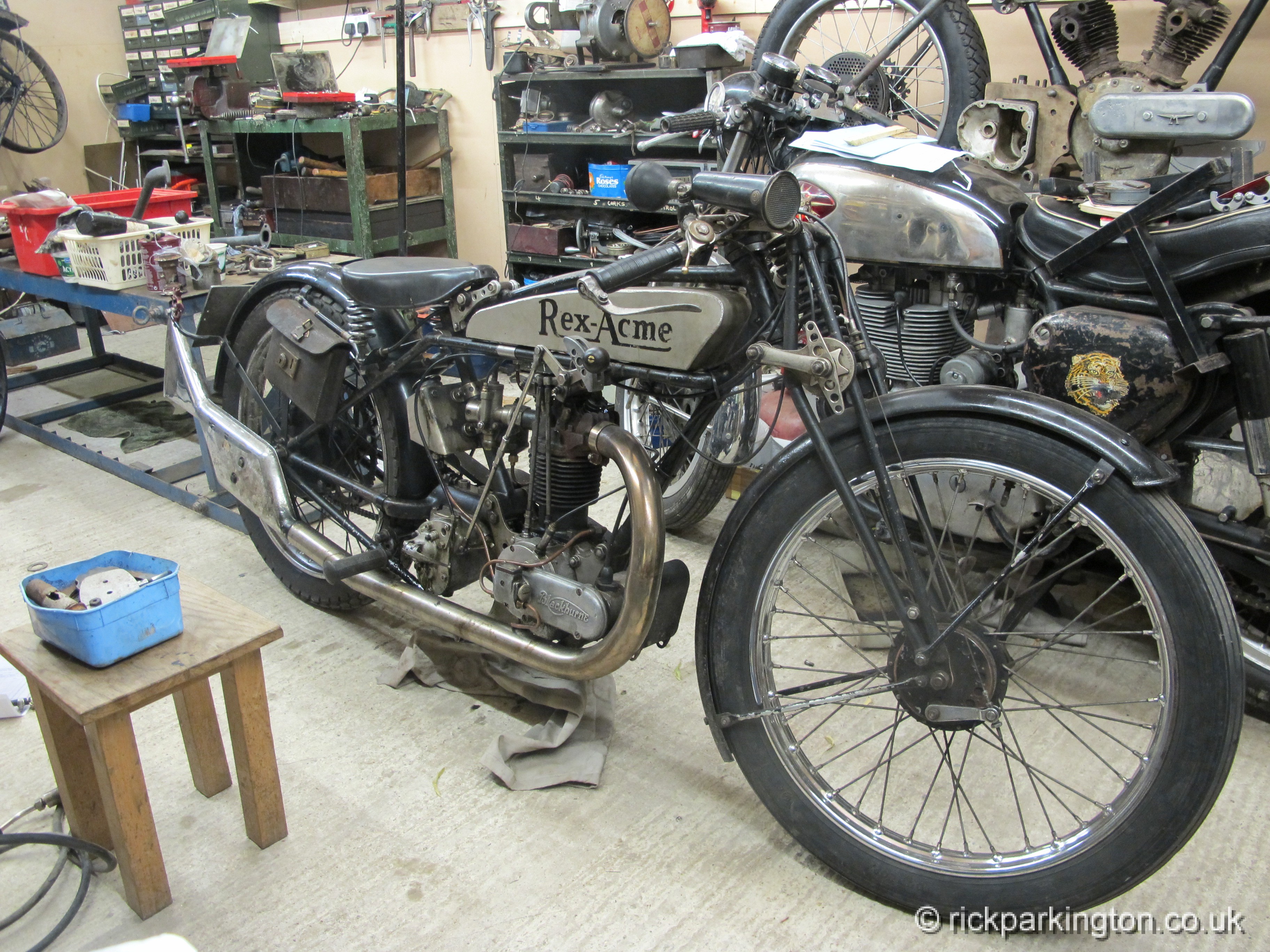
1927 Rex Acme 350TT Sports
My Rex Acme is fitted with a 1927 350cc motor and goes like stink. But the 3-stud OHV engines were only around for a couple of years so, being a bit obsessed with Blackburne, I couldn’t resist the opportunity to get hold of one. And I do have a valid excuse… it’s research material. For the last ten years I’ve been compiling information about Blackburne in order to write a decent marque history. With every engine I strip, I learn a bit more. But that’s the problem; all the while you keep finding more information, the file stays open. This is archaeology of sorts and you will never stop learning new facts. You either need to close the file and publish, accepting that more information will come to light after – or speed up the rate of discovery. Leaning toward the latter, when an engine like this comes up, there’s no choice. Anyway, it’ll look nice on the dining table where the sizzling turkey would have been if I hadn’t just spent the Xmas budget… Beans on toast it is then.
Part of the research job has been decoding Blackburne’s complex engine numbering system, which has always been something of a mystery. Although also still work in progress, I’ve now got a pretty complete picture. So should you find any Blackburne engines under the tree on Christmas morning and you want them identified or dated, drop me a line.
Cheers RIck
Hi Rick
I’ve just been reading your article in Dec Classic Bike on your Martinsyde. What a fabulous machine. Do you know which issues/date of “Motor Cycling” the bike was in? In keen to track them down.
Cheers
Graham
Hi Graham, I don’t have the original copies myself yet, need to look out for them – but they were 7/7/39 and 8/1/48. I could email you copies of the copies I have if you like.
Cheers Rick
Any frame in mind or just as a back up?
Well, no. The problem is that there are always more engine around than frames, the good news is that at least the engines look much better diplayed on the fireplace than frames do…
I do have a project in mind for a later date which could either end up a SV or early OHV but in the meantime it’s all part of the research.I can now tell you things about Blackburne cylinder head design that would wither a cactus!
Hey Rick, got on to the blog for the first time – great reading! I live here in Adelaide, South Australia and was wondering if you knew of Martyn Adams from Halifax now residing in Mount Barker here in South Oz. He has a gorgeous Rex Acme TT that he restored and then shipped over here. It was/is on display at the Birdwood Motor Museum and he currently has another Blackburne project on the go….slipping said motor into a BSA C15 frame as the ultimate street sleeper he reckons! Anyway, I have a couple of bikes…nothing so exotic unfortunately…but one is a nicely restored ’66 BSA Hornet that was salvaged from the USA. Always love your writing in CB and will bookmark ya blog too! Merry Xmas. Send us an email if you want to get in touch with Martyn or google Martyn Adams Engineering and find him that way…he’s on facebook too. All the best – David H.
Thanks, David and all the best! Yes I know Martyn. His bike is a very fine thing. Maybe I should do a bit of a post about that, thinking about it. Not sure a C15 chassis won’t take the spring out of his other engine’s step though! The Blackburne’s aren’t all that powerful – maybe 16 or 18bhp – but the Rex is a very light bike, which makes them go well. Even a C15 is heavy by comparison – I think a D1 Bantam might be more appropriate but hey, everybody who sees someone building a special thinks they know ‘a better way to do it’ so it’ll be interesting to see wht Martyn comes up with. If you see him tell him hi from me!
Cheers Rick
sorry…had a senior moment and didn’t read the ‘your comment has been sent for moderation’…assumed my first comment disappeared into the ether and wrote another…hence the two near-identical posts, dejavu? D.