
Where would BBC Radio 4 be without ‘The Archers’ it’s decades long running saga of rural life?
Who cares? I’m talking about Sturmey Archer gearboxes….
 You see, I’ve only realised the value of the humble gearbox since running up and down the road trying to start my single speed Blackburne ‘Scarlet Runner’ Brooklands racer replica.
Thing is, veteran era single-speed race bikes have no clutch or kickstart. To get them going you had either to pedal them or run alongside with the valve lifter raised; although that takes the punch out of compression, you are still turning the engine over as you go so it’s not easy to build up any speed. But you do need to try your best because you’re permanently in top gear, so unless you get a lick on, the engine will be turning too slowly to catch – and then when it does fire, you have to run a bit faster to jump aboard.
The next problem – with the Scarlet Runner at least – is that it’s so light in weight that compression can easily lock the wheel so it’s just skidding along behind you and of course you can’t bump your backside in the seat to add grip because you’re not going fast enough and it will just fall over. Surely this can’t be ‘just how it was’ in those far-off days, can it?
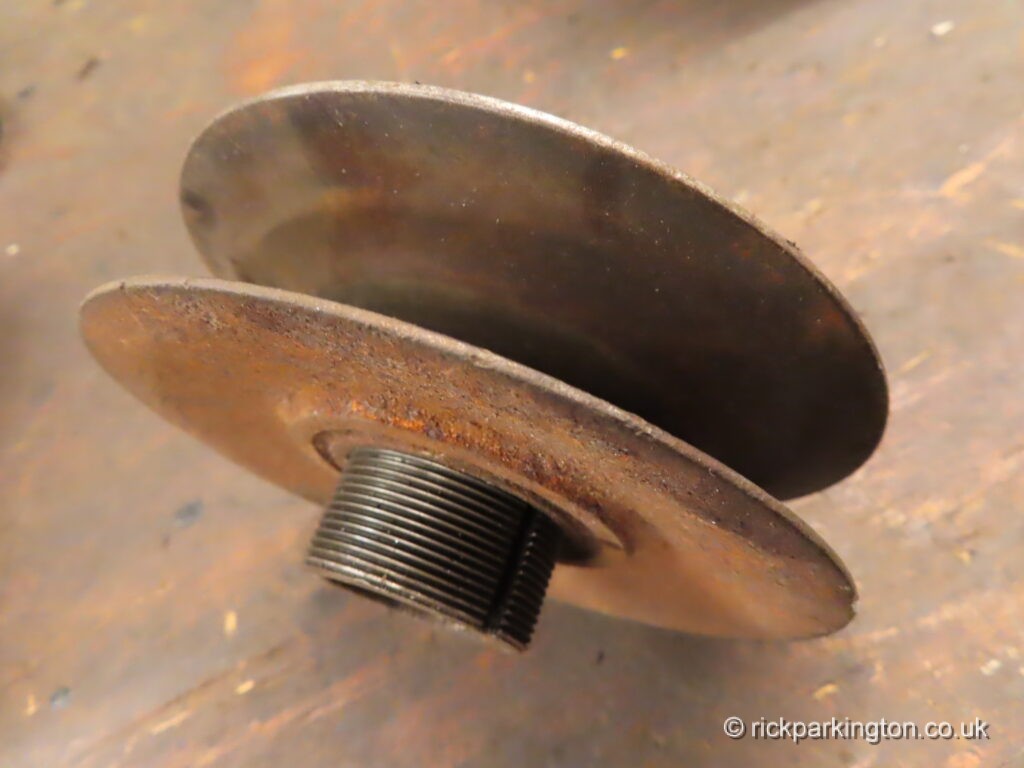 Well yes and no; it was like that for race bikes but most road bikes had pedals enabling you to start on the stand or pedal up to speed before dropping the valve lifter. As a matter of fact Blackburne never fitted pedals, they were making the point that the Blackburne was an easy push starter that didn’t need rider pedal assistance on hills. Also front pulleys were made adjustable. In the picture above, the outer flange of the pulley is threaded so by unscrewing it, the pulley flanges open, lowering the belt in the vee like a smaller sprocket. This lowers the gear ratio – but also slackens the belt making slip more likely. It wasn’t something you could do as you rode along either so the idea really was to work out a suitable top gear ratio for your weight and where you lived – flat or hilly, set the pulley for that ratio, trim the belt to the right length and leave it like that.
Obviously people dreamed of a pulley you could adjust as you rode along and Zenith provided one with their Gradua gear. Winding a handle opened the front pulley and shifted the rear wheel back to take up belt slack. Rudge’s Multi was similarly effective and had a system that opened the front pulley while closing the rear so belt tension remained constant. Effective as these systems were, they were also complicated.
Sturmey Archer were originally known for their rear wheel hub gears, a similar idea to that found on bicycles. There were also hub clutches to make life easier but the real game changer was Sturmey’s CS (countershaft) gearbox that first appeared in late Summer 1914. Although the Motor Cycle for August 14th 1913 featured a letter from Harold Bowden of Sturmey Archer pooh-poohing Ixion’s praise of countershaft gears, within a year, Sturmey had made a prototype countershaft box and advertised it in December 1914…along with ‘S.A. hub gears at reduced prices’.
Sturmey didn’t invent the countershaft gearbox but they made it popular. It is one of the landmark developments in motor cycle design – most of which (apologies to modern bike fans) were thought of well before 1930. I know that sounds a bit pompous but it is true. The only really new thing to have come out of the past few decades is digital fuel injection and that’s computer tech not motorcycle design. From 1890 to 1930 it was a complete whirlwind, earlier in fact. If you read the foreword to Charles Jarrot’s wonderful book ‘Ten Years of Motors and Motor Racing’ he describes the difficulties of the early years and blithely compares them to the ease of reaching any destination reliably today – it comes as a bit of a shock that he wrote this in 1910! It’s like the well-known fact that you learn 75% of what you know before the age of three – or similar, it sounds daft – I didn’t know one end of a bike from the other then…but consider things like learning to breathe, eat, listen, copy, avoid danger, balance, walk, talk, reason and your degree in computer science seems pretty small beer.
If you haven’t ridden a single speed veteran it’s hard to imagine just how much difference having a countershaft gearbox and a multiplate clutch AND a kickstarter made, the fact that it was just three speeds not five or six is nothing – the engines in those days had a wide enough power spread to manage with one gear, three was a luxury. As a proprietary manufacturer, Sturmey Archer already had many customers for their Hub Gears and these soon took up the new CS (CounterShaft ) gearbox in 1915. Being a proprietary manufacturer, their boxes were available to anybody making bikes. The units came ready assembled and drawings were available giving dimensions and chain/belt lines so you could virtually order the gearboxes while you made the frames, knowing they’d fit. Among the takers were Triumph and when the Ministry of Defence decided to take the Model H as one of their Despatch Rider staples, the Sturmey Archer really took off.
So you can see why the gearbox was considered a great invention when it came along – but now? Nobody cares. We’ll spend hours nursing and rebuilding engines but if a gearbox plays up (usually due to abuse) we act like it’s cheated us! Maybe it’s some primitive instinct that makes us suspicious of things with lots of teeth – but while people happily display glittering engines on stands, for all to admire, spare gearboxes are forced to live in cardboard boxes, shoved deep under the bench like some workshop down’n’out.
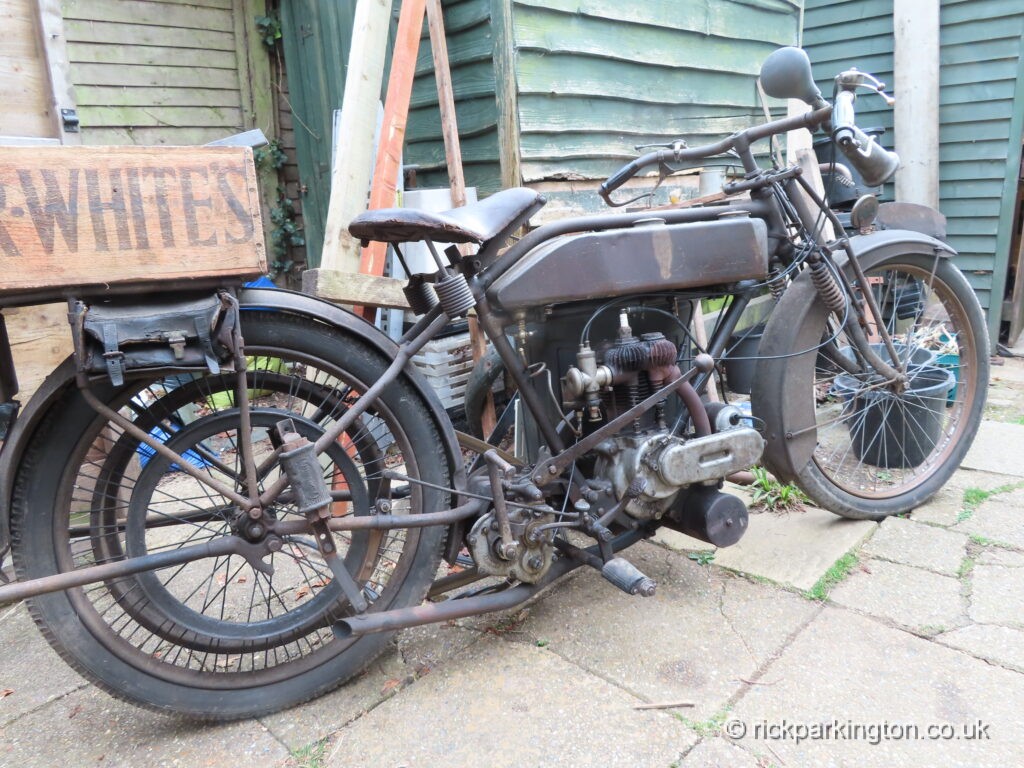 The old shonk above is my 1916 Blackburne 3.5hp TT Sports, fitted with the ‘new’ Sturmey Archer gearbox. I say new because despite the bike being 1916 the gearbox is actually one is one of the first made. It’s hard to be precise about the age of this bike. The registration is 1919, the front frame is 1914-style, the rear frame and engine are 1916.
Incidentally, from this you can guess I am a Blackburne obsessive so if you need anything Blackburne identified (not aircraft – that’s a different company!) let me know, I may be able to help.
Anyway, back to the story. Production of all civilian machines was stopped by law in 1917, so whether my Rusty Trusty was made and sold in 1916 or assembled from bits lying about the factory as part of getting back into production in 1919 is impossible to say. The Tongham factory allegedly employed 160 people in 1918 so it was a sizeable operation – but there was a War on after all so either is possible.
Here’s the important bit for gearbox lovers everywhere…
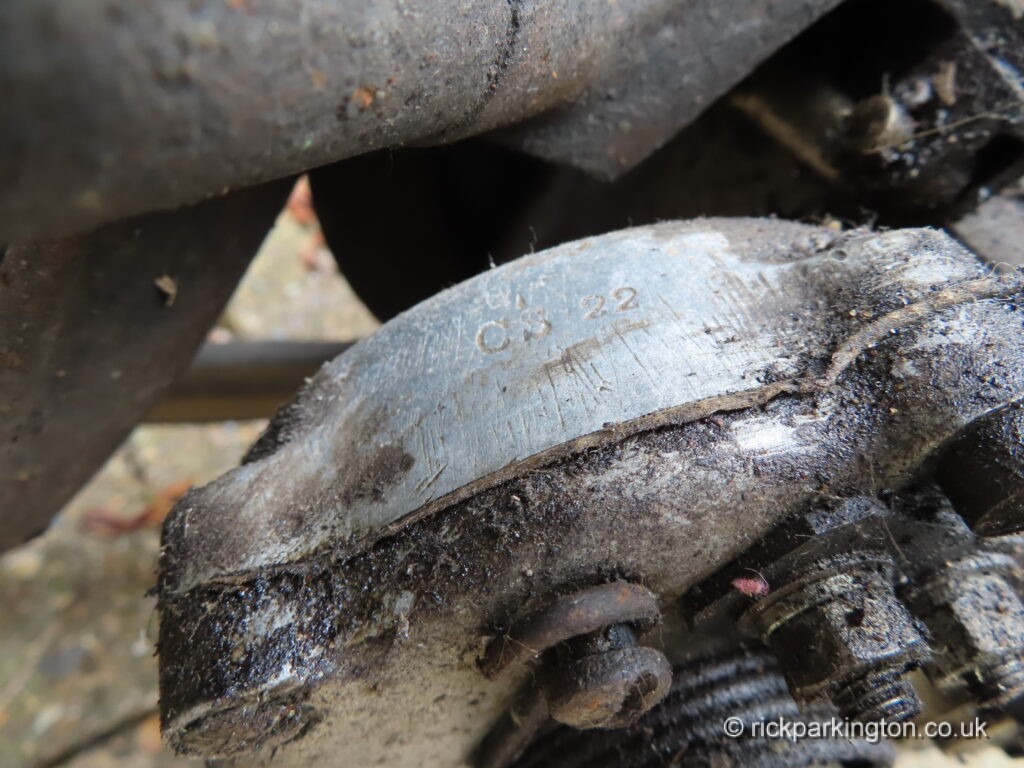
CS 22. By the end of the War CS numbers had reached CS30000, primarily because of Triumph’s Model H, the Sturmey Archer equipped trench-dodger. So it’s pretty amazing to have number 22, possibly the earliest survivor and I would imagine it’s the sample ‘box supplied to Blackburne in late 1914 when they were planning their 1915 range; ‘virtually a prototype’ as my friend and VMCC Blackburne/OEC marque specialist Martin Shelley put it.
Wouldn’t it be fascinating to know what changes were made to that ‘prototype’ before Sturmey began real production? Well, I can help there…
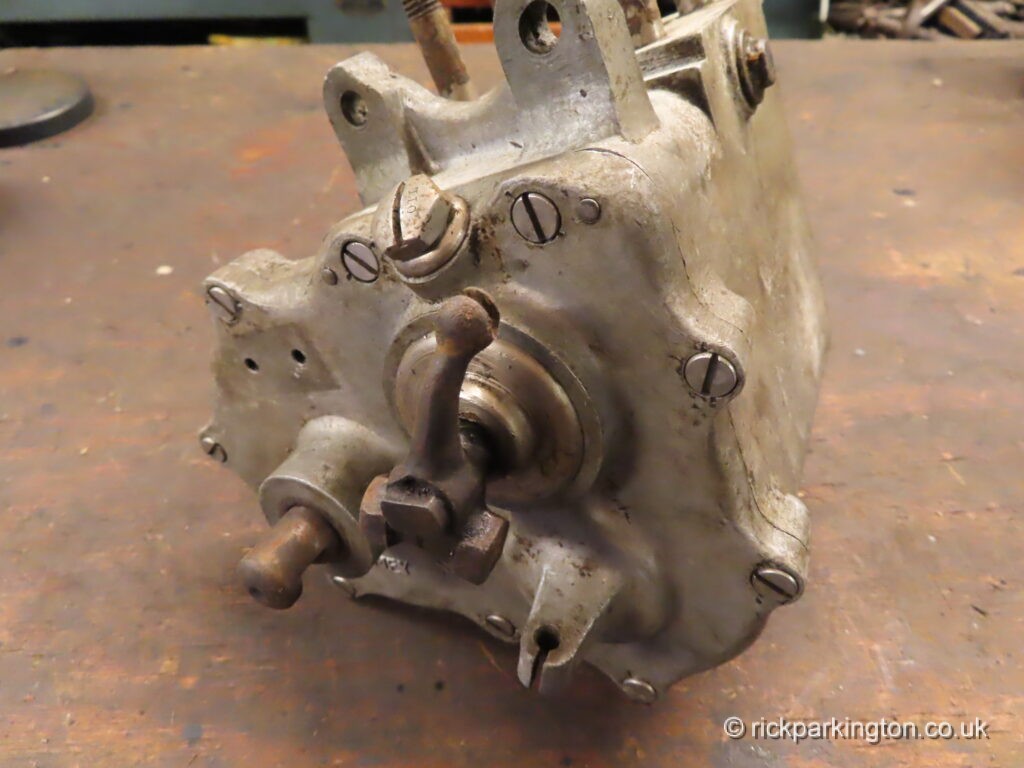 This one is CS68! How I come to have two of the first 100 Sturmey gearboxes is a long story but it’s always good to have a spare. Somewhere between CS 22 and CS 68, the shell acquired cast lugs to hold the gearchange, on CS 22 it’s a bolt on bracket.
On these very early boxes, the clutch cable is attached to the layshaft bearing housing; when I got the 1916 bike the (possibly original) cable came up from beneath but I decided to reverse it because it seemed a bit clumsy.
Later Sturmeys (top in the photo below) had a more conventional cable run across the top of the box, from the lug at the top right corner. Looking at Blackburne pictures it seems this feature was introduced on 1916 models. The bottom cover, (below) is from CS132 and still has the lower lug – albeit broken off with a thread tapped in place instead, maybe fragility is why it changed – notice on the later cover, the cable mount is buttressed across to the mainshaft bearing housing. 
These early boxes, with screw screw lugs on the outside of he gasket face seems to have lasted into the 12000 number range. Sturmey dating is unclear about Great War era boxes but these are seen on some Model H Triumphs.
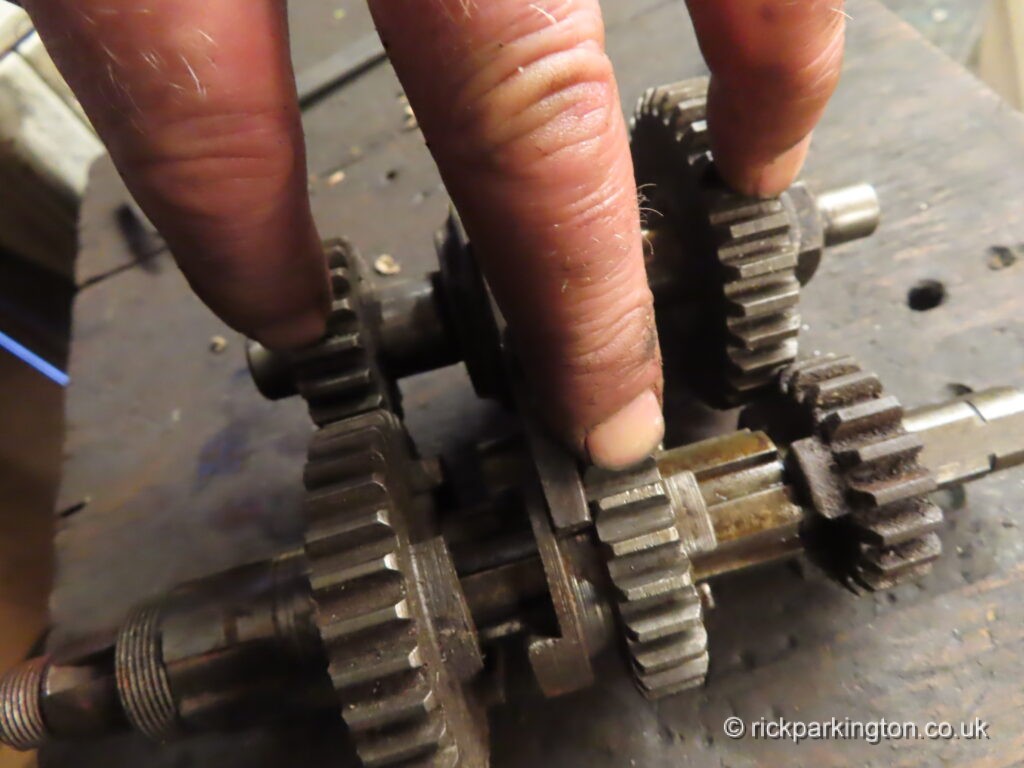
Next stop on our history tour is this one: CS16133….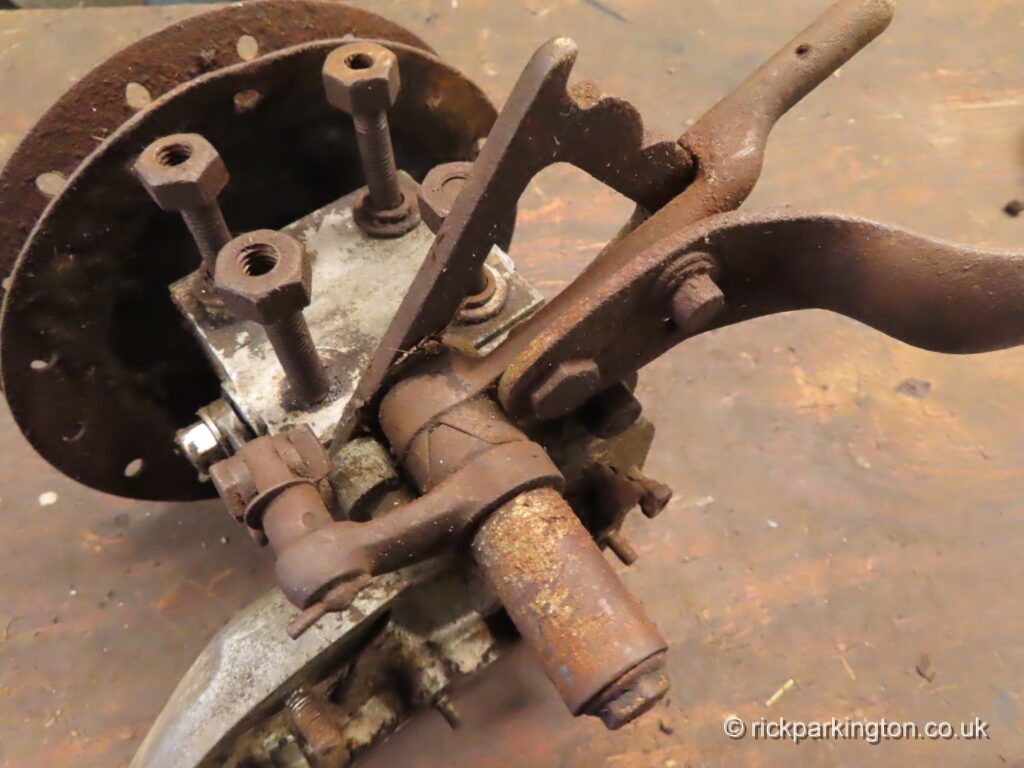 This, I’d guess, is around 1917 and still has the gearchange bolted onto lugs on the shell but now the bosses for the cover studs are internal not external. There’s another difference too, see there’s a curve in the gasket face where where my finger is pointing?
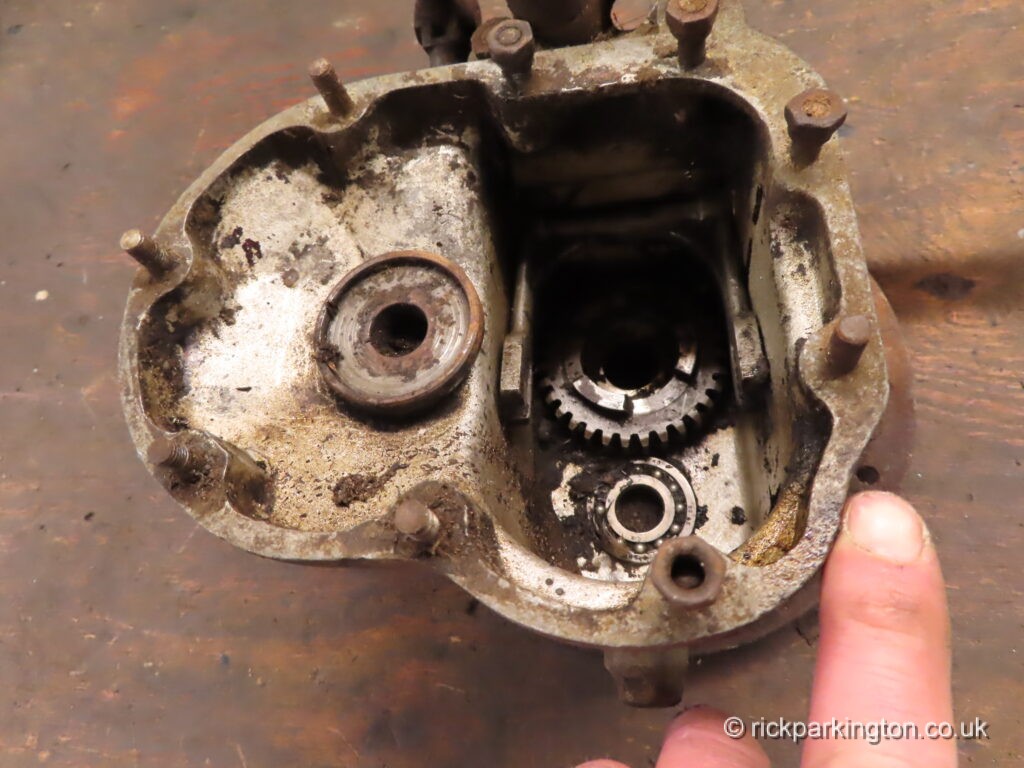 That where it differs from the later cover – which is annoying since I don’t have a cover for this one and a later one won’t fit.
Oh, that’s a point, CS shells and covers are numbered and were drilled together, so you really need the matched cover for the shell or the cover screws won’t line up. I think they standardised that later and although the LS shells and covers are also numbered I think they are interchangeable. Obviously you could fill and redrill the screw holes but you’d need to be sure the shafts are properly aligned which could be tricky.
This shell also has some other clearance areas on the back that are not seen on later types, partly related to the bolt on gearchange linkage.
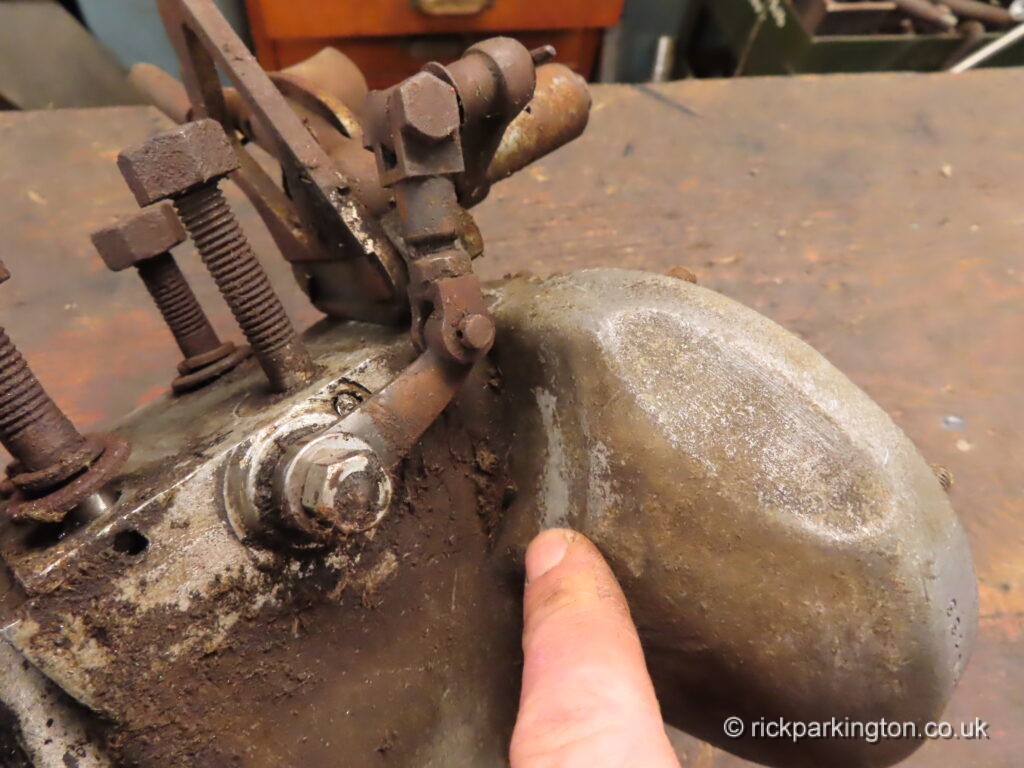 One other thing about these early boxes; they are chain-cum-belt; that is belt drive to the rear wheel and primary drive by chain.
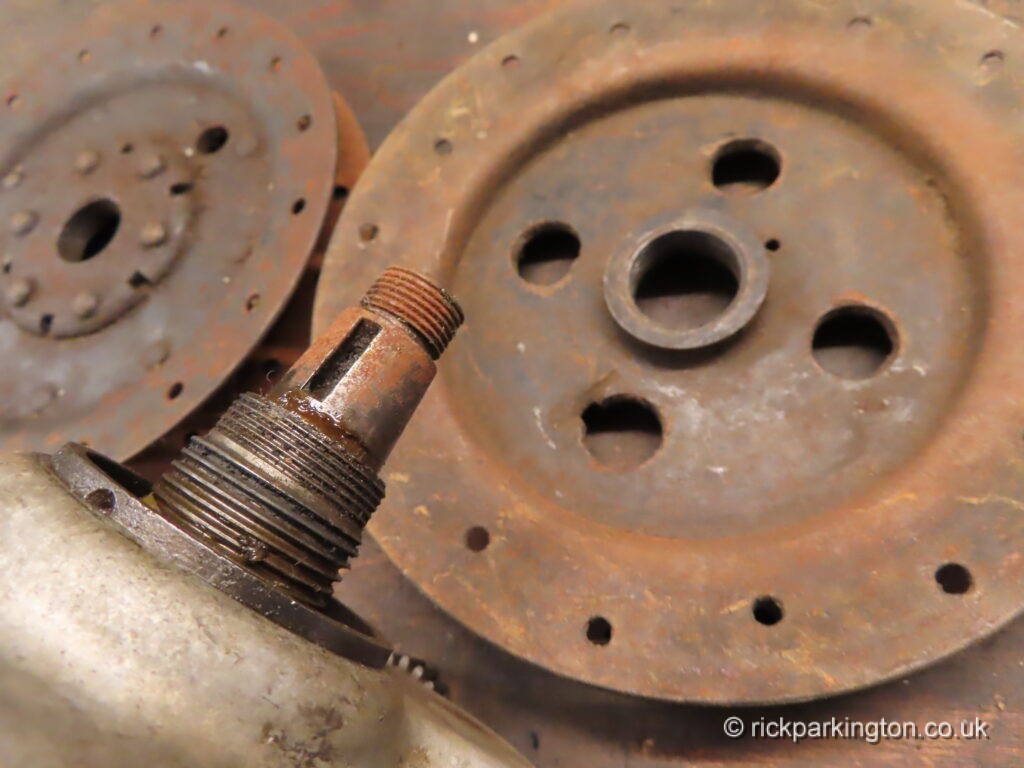 The early boxes have a screw-on belt pulley. Later top gear pinions have splines for a sprocket and it may be that Sturmey made a splined pulley as an option; I don’t know – if you know the answer, please get in touch. The thread is right-hand for the pulley and left-hand for the locknut and the tapered mainshaft took a six spring clutch on these early boxes. :Later models had single spring.
Expect the pulley to be tight. I was unable to remove the one on the 1916 bike. It didn’t want to budge and as I wasn’t certain which way it went at the time I didn’t want to risk getting too heavy with it in case it broke.
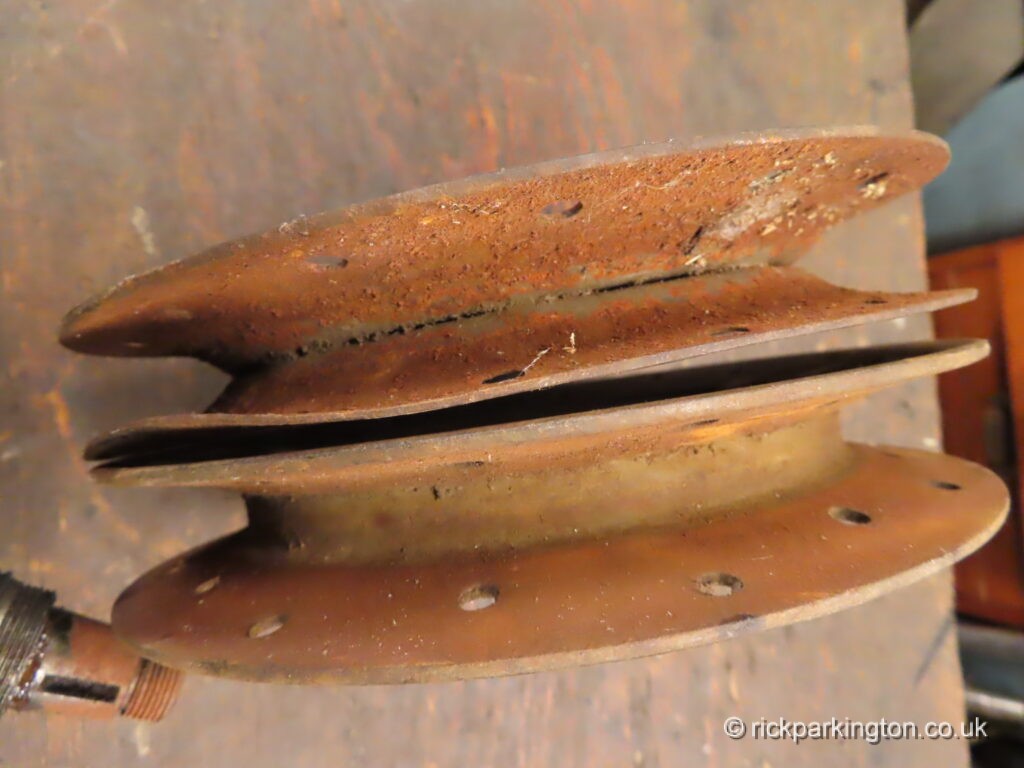 t One more point here, the early pulley as on CS22 and CS68 is solid, the later type (top) is pressed and riveted – possibly a wartime economy.
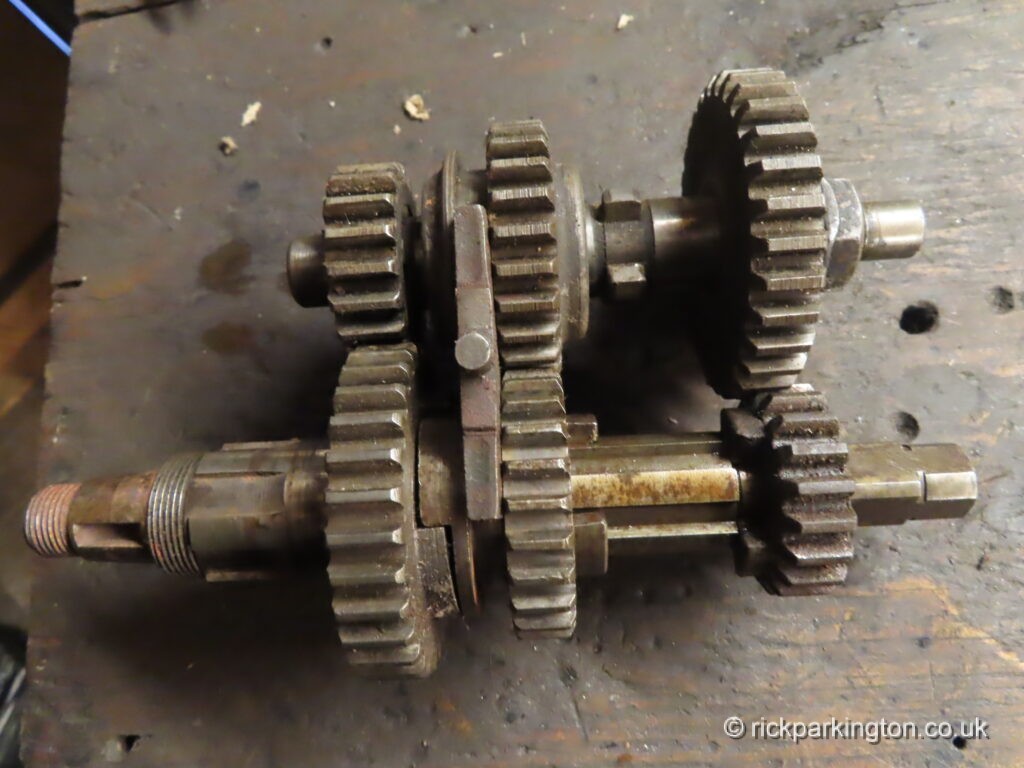 Here’s the gear cluster; it’s a pretty simple setup.
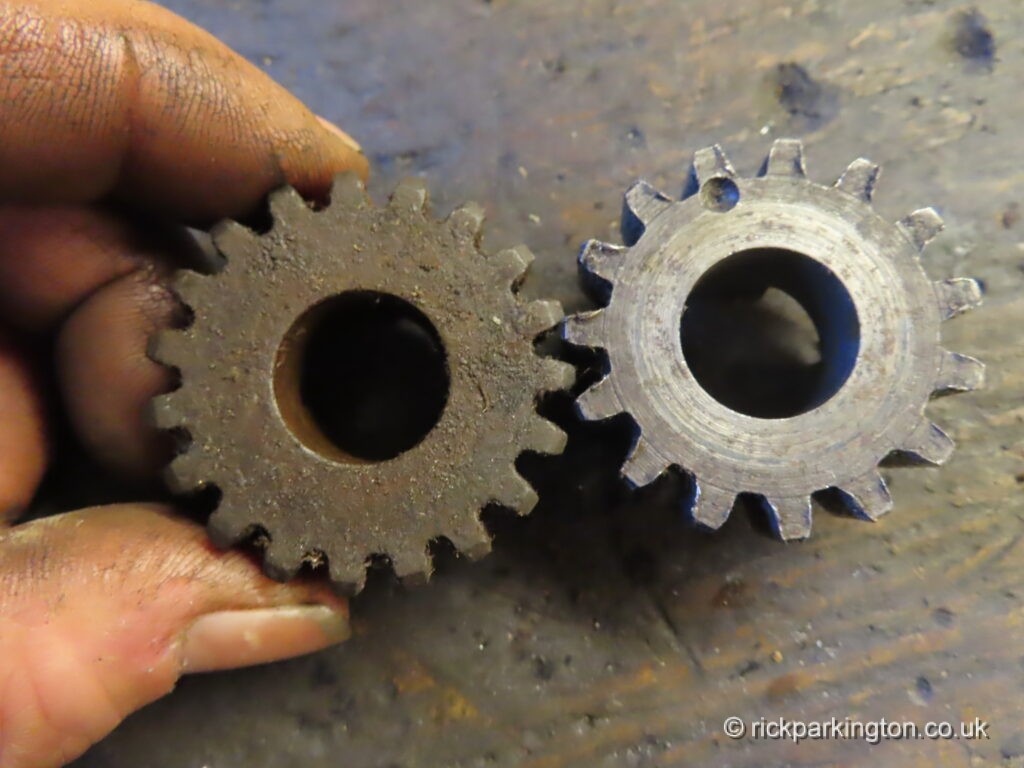 There was a change in tooth pitch from 1927. The later coarse pitch (right) gearboxes are generally more sought after – probably due to their association with Norton Model 18s and CS1s. But I’m not sure they are actually stronger gears – all the broken gears I have seen are coarse pitch – but to be fair that could just be because they were fitted to later, more powerful bikes.
 .There are also two types of CS mainshaft – splined and tapered for different clutches. I’d guess the splined came later. The Sturmey Archer gearbox sort of evolved into the Norton gearbox and the splines stayed the same form so you could probably fit a clutch from a Featherbed Norton to a vintage Sturmey box if you wanted to!
I have to admit that CS22 is actually not a very nice gearbox, it tends to jump in and out of first and second. There’s a strange lurch – almost like the chain has jumped the sprocket – but it never ends up in neutral. I have had it apart and there’s no obvious wear, although I couldn’t completely strip it because of being unable to remove that belt pulley.
Interestingly I even found a back-in-the-day reader enquiry – or rather a reader’s answer to another reader’s query – in the Motor Cycle about this problem, suggesting that worn linkage is the cause but I’m not sure that’s right.
CS boxes do not have an internal ‘detent’ – the spring loaded ‘click’ that locates each gear – it is all done externally at the hand-lever so it’s certainly likely that wear in the intervening linkage could cause issues but there’s no significant wear on my Blackburne and the only other Sturmey I’m familiar with – the LS box on my Martinsyde – is also ‘a bit jumpy’.
So how does the CS box work? Gearboxes can be confusing so the first thing to understand is that some of the pinions are permanently driven by the shafts, some are free spinning and some are half and half – free spinning or driven depending upon gear selection.
On a CS these are the permanently driven, pinions…pinia? I dunno, I didn’t do Latin at school…
 On the layshaft (upper) the (smallest) top gear pinion seen on the left, is splined to the shaft. On the right, the first gear is actually a taper fit on the shaft, secured by a nut. The second gear pinion (centre)is driven by dogs on the shaft in certain positions. On the mainshaft (bottom) the only permanently driven gear is the middle (2nd gear) which is on the splined shaft.
The whole principle is that drive comes in from the clutch, turning the mainshaft (extreme bottom left – with the keyway) and to make the bike go, the ‘sleeve gear’ (mainshaft top – also bottom left) that carries the rear chain sprocket has to be turning too; that’s done by connections between the other pinions. As seen above we are in neutral because when the mainshaft turns the second gear pinion, layshaft second is free to spin on the layshaft without turning it so nothing else is driven.
But shift MS 2nd left and its dogs engage the sleeve gear in a 1 to 1 drive – top gear. The top gear pinion will also drive layshaft top – and the layshaft – but because LS 2nd and 1st are free spinning in this position, nothing else is happening.
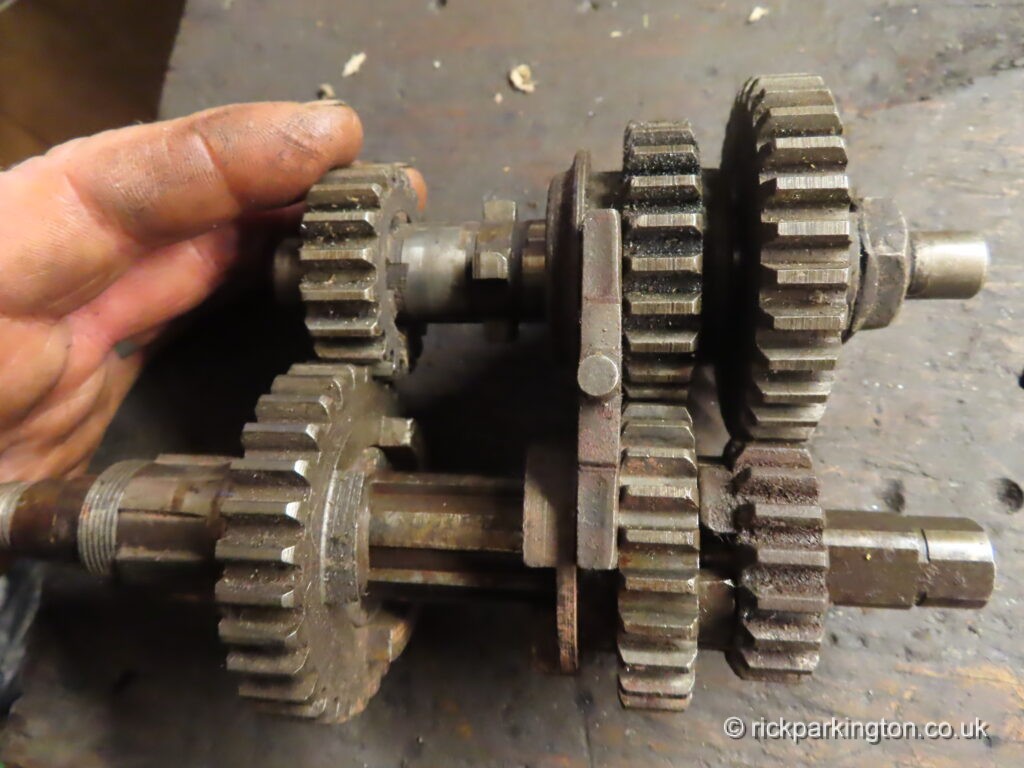
Slide MS 2nd all the way right and it engages MS 1st, which drives LS first which turns the layshaft – and the difference in pinion size means it spins slower than the mainshaft, if we imagine the big gear has twice the teeth of the small gear, it would be a 2 to 1 reduction. At the other end the LS top pinion now turns the sleeve gear and rear chain but again there’s a (for example) ” to 1 reduction making 4 to 1. So where in top the ratio is 1 to 1, the sleeve gear spinning at the same speed as the mainshaft – ie the clutch and rear sprocket are at the same speed – now the rear sprocket is spinning once for every 4 rotations of the clutch – hence we are now in bottom, or first gear.
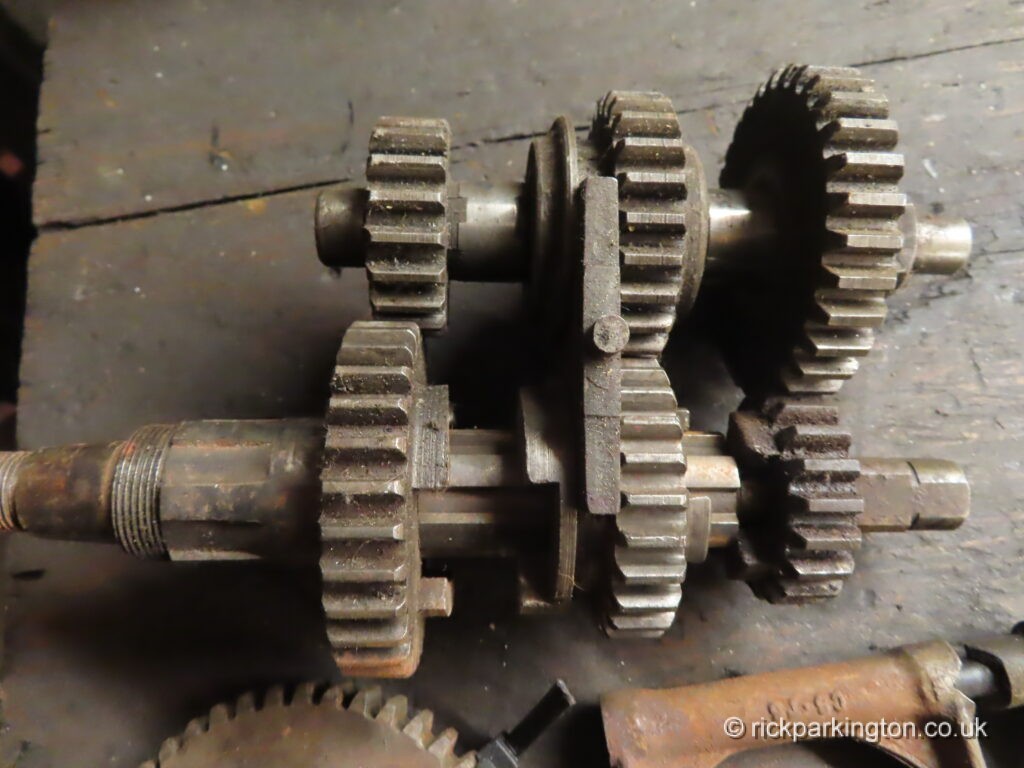
With the second gears in the final position – to one side of neutral, the radial dogs on the layshaft locate layshaft second, so now drive from MS 2nd drives the layshaft and because both 2nd gear pinions are the same size, there s no reduction – the shafts run at the same speed – 1 to 1 – but there’s still our nominal 2 to 1 reduction between LS top and MS top, so now the sleeve gear and chain sprocket turns once for every two turns of the clutch and mainshaft giving us middle, second, gear.
I hope all this makes sense – it takes a bit of thinking about but really it’s pretty simple once you get it. In essence, top gear in any box is when the output is directly driven by the mainshaft. You’ll notice that in that situation the rest of the gears may be spinning and chucking oil about – but they are not under load, which is how it should be for most riding, less load on gear teeth results in less power wastage and less wear.
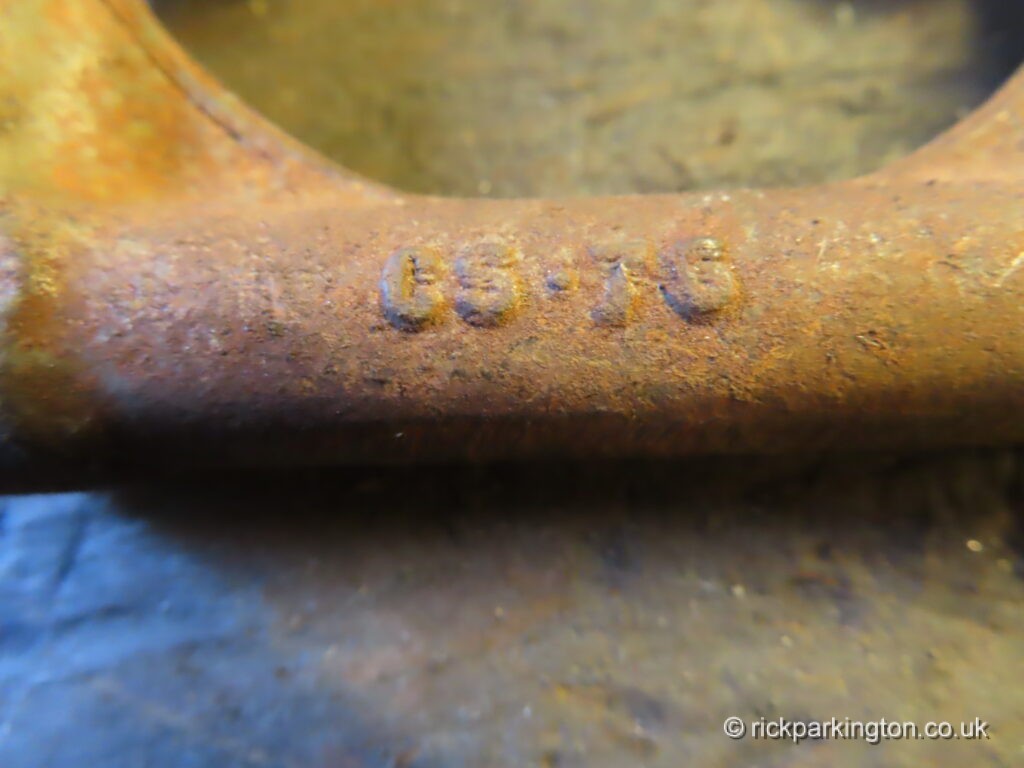 Usefully some SA parts have CS cast into them for ease of identification but there are a lot of Sturmey Archer gearboxes 2, 3 and 4 speed and many of the parts look similar at first sight so it’s not always easy to identify the right parts.
 These are the kickstarter parts for a CS box. The gear with the square hole just sits on the square end of the mainshaft – that square end is a good way to identify a CS mainshaft from an LS, by the way. So being driven by the mainshaft, the big wheel rotates all the time the engine is running..
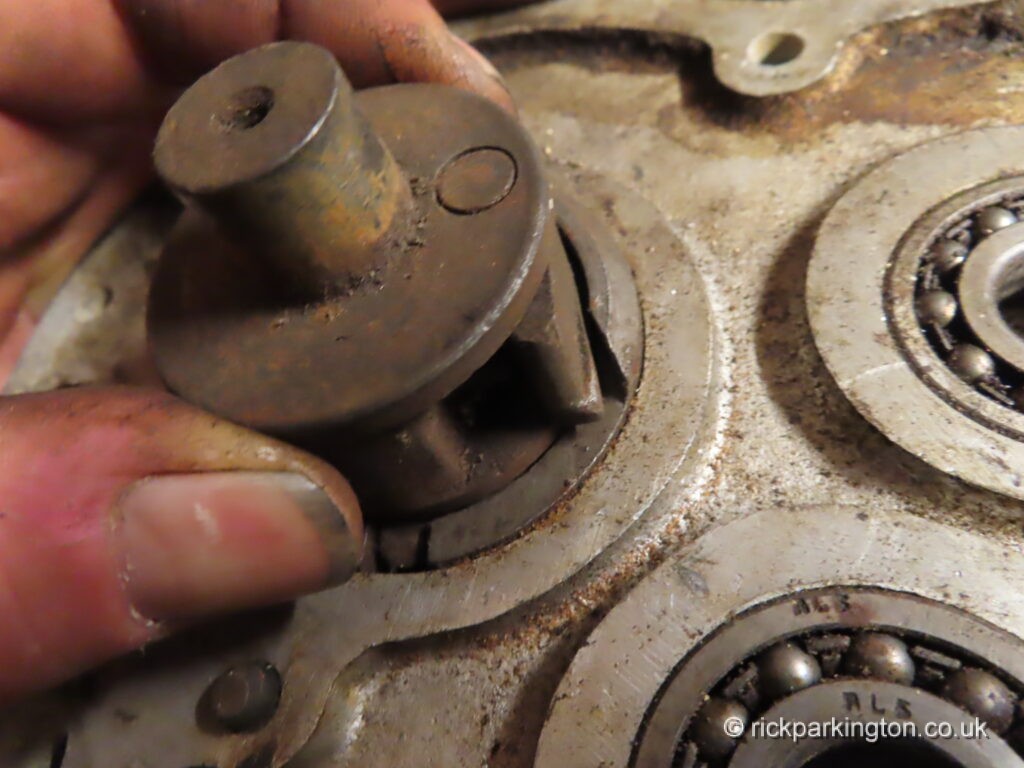 To disengage the ratchet from this spinning gear wheel, the kickstarter shaft has a spring loaded pawl which is neatly retracted by a sort of cam ring idea when the kickstarter returns to vertical. It’s a similar design to what’s found on the Norton AMC box. After the CS box, Sturmey Archer decided to fit the ratchet into the layshaft first gear pinion, thus getting rid of a big heavy gear wheel – and a big chunk of gearbox casting to house it. That gearbox was called the LS and that kickstarter method remained on subsequent SA boxes, then onto Nortons all the way up to the 850 Commando. I don’t know but I presume that since CS meant ‘countershaft’ – the generic term for this revolutionary new design in multi speed technology – maybe LS stood for Layshaft indicating the change to layshaft kickstarter drive.
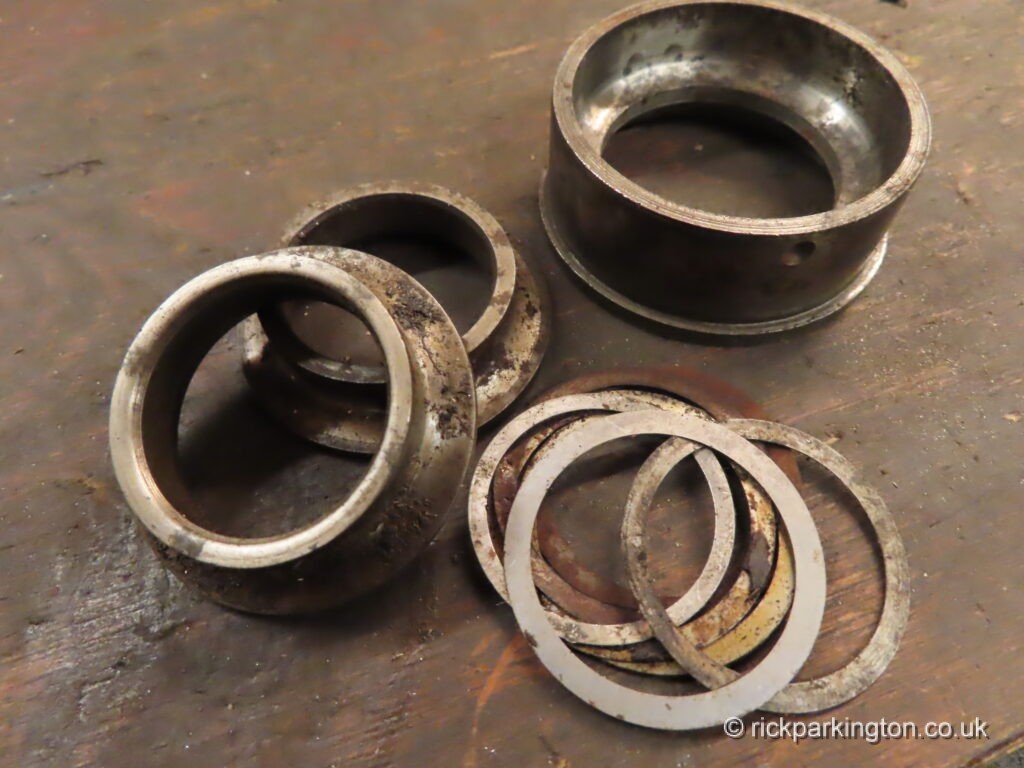 The high gear bearing (behind the gearbox sprocket) is unusual. Instead of a ballrace, it is a cup and cone – very like a steering head bearing except that the two cones are either side of a double sided ‘cup’. The cones are identical and adjustment of the bearing is made by fitting thin shims between the two. I think originally the bearing came with several shims fitted and these could be selectively removed later to take up wear. The outer is pressed into the gearbox from the inside, having a flange that prevents it pushing right through. It’s quite a good bearing but unique to Sturmey meaning you can’t go to a bearing suppler to get a replacement – well, you can at the moment – Vintage Bearing Co (vintagebearings.co.uk) have had them remade. They are not cheap but having parts like this specially made when you have no idea how many you will sell is a very risky business and in general a supplier will not cover his costs until he has sold at least 50% of the stock. Also if you make say fifty and sell them all – with people still enquiring, you can just bet that if you make another batch of fifty you will sell half a dozen and never be asked again, so stuff like this is often single batch and no more. There is a limited demand and few people wear out parts like this on the road now so if you need one, don’t hang about – you could be customer 51 and miss out! Years ago a guy doing up a Ducati single told me that hearing the price of new bevel gears, he’d decided to leave it till later in the build – but when he finally ordered them he was told ‘sold the last set a couple of years ago mate.’ So if you need them, just cough up and don’t make a fuss!
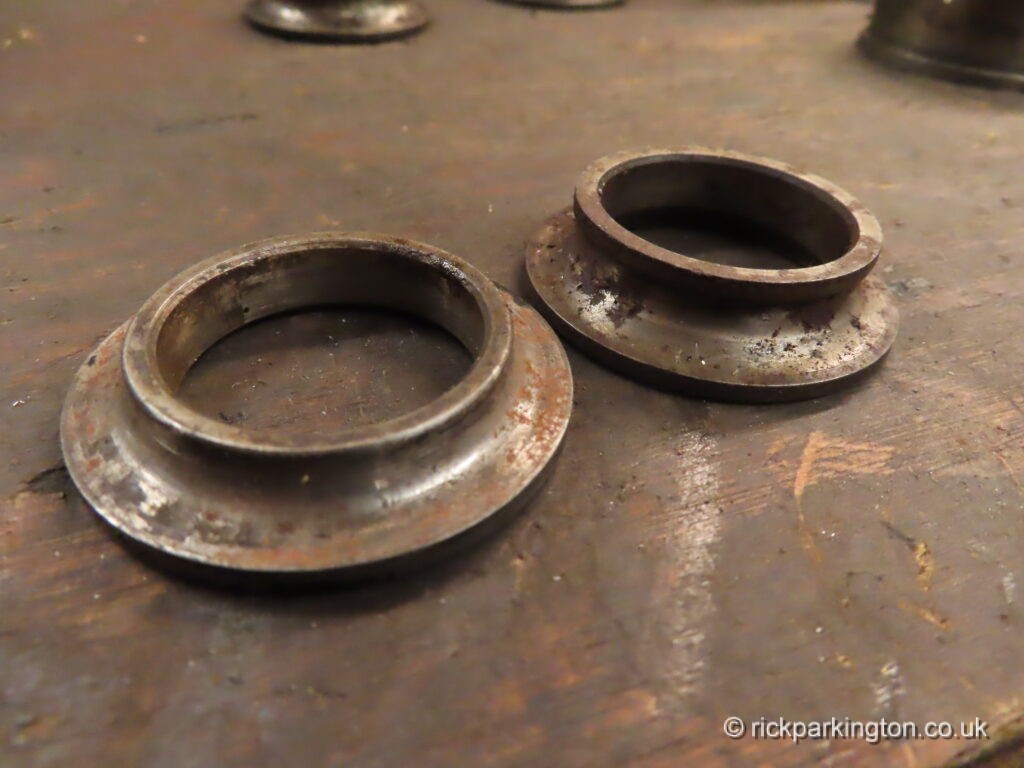 Having said that…I did once investigate options and found that pre-unit swinging arm BSA A10/B31 etc steering head bearings are tantalisingly similar, both inside and outside diameter. These are the cups compared BSA on the left.
But…you would need to weld the cups together (no doubt distorting them and destroying the hardening) and even then there would be no flange to locate the ensemble in the gearbox, so that’s a dead end…
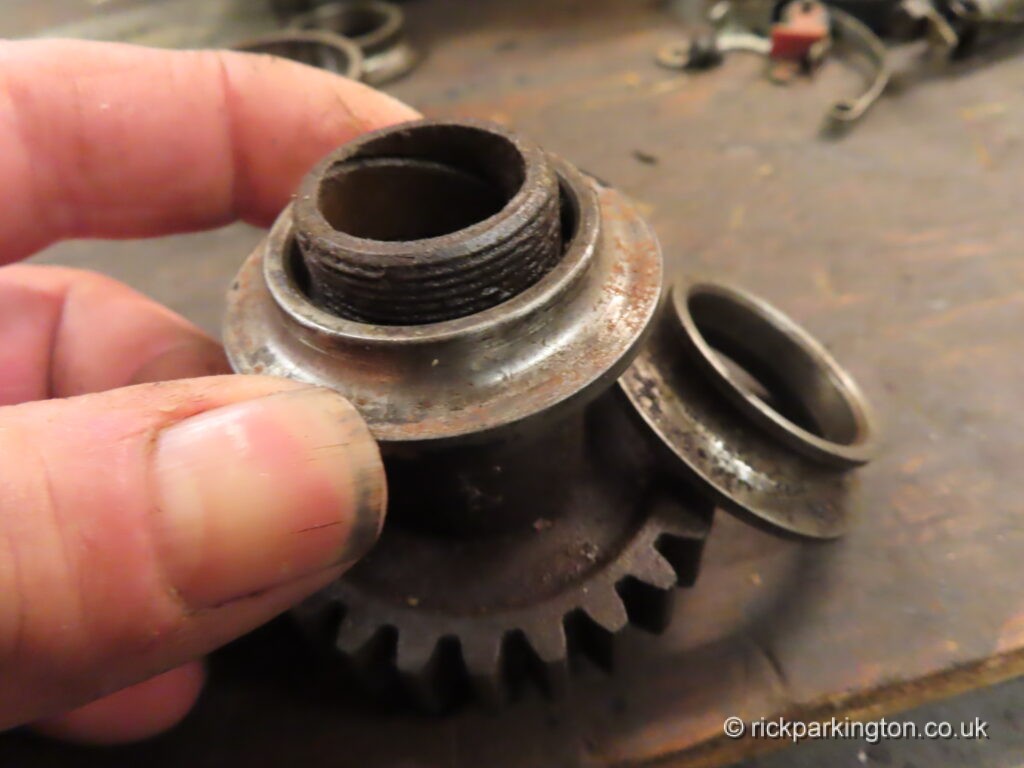 – Unless you had a missing cone, you might get away using an A10 one – making up shims to suit – rather than buying a complete bearing. I think the balls are 1/4 from memory. Like a steering head leave space for one extra ball and be aware that it’s easy to dislodge a ball on assembly – but unlike a steering head it won’t lie quietly in the frame it will float about like a roulette ball among the gears….
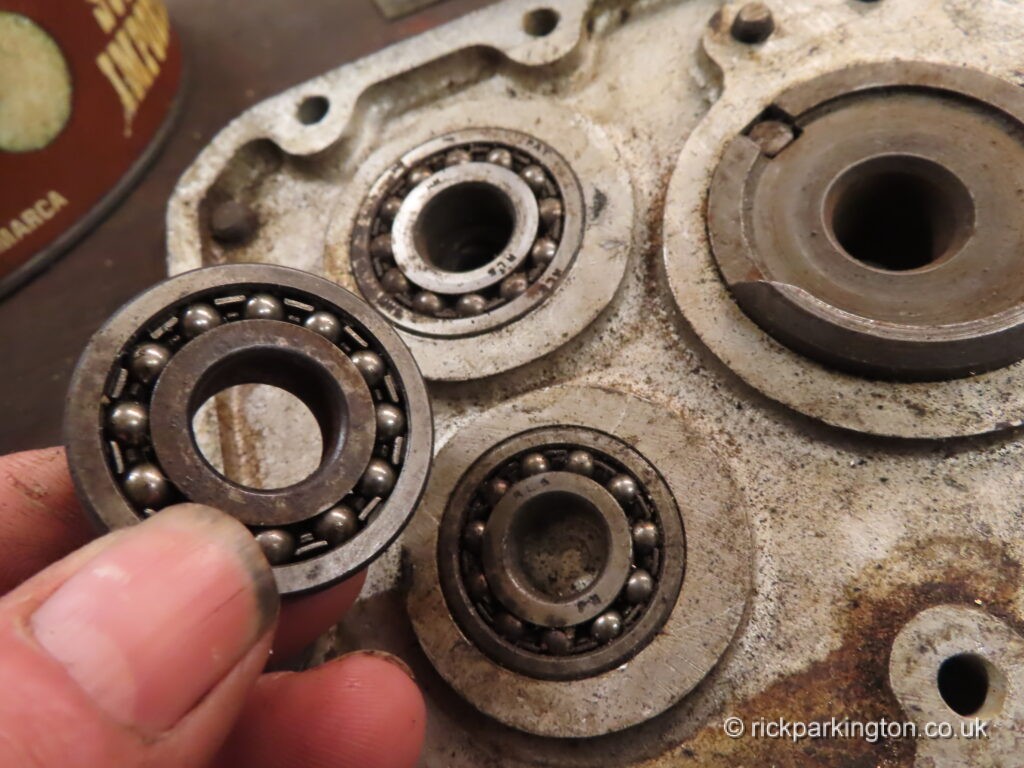
The other bearings sin the box are self aligning double row type, SKF RL4 and RL 5. The self aligning idea was popular then, I believe Triumphs had self aligning main bearings, the person who told me scoffing that they obiously couldn’t assemble the cranks in line – but a self-aligning bearing wouldn’t fix that. it’s more likely to do with flex of the crank – or here, gearbox – shafts. That makes it the same idea as Norton’s Superblend main bearings on Commandos. Shafts are bound to flex to a degree – especially a gearbox shaft with a cutch pushrod hole up the middle. A rigid bearing creates a ‘stress raiser’ – a focus for fracture, a self aligning bearing gives some room for manoeuvre.
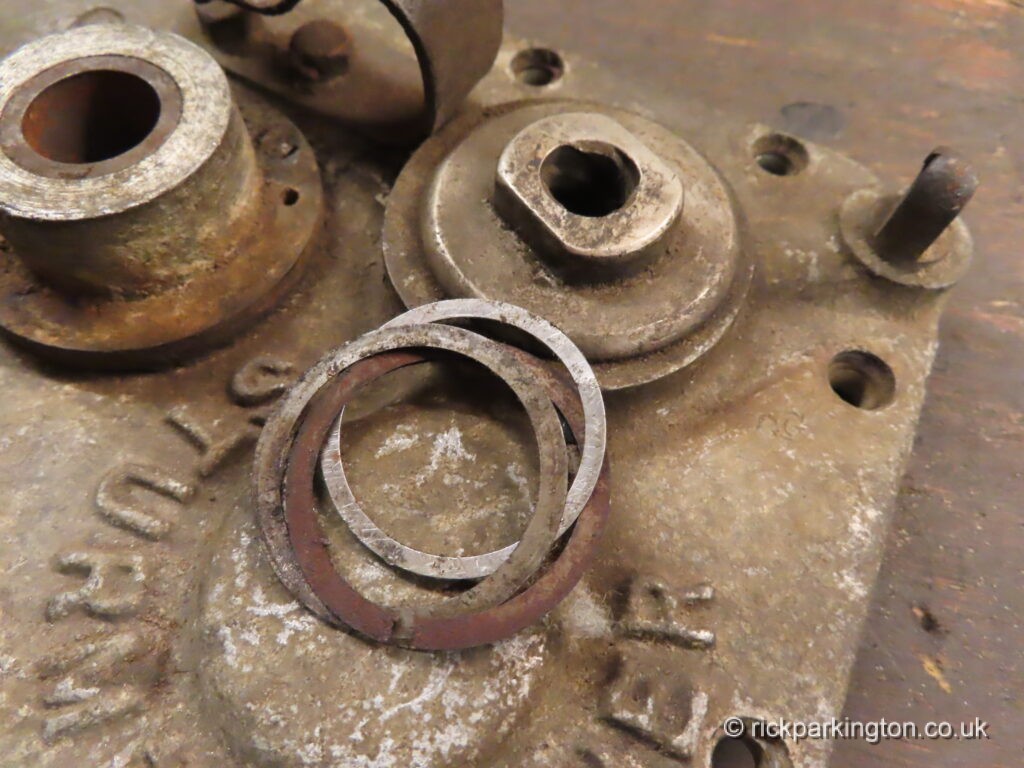 Shims can also be fitted under the clutch operating worm nut on the outer cover these push the bearing inward to take up endfloat.
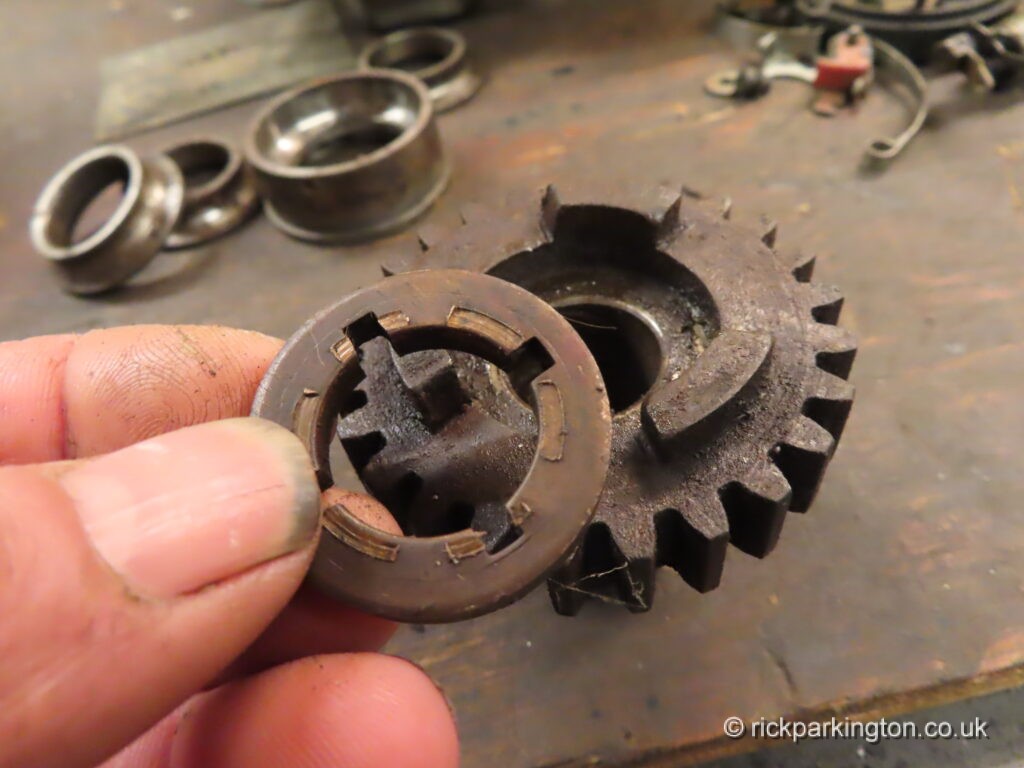 There is also a bronze thrust washer fitted on the mainshaft between the splined portion and the sleeve gear. it fist into a rebate in the gear seen here. The washers I’ve seen are usually 7/ 32″ thick and the 4 notches are probably for oil but one locates on a Mills pin (dowel) pressed into some shafts (you can see it in the earlier pic of two mainshafts, it’s on the bottom one) and I suspect this was a later modification. The same washer appears on LS gearboxes but the LS sleeve gear does not have the rebate found on the CS.
Right that’s about all can think to say about CS gearboxes, if you can add anything please feel free!
Cheers Rick
I was thinking that it was about time for your annual post.
Loose bearings – of various sizes – available from all good pushbike shops, incidentally…!
Hardy ha ha, Derek. Time seems to fly at present and I’d been meaning to write about these boxes for ages. Good suggestion on the cycle shops!
Cheers Rick
Hi Rick, interesting read thanks!
I have an early 1920’s CS-TT gearbox (number 312) on my grandad Stan Johnson’s old Sheffield-Henderson, CS-TT was a racing version with no kickstart, which was the standard box used by Sheffield-Henderson in 1922 on their OHV sports model.
Simon Grigson told me that a few CS-TT boxes also went on racing Nortons in the 20’S but have become very rare – he has only ever seen two others (both on Nortons).
The mainshaft was the original taper drive type when Stan was using the bike for grasstrack and hill climbs back in the 30’s, but was replaced for the later spline drive version when he converted the bike for sprinting and now uses the late 20’s single spring type clutch.
Best wishes, Neil
Hi Neil,
Thannks, yes that is a rare box. It didn’t occur to me that it might have been the original – I guessed Stan probably got it through his Norton connections but maybe not…! Interesting and good to hear you are still getting on with the bike!
All the best Rick
Hi
I’m having trouble with my Heavy Weight 3 speed jumping in and out of second gear. All adjustments and measurements have not helped and stripping the box there isn’t anything really wrong in there, just a little wear. I at the point where I’m looking for replacement parts or a complete box…. any suggestions please? its a 1925 Flying 8
Many thnaks
John
Regarding the CS cluster gear bearing . A few people here make up a housing to take two single row ball bearing races, one each side. the bearings are cheap. I have one of these and it’s done about 10,000 km or more and seems to work OK. As I recall the bearing is metric and you have to lap about a thou off the shaft to make it fit. I have drawings if you’re interested.