

Well, I’ve punctuated that badly – maybe I should say: Time! For a change…
Because although time seems to be my enemy, I’ve finally managed to befriend it long enough to write about my weekend but first, I should explain. Two comments on this site have nagged my conscience:
The first came from ‘Bretto’ saying ‘Rick-is this site still running? I tune every month or so to see if any updates but seems nothing regular – which is a pity ?’
That was followed by one from Eric Gallardo saying:
Hi Rick,
Same as “Bretto” above. Very frustrating to see so few new threads as I much like your stories. Guess you must be very busy.
Cheers anyway.
Well, I am sorry. We all know the internet can be a grumpy place and I appreciate not only that people still check in regularly to see if there’s anything new but particularly that when I do get a nudge to get on with it, it is done in such a considerate way. So thanks Eric and Bretto – and everyone else still looking in – and apologies for my absence.
While I don’t like boring people with excuses, having been away for so long it doesn’t seem right just to pop up as if nothing has happened. The main reason input to this site slowed up was due to a change in the day job – Classic Bike magazine.
I started the site because magazines naturally tend to aim their appeal to the maximum amount of readers and at the time, because I was getting more involved with 1920s bikes, the stuff I was working on wasn’t considered ‘target reader’ material. Admittedly I’m not a journalist – I’m a mechanic with English O level – but I felt this was a mistake. I find myself tired of reading about the same ‘core bikes’ in magazines and maybe other people want to see something different too – but of course that’s easy to say when you’re not paying the bills, instead I decided to start this site. I wasn’t looking to make money out of it – I’m not here to collect cookies or sell ad space – so I didn’t have to worry about reader appeal and that meant I could just write things I hoped people would find interesting. I’m pleased if people enjoy it but it’s a lot easier when you’re not depending on it.
But…then there was a change at the magazine and it became okay for me to feature more or less whatever I wanted. The day job obviously has to take priority – I’ve got to make a living out of something! So with most of what I was doing in the workshop ending up in CB, I had less to put on here. Computers are thieves of time – I have to spend too long on the as it is and found it alarmingly easy to overlook posting regularly until enough time had elapsed that it became hard to restart, because I felt whatever I did would have to be really good to make up for it!
Well, not saying this is that special but last weekend I got out of the workshop and enjoyed a very pleasant day’s bike testing . Not road testing, this was a Sunbeam MCC event on a former go kart track, the object being to check everything is tickety-boo with bikes that have been laid up over winter.

This is the track, small but perfectly formed. We were here last year but I tried to achieve too much. When you live in a suburban area it’s a little tricky zooming round the block on very noisy old bikes, so I got a bit carried away and brought too many bikes – and achieved little. This year I decided to be more sensible and take just what we need to sort out for now – Judy’s Scott, the 1927 Rex Acme and the Martinsyde.
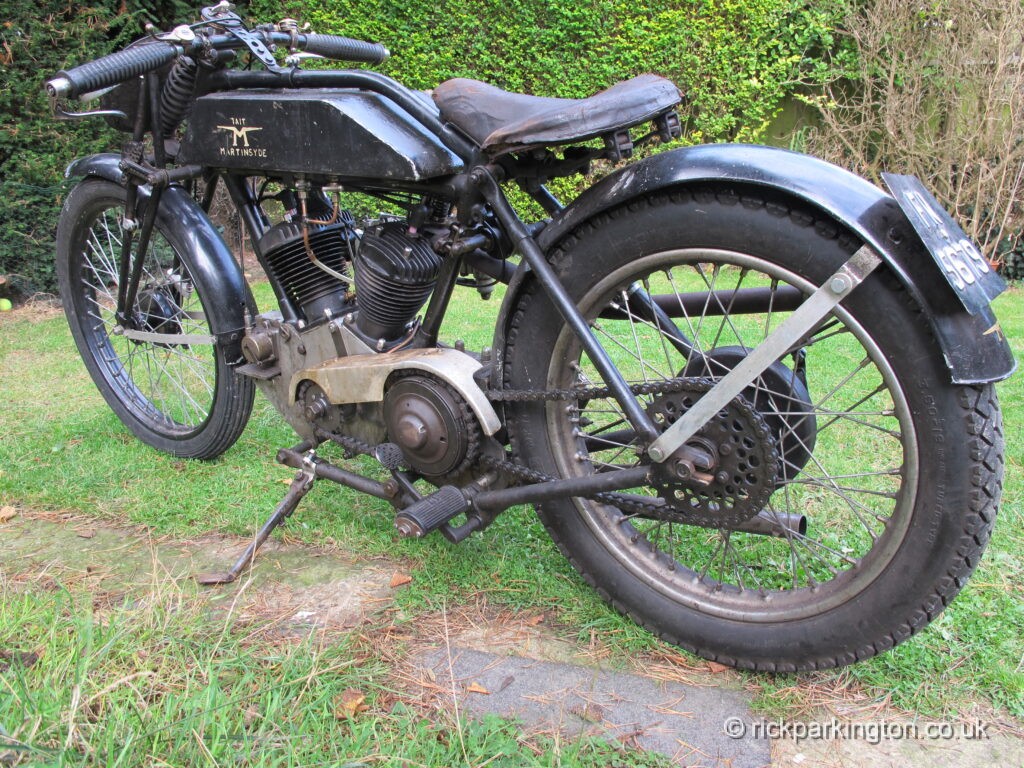
We’ve got a hillclimb coming up soon and it made sense to check the two bikes we’ll be taking are working properly – plus ever since my buddy Will did a video about the Rex Acme on his Coleman Customs youtube, he’s been making hints that he’d like a go on it….

The Rex Acme is from 1927 and has a 348cc Blackburne motor, Amac TT carb and three speed close ratio Burman gearbox. It’s a staggeringly good bike in my view, extremely light in weight and very lively. The following year, 1928, is when the old flat tanks went out of style and most makers replaced them with saddle tanks. That was the cue for new frames, bigger tyres, thicker frame tubes, wider wheel rims – bikes suddenly got heavy, so although the engines were by then delivering good power, it was lost in the extra weight – a trend that would carry on for the next sixty or more years. So this bike represents an engine that was fast and reliable in a super light frame – but light doesn’t have to mean feeble. The Rex Acme trademark frame design was to have twin frame rails beneath the tank, which extend down to the rear axle. The foundation of frame design is to keep the steering headstock perpendicular to the rear axle and that was Rex Acme’s way of doing it – introduced, by the way, on the works TT bikes for 1923 albeit in bolt-up form, the solid brazed frame arrived for 1926. In 1925, thanks to star rider Wal Handley, Rex Acme became the first company to win two TT races in one week – Handley taking first place in the 175cc (ultra lightweight) and 350cc (Junior) while setting fastest lap in the 250cc (lightweight) before retiring. That achievement put Rex Acme into the limelight for the next few years and I’d say anyone buying the 348cc ‘TT Model’ like mine new in 1927 would not have been disappointed.
 Will certainly wasn’t – and neither was his dad Nev, who also had a run round the track on the Rex. It’s Nev’s first ride on a hand change/ lever throttle bike so he took it steady – next time Ihope he” open it up a bit – but I think the problem with bikes this age is there’s quite a bit that’s unfamiliar, making it seem harder than it really is – it’s still just a bike, you just need to figure out the different controls.
I’ve pushed Will into riding my older stuff before and was pleased to hear after a moment’s uncertainty initially he soon felt completely happy on the Rex.

He also took the Martinsyde round – he’s ridden it before but it was a hectic moment between runs at hillclimb. This weekend was much calmer but Will said he found it hard to compare the two bikes, both are very light and the Martinsyde, being 767cc, is obviously more powerful but it is also very tall geared, giving it an incredibly lazy feel – I noticed, riding it round in second gear – that made the Rex feel the more lively bike.
One thing we were there to do was try a different slide in Judy’s 1928 Scott. It goes very well but there was a slight flat spot low down and talking to a mate recently he said he’d found fitting a weaker carb slide made a positive difference. I tried going from a number 3 to a 3.5 and Judy said it was an improvement, accelerating much more cleanly from low speed. Although the Scott seems to enjoy a handful of throttle, I guess it’s handy for it to be more user friendly in traffic!
When i was riding the Scott I was following another 2 stroke – going well and ridden tidily by a deerstalker-wearing rider.

The bike was this lovely little 1925 147cc Francis Barnett. This is one of their straight tube models, sold under the ‘Built like a Bridge’ byline. Of course we all understand that straight tubes are much stronger than curved tubes but given that Fanny B’s were just flattened at the end and bolted together I hope I am not being too uncharitable to suggest it’s also a very affordable way to make a motor cycle frame!
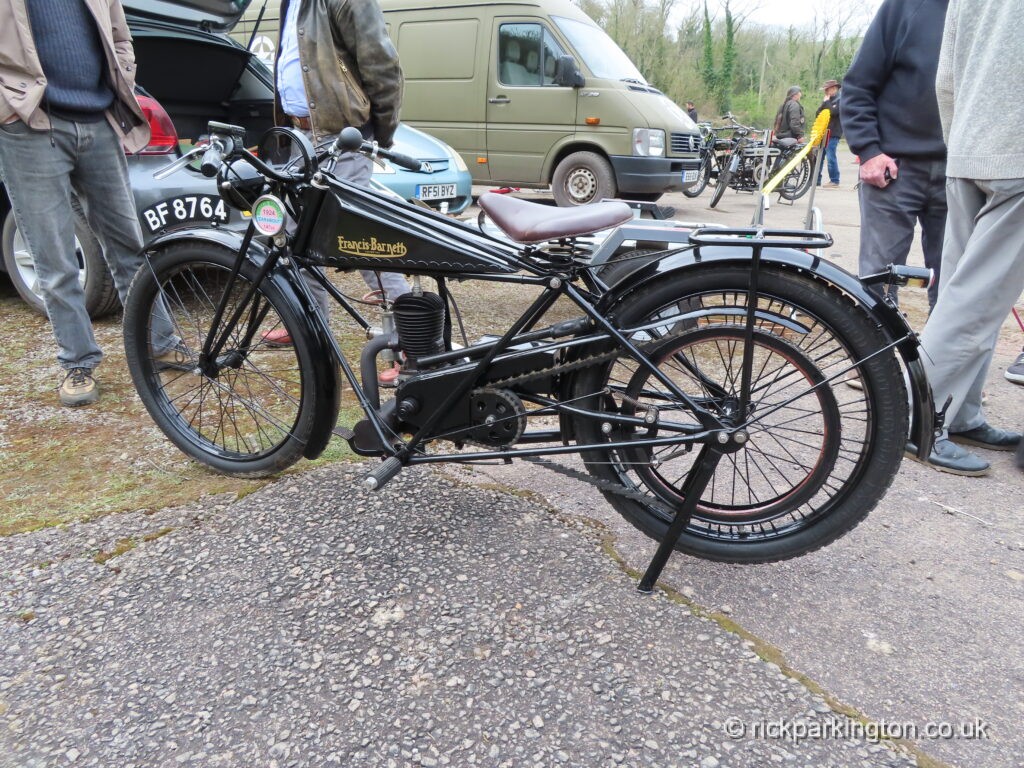 to This would have been a learner lightweight in 1925 – back then I think you could ride on the road at 14. It’s basic, with no clutch and two brakes on the rear wheel – an economy measure also used on the ‘Round Tank’ BSA 250cc to get around the law’s demand for ‘two independent brakes’. It also has a curious looped leaf spring that forms both the top clip (yoke) and fork spring – but as I say it ran sweetly and maintained a good pace.
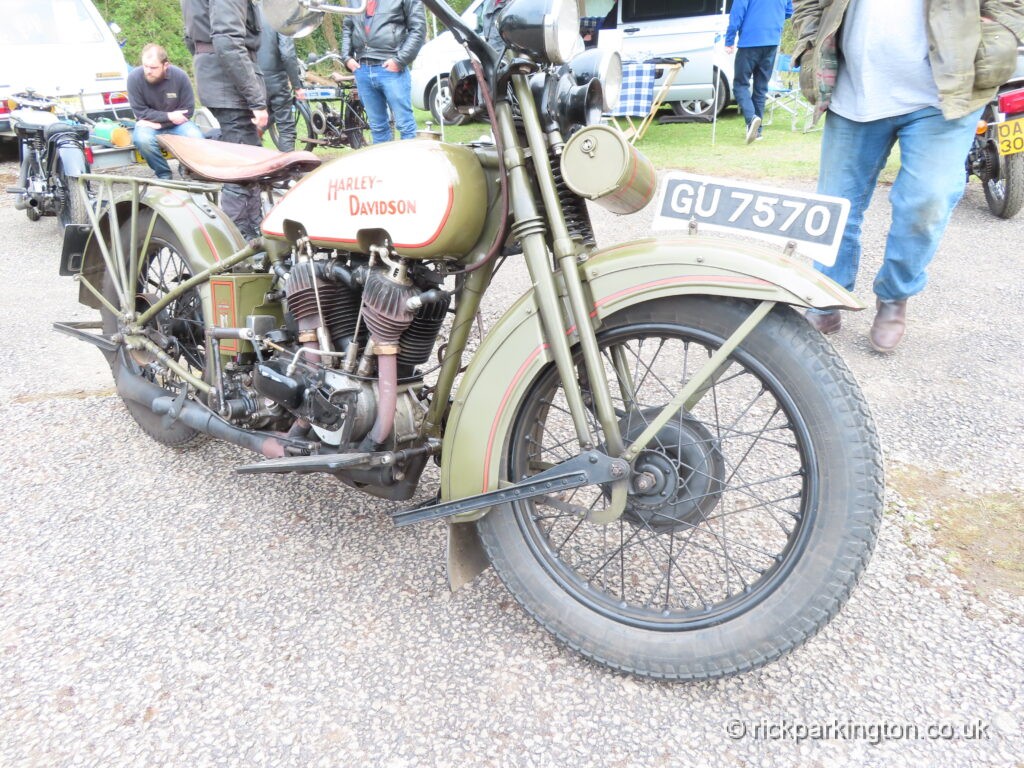
I rode round with Andy (from ‘the Magneto Guys’) on his Harley for a while – he was circulating well for a big bike on a small track but admitted the low footboards were a limiting factor. He said one rolling the Harley feels a lot lighter than it looks
 But the bike I’d probably best like to take home was this lovely Norton Model 18, it sounded as good as it looked…
 It wasn’t for sale of course – but had anyone wanted to buy a bike, there was a Sunbeam project up for sale – admittedly with no engine….
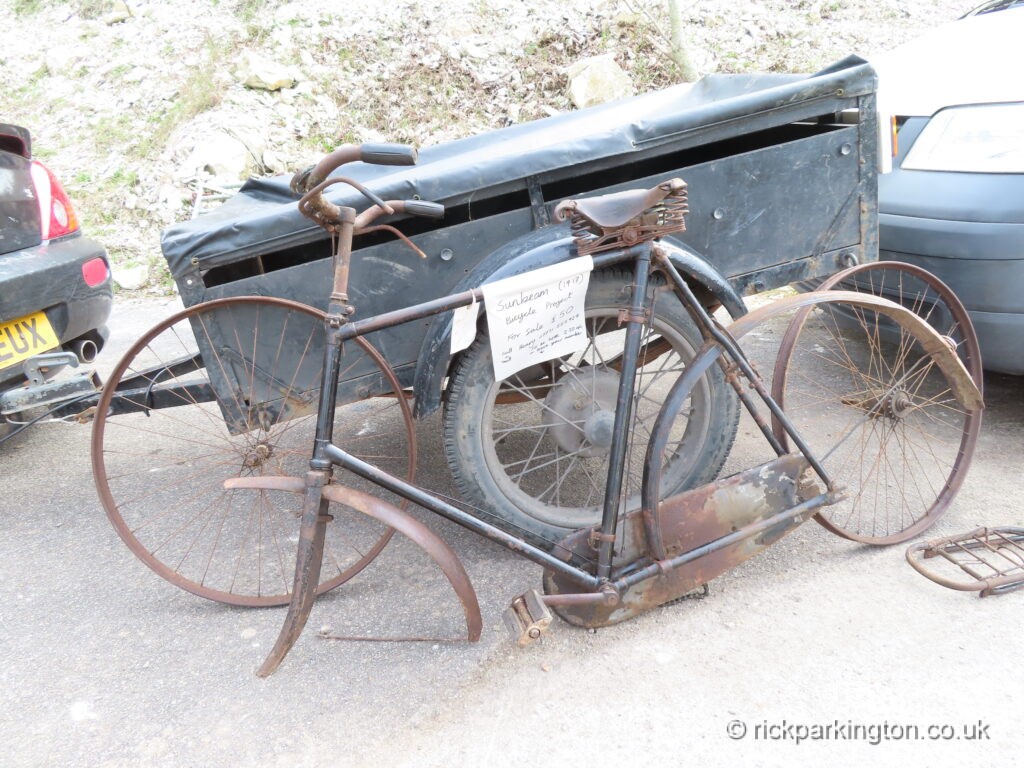 Before loading up I thought this photo was worth taking. One of my favourite things to say to people with modern bikes is that nothing major has really changed in the core design of motorcycles since about 1915. Think about it, by then we had countershaft gearboxes, 2 or 4 stroke engines, multiplate clutches, carburettors, brakes, chain drive… And designers of those days would be appalled to discover we’re still using inefficient internal combustion engines! Well, I guess that has changed now – although not I fear for the better. Whatever your opinions on the state of the planet I am not at all convinced that mining difficult minerals from the soil and creating more consumer non durable vehicles which only appear clean because the smoke they create comes from mines, foundries and power stations far away – is really helping. But I would say that!

Cheerio for now
Rick
Hi Rick,
Nice to have you back here! Fantastic bikes, I really hope to be lucky enough to own a flat tanker one day.
Cheers.
Eric
Thanks Eric – and thanks for sticking with the site! Yes, the flat tank thing is great – a completely different motor cycling experience and best of all you can have as much fun riding a 20s bike around a go kart circuit as an expensive track day on a modern sports bike at a fraction of the cost!
Cheers Rick
It’s a big pleasure to have happened on your site! I stopped reading CB mostly because I’m chronically impoverished, but also because it had become targeted toward collectors; the old-tech and odd-tech content was largely abandoned. Your columns were very often the best material that CB offered.
You mention that there has been a change at the magazine. I’ll have to start buying it again. Anyway, and once again, it’s really good to read your words.
Thanks James, these are difficult times for magazines – well all forms of entertainment other than the internet – and editors are always trying to cater for as many potential readers as possible which makes it quite difficult to get right. Luckily for me, technical stuff is always popular!
Cheers Rick
In 1959 I took my motorcycle test on a 125 cc villiers engined Excelsior with gear change through the middle of the petrol tank in Swindon. At the conclusion of the test the examiner told me I deserved to pass for taking the test on such a machine!!!
That’ll be the Model O, Michael, with the Villiers 9D twin port motor. It was the early postwar, final version of Excelsior’s pre-war Universal model – it must have cost them a fortune to make that tank!
Cheers Rick