There’s something very satisfying about visiting a master craftsman…
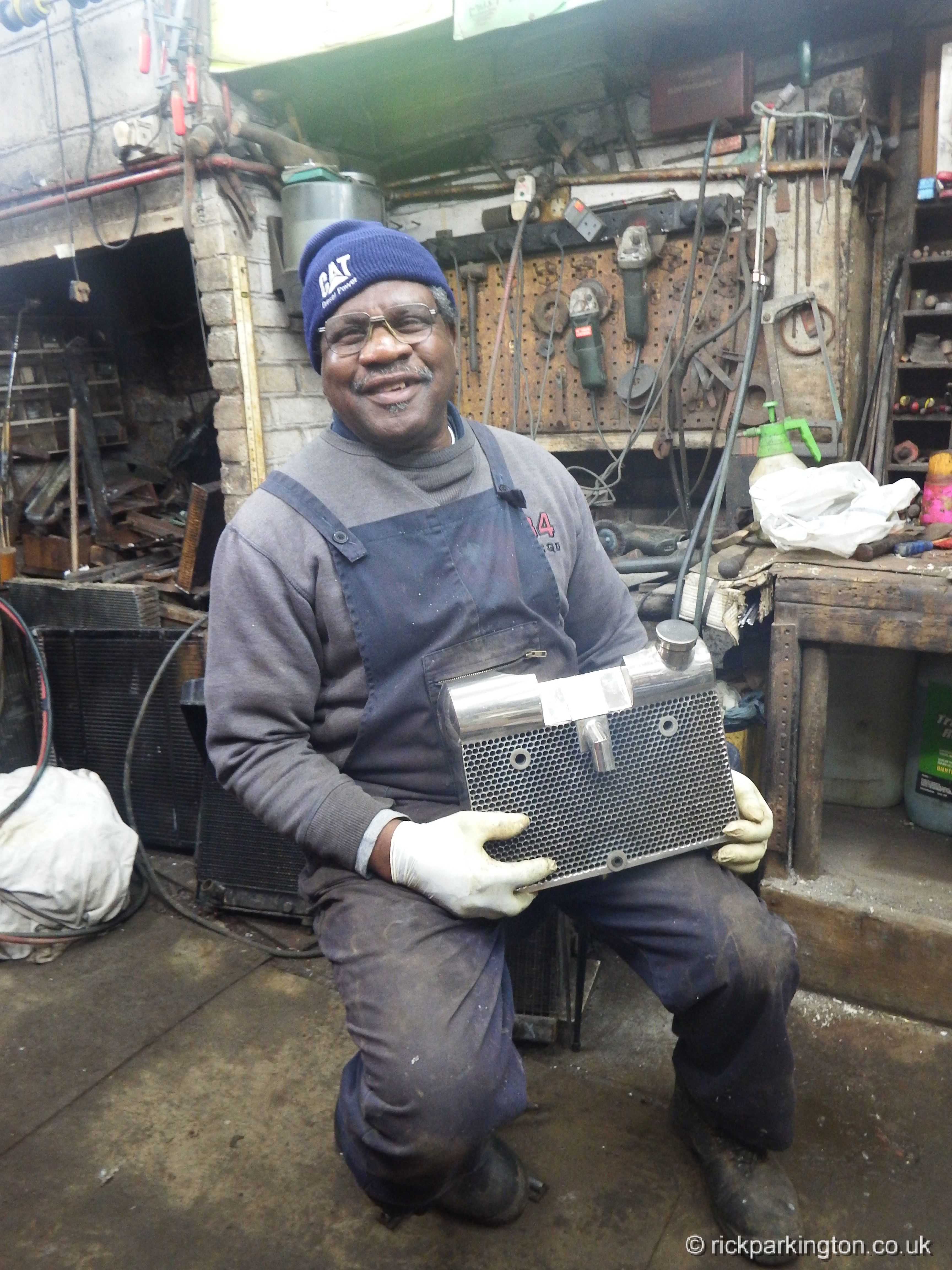 Meet Bryan. Bryan and Son repair radiators in Tunbridge Wells, Kent. Well Bryan does; his son has unfortunately not followed him into the business but he is often assisted by his wife, Julie.
I took a Scott radiator down to him earlier this month. A leaking radiator is one of the Scott owner’s biggest fears. The soft-soldered honeycomb radiator, gleaming with nickel or chromium plate is a spendid feature of the Scott motorcycle but if you want to create major panic at a Scott meeting, just pour a few splashes from your beer glass beneath the front of the bikes.
New radiators are made, but you’re into four figures and even then it’s inexpensive at the price, given the work involved. So it’s good news to find somebody like Bryan who will repair a radiator for a reasonable sum. He is very well-known in the vintage car world and is often to be found working on the gigantic gleaming honeycombs that grace the forward end of Rolls Royce, Bugatti and Bentley – but ,as he says, he draws the line at central heating radiators.
He does, however, solder petrol tanks so my previous visit to him was to deliver the Martinsyde tank and he had a story for me. “Enjoy your holiday, Bryan?” I enquired. “No,” he replied with a grin, “I died! Didn’t you see it on theTV?!”
He let me off when I reminded him we don’t have a television and filled me in personally. It turned out that while on holiday with Julie, someone as yet unidentified – Bryan suspects a business rival, although there can’t be many – had put about a rumour on the internet that he had perished from a heart attack while away. A well-wisher had even set up a tribute website. Bryan is popular and word had travelled fast. Upon their return, they had to field phone calls asking for funeral details and explain, as best they could, Bryan’s evident good health to some very surprised people as well as trying to reassure customers that he was not only still with us but open for business. The best approach was clearly to announce his ‘Second Coming’ in the local press, but Bryan was nonetheless amazed to receive word from a friend travelling on the other side of the world that the story had just been featured on TV news at the airport. So if someone was attempting to damage Bryan’s business, it backfired, giving Bryan advertising worldwide!
Anyway, the Martinsyde tank. Like many vintage tanks it contains both petrol and oil with an internal division between. This was leaking and the seam at the top was split open. Now I’ve had a go at soldering tanks and I have not been met with success. The problem is that using gas there’s a tendency for the thin sheet steel to warp at around the melting point of the solder, so as the solder sets, the steel is moves and breaks the joint. When I took the tank to Bryan he turned it over and over pondering aloud “How did they make this”. Then he spotted that the front corner triangles were removable gaining access to the inside:
 At the Isle of Man last year the Martinsyde’s tank was leaking quite badly, not from Bryan’s repairs but from the mounting bolts. Inevitably when a tank is this old, the solder is brittle and easily fractured. I decided to have a go at fixing it myself. I was getting along quite well soldering up the mounting bolt holes until the last one when unfortunately there was an almighty WHUFF!! and the tank cap went flying across the workshop. I meant to take he cap off to let the gasses expand. Luckily, it was only on half a turn, so no harm done but it goes to show what happens with petrol fumes under compression…
Anyway, although I eventually got the external leaks fixed, the blast had blown the petrol/oil barrier again. I was about to take it back to Bryan and explain that I had been having a go myself when I had another thought. Since Bryan had only just taken out the front triangles they would be clean and well tinned, so maybe I should carry on having a go… I did. I popped them out, soldered the seam and replaced them. It worked perfectly.
This has led to a bit of a boost to my confidence. There’s a couple of scrap Martinsyde tanks, this one had a perforated bottom and some strange woodworm holes in the top, possibly where solder flux has corroded the original plating, you can see here inside. The material used to make these tanks was ‘tinplate’, thin sheet steel plated with tin, like tin cans were originally – the clue us in the name. The tin made the metal easy to solder, it was effectively ready-tinned.
 This tank is made differently to my original, the front triangles are formed out of one piece and the bottom slides in like the lid of a old-fashioned wooden box of dominos.
Here’s another tank I have just begun cutting out and this is more like mine. The base here is a proper tinman’s joint where the two sheets are folded together at the seam before soldering. A better joint suggesting a slightly older tank.
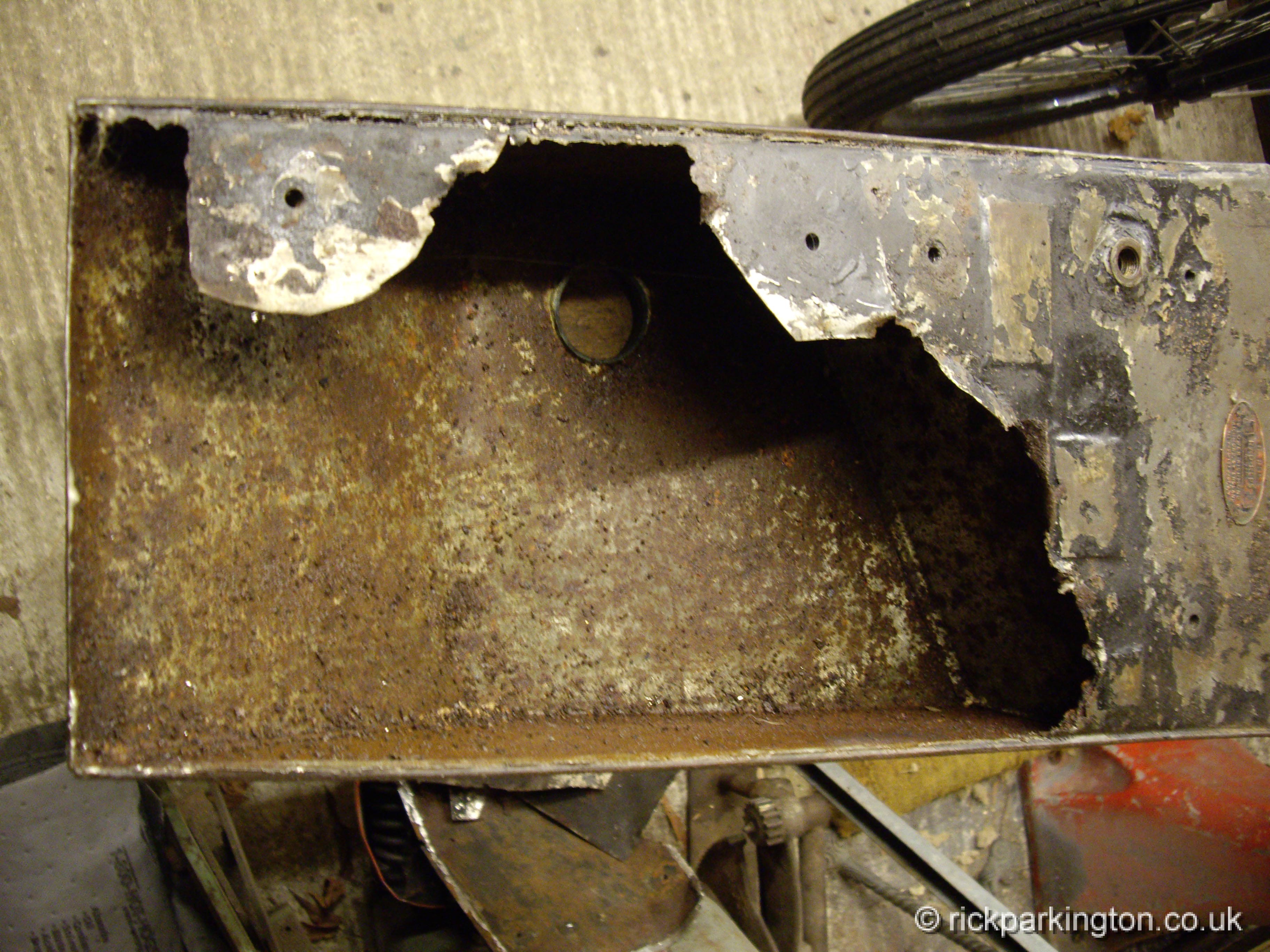 Then there’s this 1924 BSA tank that leaked at the front of the oil tank seam…
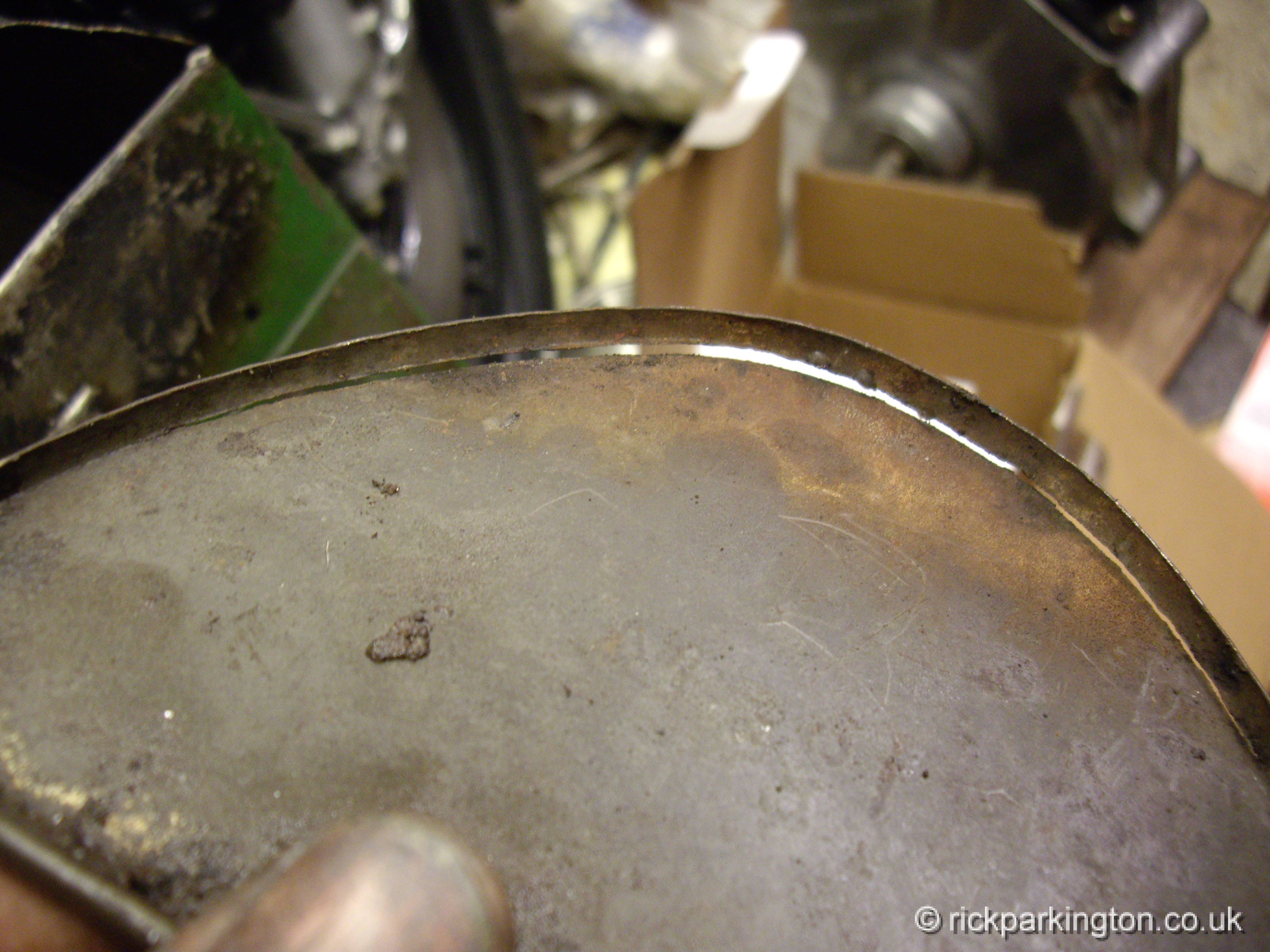
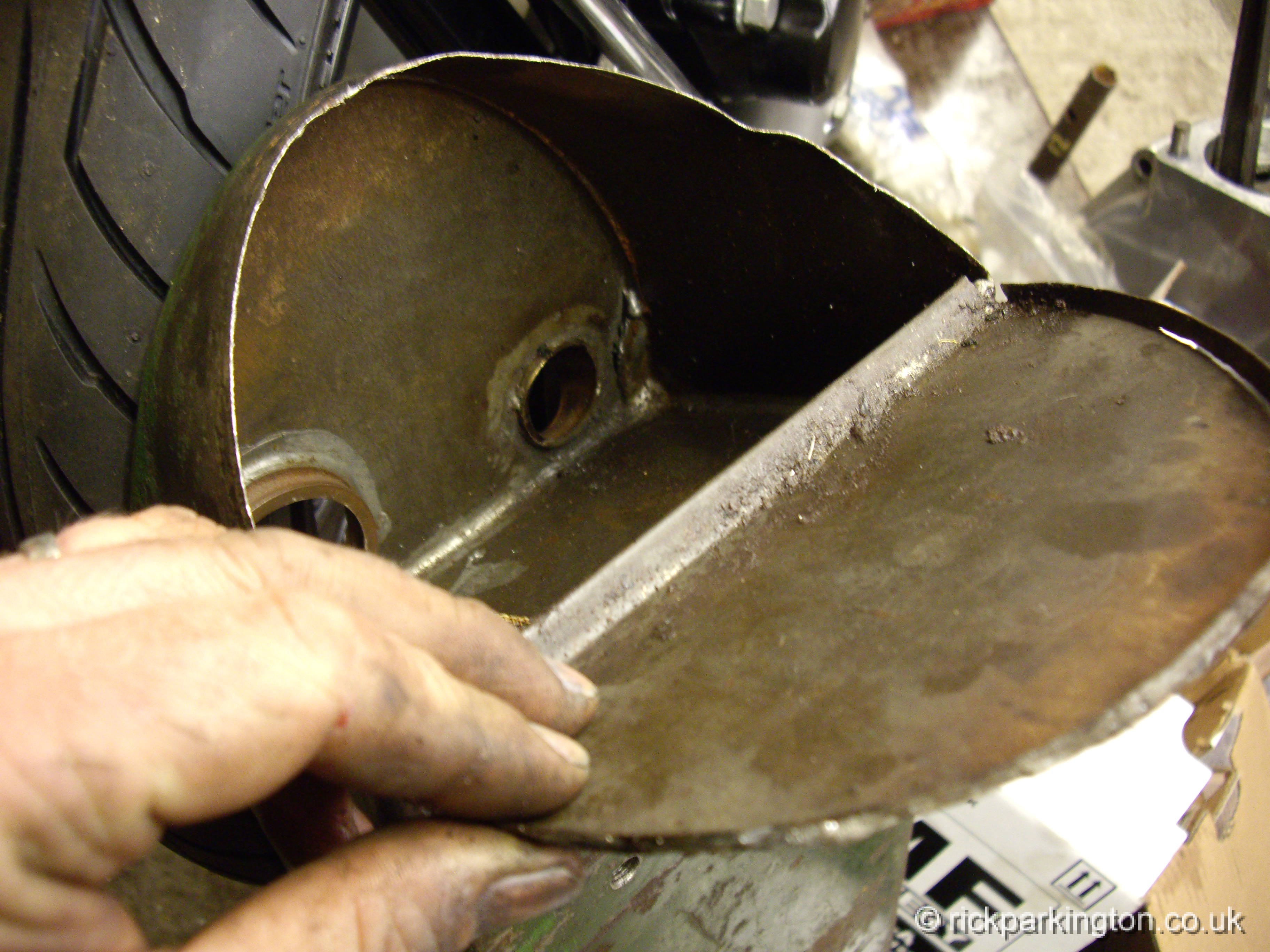 Having got it apart I see that the panel has actually split at the rolled edge, the seam itself was fine. I suspect the easiest solution to this one is to make a new panel.
 The big lesson is, as usual, ‘faint heat never won fair maid’. Bryan had the confidence to pull the tank apart, giving him proper access to fix the internal joint before putting it all back together. When you lack this confidence you always try to fix things with keyhole surgery that just makes it all more difficult; you can’t get it properly clean or tinned and you end up using too much heat to compensate. The heat builds up like an oven, the steel distorts, other bits start melting and you lose control of the job.
Anyway, suffice to say I have landed myself another project which I may or may not be tackling over Christmas. There’s a few other jobs to do first…
Whatever you find yourself doing, and whatever you celebrate, enjoy your time off and see you in the New Year
HAPPY CHRISTMAS! Cheers
Rick