
Readers of this month’s Classic Bike magazine (November 2024) may have noticed that I’ve bought another bike…
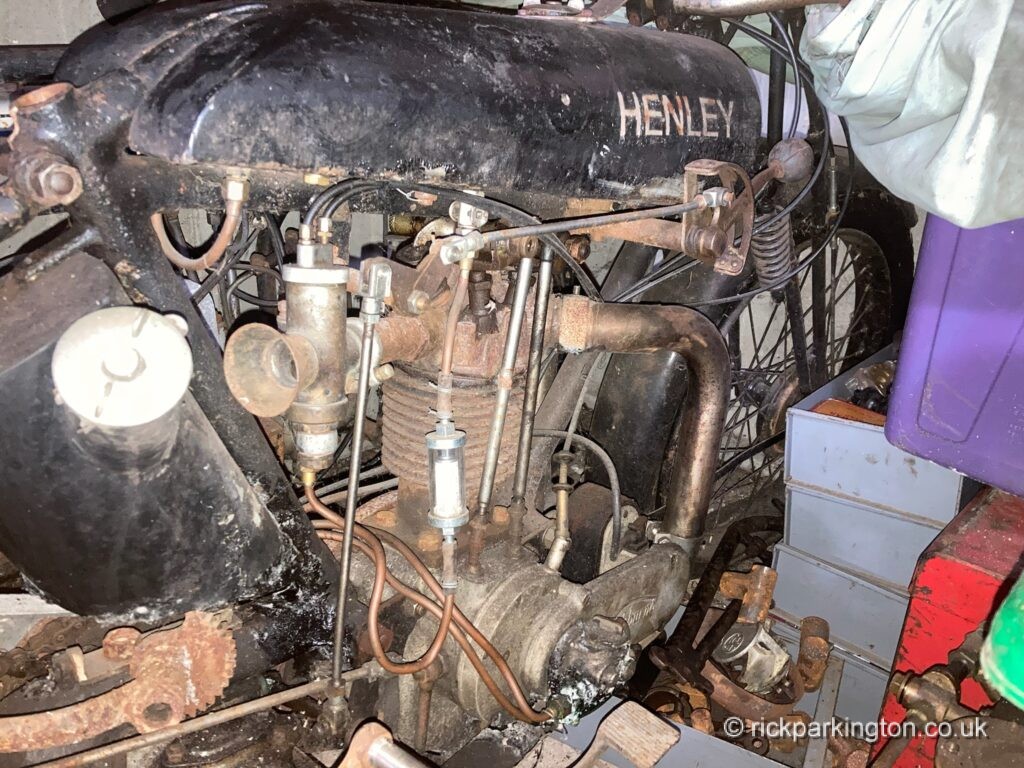 It’s a Henley Blackburne and came from the same stable as a fearsome Zenith, fitted with a 1000cc JAP vee twin, that recently sold at Beaulieu autojumble – you may know that bike if you follow the ‘Shed Racing’ youtube programme. Both the Zenith and the Henley looked like fantastic original/unrestored barn finds and I’d have jumped at either bike but the Henley was the better bet for me for two reasons – first, obviously, the Zenith was a lot of money and second, I’ve learned that in the world of obscure (ie expensive) vintage bikes, you are wise not to stray too far outside your specialist area. Barn finds usually went into the barn for a reason and while JAP twins are not my speciality, I do know how much they can cost to fix. I’m on home ground with Blackburne-engined bikes but that actually led me to serious doubts about the Henley when my friend Simon sent me this photo. According to the log book it was 1924 and looked like it hadn’t been ridden for decades – but I could see that the engine and forks were at least 1926 – and in any case, it didn’t look anything like a 1924 Henley.
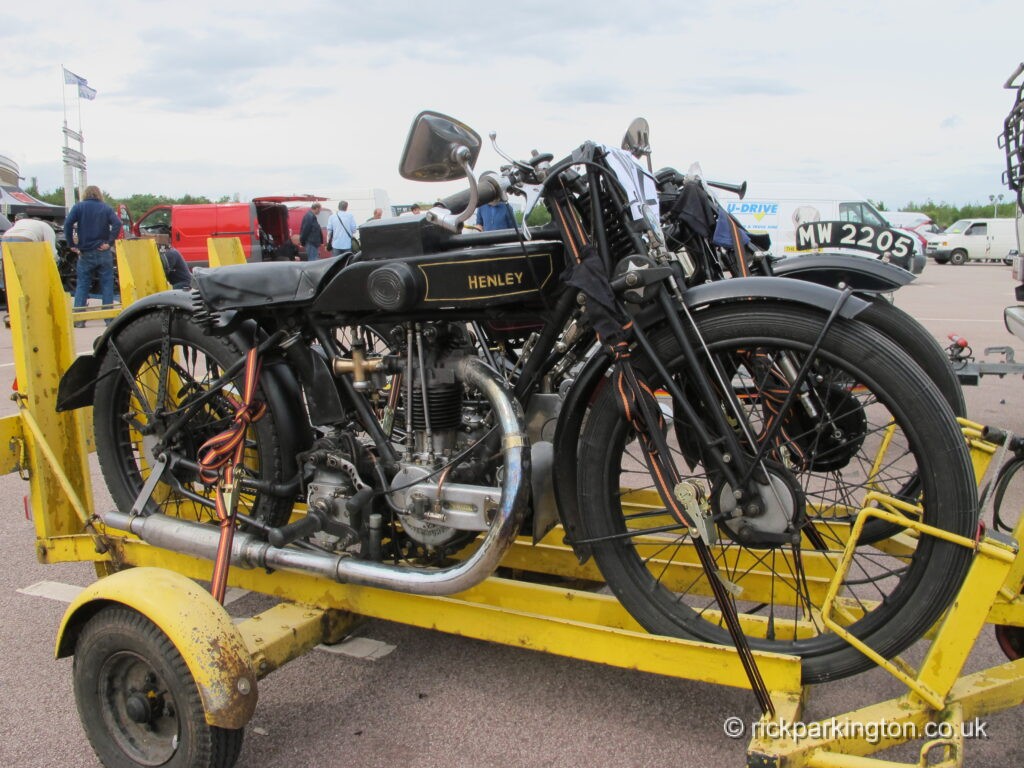
This is a 1924 Henley. Formerly owned by the late Guy Ashenden, who rode and raced it from the early 1930s onward, it’s a flat tanker not a saddle tank like the bike in Simon’s photo. Okay, well I did say the engine and forks were 1926 – but…that’s not right either.

In 1926 ‘Henley’ became ‘New Henley’ with a completely different frame and this more box-like tank. So what was the bike in the photo? I had a feeling it may not be a Henley at all but either another make altogether, wrongly identified, or even just an ‘autojumble special’, made up from bits and pieces in relatively recent years.
Does it matter? After all, just like that Zenith, it looks like a lot of fun with its sporty engine. Well that’s the point; sporty – and particularly unrestored-looking – vintage bikes are hugely popular these days and while most people carry the internet in their pockets, there is so little proper, factual research material available that a dodger can pretty much pass almost anything off as genuine with a bluff ‘Yeh, it was modified to race at Brooklands mate’ type comment. A little knowledge is a dangerous thing but I’m pleased to say that while that patter will convince people taking photos for instagram, those with money in their pocket are more cautious. It’s that thing of knowing when you are outside your field, people looking to buy are (rightly) fussy about authenticity and not impressed by sales talk that can’t be backed up by evidence. Some years ago there was a bike that failed to sell in several auctions because nobody was quite sure what it was – and I can’t help remembering that in one of its incarnations it had ‘Henley’ on the tank…. I’m not a dealer, I buy bikes I like but equally I am not rich enough to buy bikes I couldn’t sell if I needed to. I had ‘a feeling’ about this ‘Henley’ so I gave it a swerve.
Besides; while I started my shuffle down the Blackburne path humbly, with the rusty skeleton of a 1920 500 sidevalve and a 350cc sidevalve engine fitted into a BSA frame, I have since collected a number of others. I sold the BSA special but the skeleton became my belt drive Scarlet Runner Brooklands bike, I also have the 1916 500cc Blackburne, a 1922 OEC-Blackburne 550, 1923 and ’27 Rex Acme 350 Blackburne ohv’s and a pair of Cotton Blackburne projects – 1924 and ’27; that’s seven Blackburne-engined bikes, for Pete’s sake – I hardly need another one, Henley the 8th!
But not buying it didn’t mean I wasn’t interested enough to research it further and ultimately I found I’d been wrong. There it was in the November 1924 ‘show issue’ of the MotorCycle, a Henley-Blackburne 348cc Super Sports…
 The bikes on show were of course the 1925 range so clearly this was the model that followed Guy Ashenden’s bike and I’ve never seen another. Now my mind started working overtime; when exactly did Henley become New Henley? I didn’t have any pictures of the Henleys from the 1925 show – what if this was a completely original, super rare, latr version of the bike above -an immediately pre-New Henley model? Maybe it was worth going to have a closer look after all.
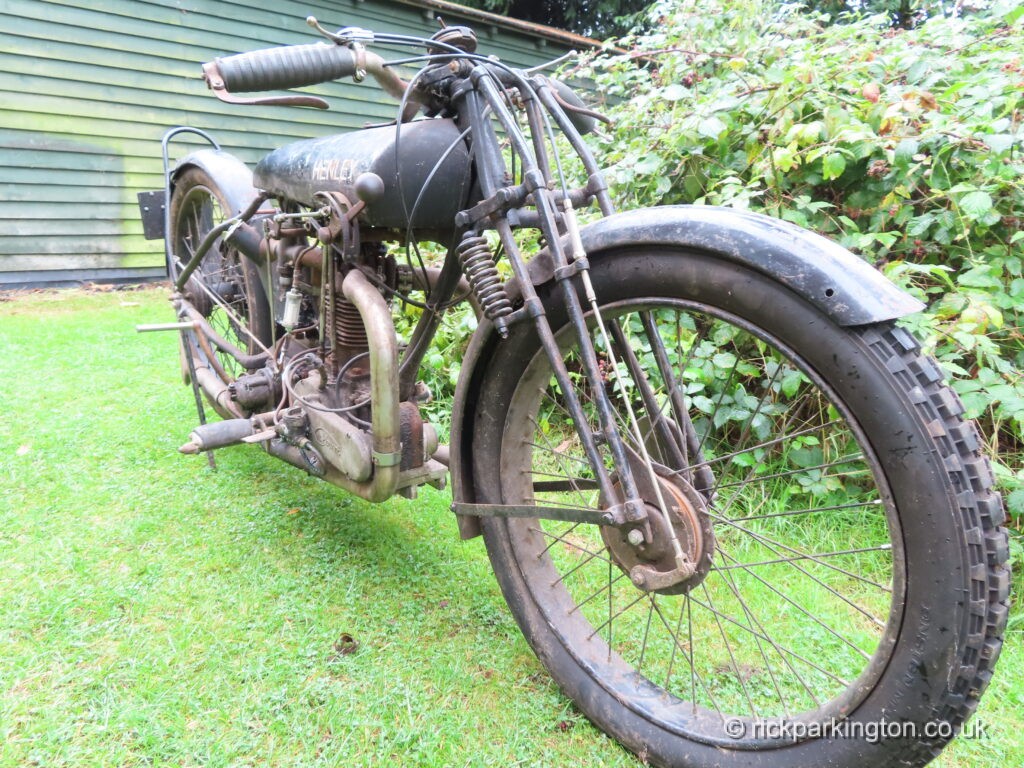
Well, I Iearned a lot in that visit – but still came away with another Blackburne-engined bike, that’s eight, so this here is Henley VIII.
We dragged the Henley out of a very damp garage and the first thing I saw was unexpected, in the licence holder was a 2011 tax disc and on the front mudguard a sticker commemorating the 2010 Grossglockner Hillclimb. This was not an ancient barn find at all, it just looked like one – only 14 years ago it was up and on the road. The next thing was that it wasn’t original either. Although it may not be obvious from the photo, the top and bottom fork links were way off parallel – a sure sign they’d come off another bike with a shorter steering head. And do you see how the spokes in the front wheel rim are all in the middle? That’s normal on later, well-based rims but with beaded edge they are usually staggered left and right, a centre spoke run like this is for bikes with bicycle-type stirrup brakes. The more I looked the more I saw – and then I was shown the ‘before’ photo.

Ah, right. That explained it. Seeing that photo I decided I’d better adjust my offer in a southerly direction. I’d been right all along it was an autojumble build. Having been both a buyer and a seller I’m not into messing around, adding a bit on or knocking a bit off for negotiation. Realistically a bike is worth so-much to the seller and so-much to the buyer and I’d rather say ‘it’s worth so-much to me and if that’s not enough then no problem and thankyou for your time.’ I find people appreciate that over silly tyre kicking and sharp intakes of breath. In the event, Peter was happy with my offer and I brought the bike home.
The forks bothered me the most; they really made the bike look like a ‘bitsa’ – but to be fair, they’re Druids like the originals, just a bit later and the engine likewise, apart from the 1927 twin port head it’s the same as a 1925 motor. Even the gearbox, it’s Burman not Moss but Burmans were fitted to TT and race bikes from 1922 so all of this could be seen as in-period upgrades.
Well, if the forks fitted properly that is.
Looking at it I realised there was a spacer fitted under the top clip (top yoke to you tele-fork types!) It was there to stop the handlebar brackets hitting the tank. After looking at various options I decided to cut the handlebar clamps off and weld them back on higher up to clear the tank. With the spacer removed the forks fitted perfectly and my sun came out from behind the clouds. I checked the mag with a meter and got 5,000 ohms across the secondary coil, which is good. I removed and cleaned the points and got a cracking spark from the mag and a bit of fuel and three kicks later the engine was running.
There is a Henley at the National Motorcycle Museum that also doesn’t quite fit between the 1924 and 1926 models.
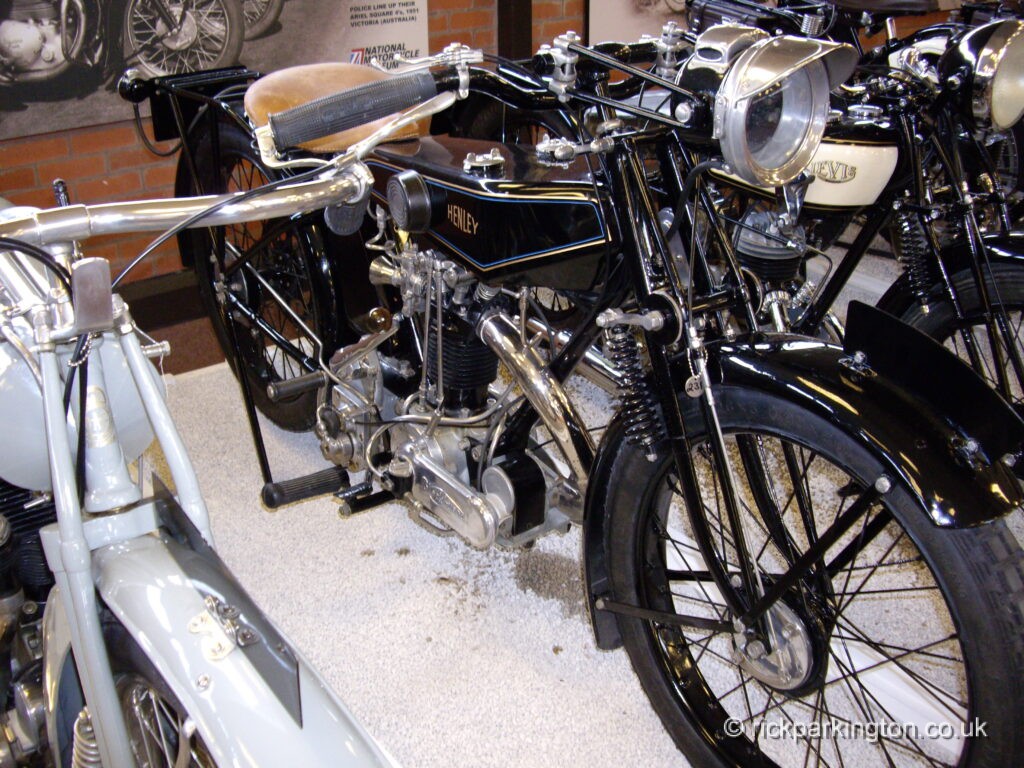
In the past I took the view that it was a 1926 New Henley type but with a remade tank, a bit less curvy than it should be but now I’m not so sure.
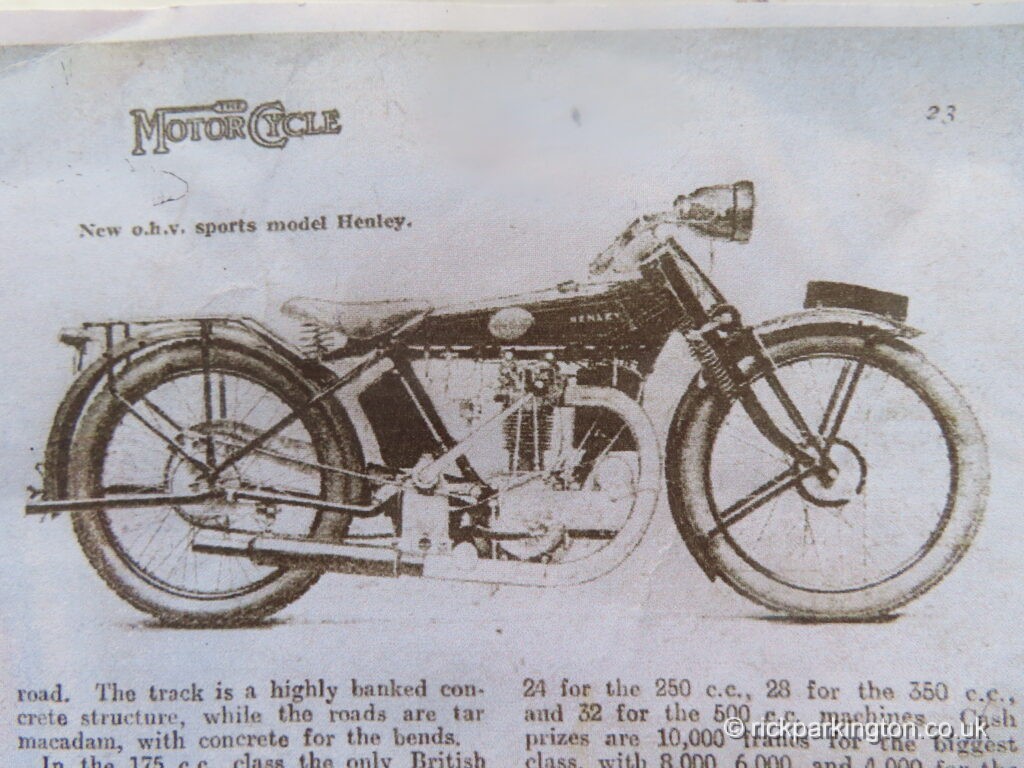
This photo shows a mid 1925 Henley and the tank looks different to the previous old magazine photo and more like the NMM bike. Looking closely at the NMM bike the frame is identical but unfortunately the paint coating is so thick you can’t read the frame number to see if it’s later than mine. The engine in the NMM bike is also later so I can’t date it from that either – but otherwise it is much more original than mine. I found a period photo of a lady rider on a Henley Blackburne sidevalve online and it seems to have the same coffin shape tank. The one on the NMM bike has an oil compartment and a toolbox where my oil tank sits so it may have been a more touring model, the as-found shot of my bike shows a steering damper on the tank which was generally reserved for ‘speedmen’s’ models but it could simply be that my tank was only fitted to early models.
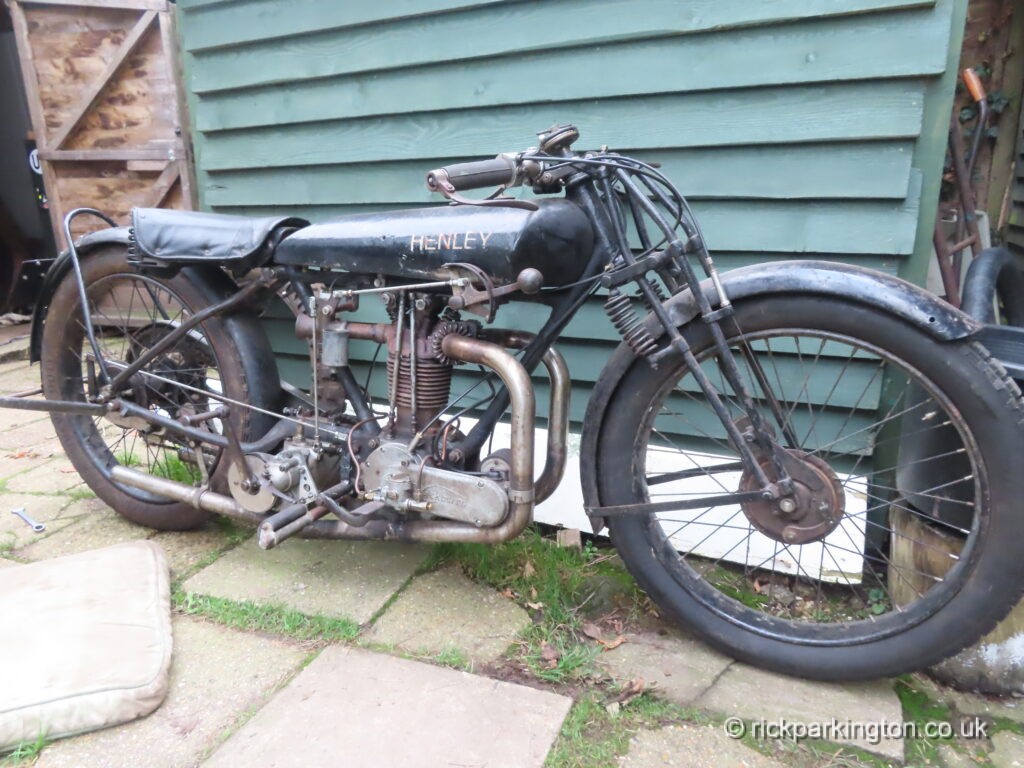
But the really good thing is I’m no longer worried. As soon as you start working on a bike you start to bond with it and concerns slip away. I don’t care how original it is or isn’t, it’s just a great bike and I’m looking forward to getting it on the road. I’ve already had two generous offers to buy it – but it’s not for sale.
I realise that we are still largely bound by the old dogmas, handed down from past generations; originality in the old bike world is still The Law – it’s tantamount to an HPI check when buying a second hand car – who dares defy it? With any ‘antique’ you need a value structure, otherwise how do you differentiate between Rolex and a ticka-ticka-Timex? I think originality became the benchmark because on the one hand everybody can relate to an original bike, any deviation from that – like a ‘custom’ – becomes very subjective and equally an original bike has either been carefully looked after from new or someone has gone to a lot of trouble to find the parts; lashing it together with whatever’s around suggests less commitment. Where does the Henley fit in there? Well with bikes like this, finding original parts may be impossible, Peter made a very good stab at getting it as close as possible and I respect the fact that his build very nearly took me in. I suspect the time is coming where if a job is done well enough it won’t really matter if it’s original or not – maybe it wasn’t modified for Brooklands racing – but it could have been….
Cheers Rick
Raymond mentioned this on Saturday (I found him some bits for his Rudge). I might be about to buy back Laura’s James Comet.
I could cycle faster…