
I mean, how hard can it be? It’s one of the last details I am doing on the current Classic Bike project Excelsior Universal and for those who don’t read the magazine here’s the back story…
 The speedo had had it, the glass was broken and the innards had suffered accordingly and the drive gearbox was missing its drive pinion. Ferret, the King Rat of motor cycle electrickery, kindly came up with a speedo for us but the drive was a problem. These right angle drives have been expensive and hard to find for as long as I can remember. Being made from Mazak (commonly known as ‘shit metal’ in engineering) the cast bodies are fragile and prone to corrosion. A zinc based alloy, it seems to be porous so instead of simply corroding on its surface it tends to crumble. Still, our casting was fine, perhaps we could find a crumbled body with useable gears…and do you know what? I stumbled across a rotted away Norton hub with a rotted away gearbox attached that provided a pair.
 First lesson was that I hadn’t realised there were so many variations… The tooth form on the Norton box was coarser than on the Excelsior and it’s nothing to do with drive ratios, drive and driven pinions being the same size makes it one-to-one…you just cant swap round the bits. Huh!
Still never mind, both the Norton pinions were okay so why not just swap the pair… Ah, well, that’s the next thing; the Excelsior uses a short drive spindle, the Norton’s is a long one. This was getting annoying but I found I had another box among my bits that although also fitted with a long spindle, was broken at the end and it looked like if I cut off the broken bit, it would just be long enough for a short spindle.
 Perfect, I took that box apart, shortened the spinidle, put the gears in the Excelsior box and replaced them with the old Norton gears in my box, thus one scrap box restored two others and I was very pleased with myself when I switched off the shed lights that night.
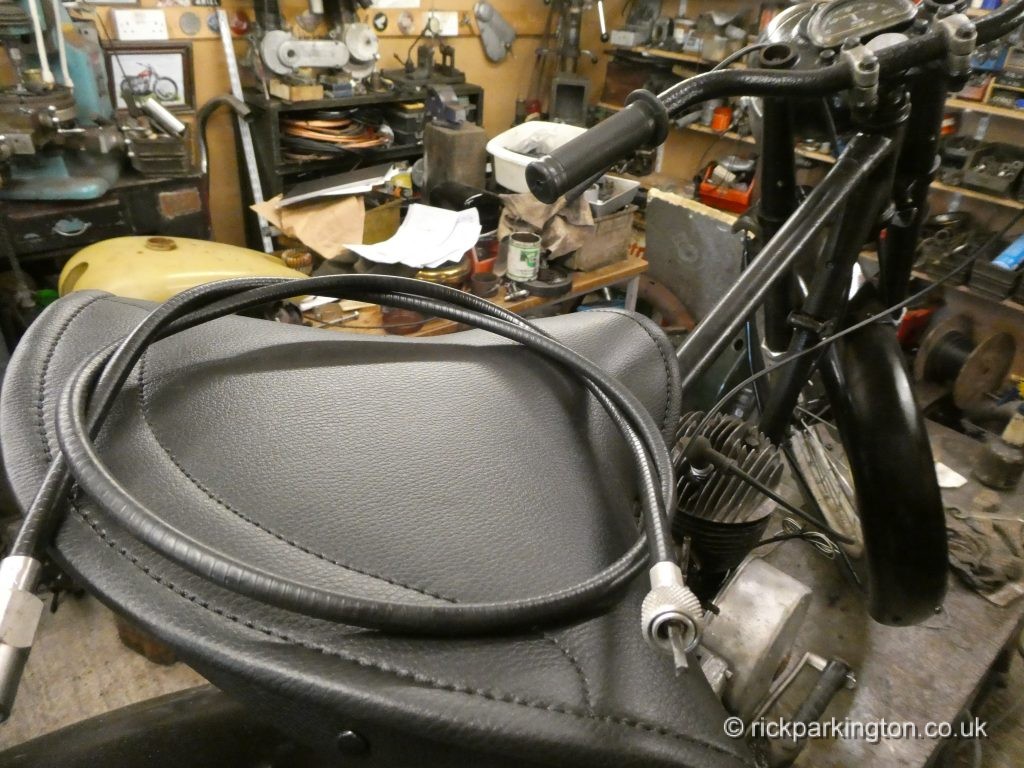
All that was left now was to fit the new cable we’d ordered for the Excelsior and we were done. Or so I thought. Unfortunately yesterday the gremlin sneaked back in the workshop. I set about fitting the cable and found that a well as being nearly a foot too long, it didn’t have the spade end demanded by these drive boxes. But I wasn’t too worried, I have a couple of spare spade ends and enough equipment to sort it. I cut the outer cable to the correct length and made up a new aluminium end, longer to accommodate the spade end, on the lathe.
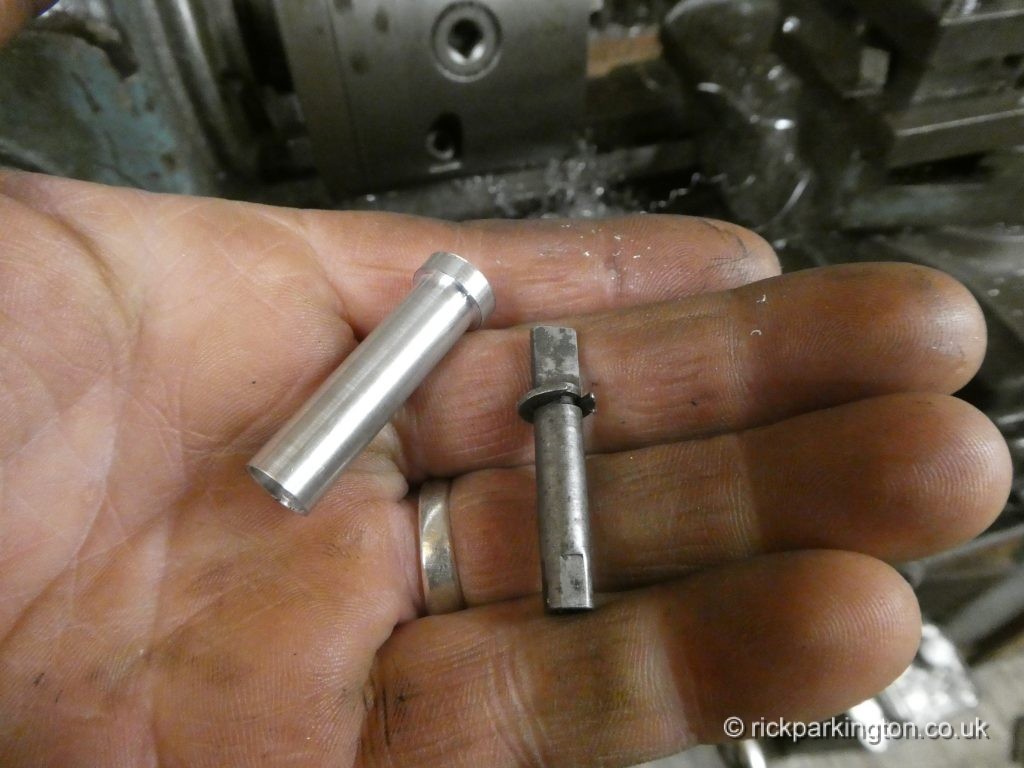
 It’s an easy job to make a new sleeve from aluminium bar on a lathe, the tricky bit is how to secure it to the outer cable – usually they are crimped with an hexagonal tool of some sort.
 Taking inspiration from control cables, I made up this tool years ago, it slides over the sleeve and the bolt has a nipple turned on the end so that when tightened it punches a neat dimple without ovalling the sleeve as happens if you used a dot punch.

Then I cut down the inner cable to length and reformed the square using the proper tool, I bought this beauty 25 years ago at Beaulieu autojumble,
“Ten quid?” said the bloke on the stall, “What is it for anyway?”
Luckily for me I had seen one before. It’s a clever thing; you mount it in a vice, tighten down the screw and then belt the anvil on top with a hammer, re-tighten the screw and belt it again. It works very well – but if you find one at an autojumble, there is a trick. To prevent the cut end of the cable fraying you need to melt the end of the cable with a torch, as you might with nylon rope, thanks to the late Max Nightingale at Alpha Bearings for steering me right on that one. That’s what I love about having equipment, it enables you to work around problems that would usually bring you to a halt.
Er, so why wouldn’t it go on? Dammit! For some reason the cable didn’t want to fit into Ferret’s speedo – and no, not the end I had squared. Right, off with the speedo then.
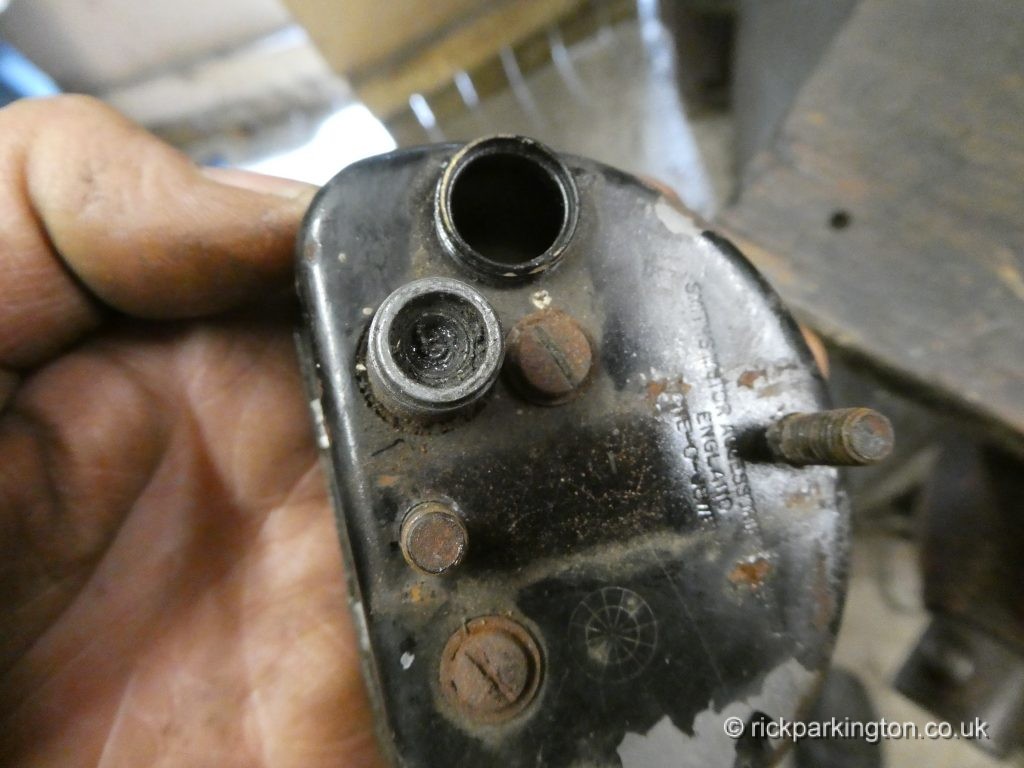 Oh no, there was a broken (and not doubt seized) bit of inner cable stuck in the socket with nothing poking out to grip, even with a pair of tweezers. Now what? Well, I couldn’t see it drilling out – but maybe if I used a very small drill it might sort of work its way in like a stud extractor. Well, maybe but fool that I am, I was trying to drill something that is supposed to revolve anyway, so all that happened was the needle registered fifteen mph! But, it did loosen it a bit and in fact the end wasn’t seized at all and fell out. Right, speedo bolted back on forks try again. With the cable tightened up and the wheel spinning, there was no needle movement, not even the faint music box tinkle that Chronometrics make to show they are trying. Off with the cable at the speedo end, spin wheel, cable rotates. I glared at the end of the cable, it seemed very short…
Problem here is that the inner cable reaches further into a magnetic clock than a chronometric. Back when the only place locally you could buy British bits was the local Triumph dealer, you had to use T140 Bonneville speedo cables on everything. But using a magnetic cable on a chrono means that the longer inner puts pressure on the little plate that holds the drive together inside, it bends slightly and the drive cog comes partly out of mesh and strips its teeth. Now that you can buy proper cables , I think manufacturers are so worried about this that they make the ends a bit shorter than they should be and sometimes the engagement is so shallow that it slips.

That seemed to be the problem here so I dug out a tiny steel washer and ground it even smaller until if fitted beneath the fibre washer on the cable inner, lifting it further out of the top. Much better, now turning the cable I could see the needle start moving.
But spinning the wheel vigorously, there was still no movement on the speedo. Off with the cable again and this time I looked again at the drive – hang on, it’s going the wrong way… Unfortunately, in all the confusion I didn’t notice that the worm on the original Excelsior gear turns the opposite direction to the ones I used.
The original Excelsior gear is on the right, the replacement on the left.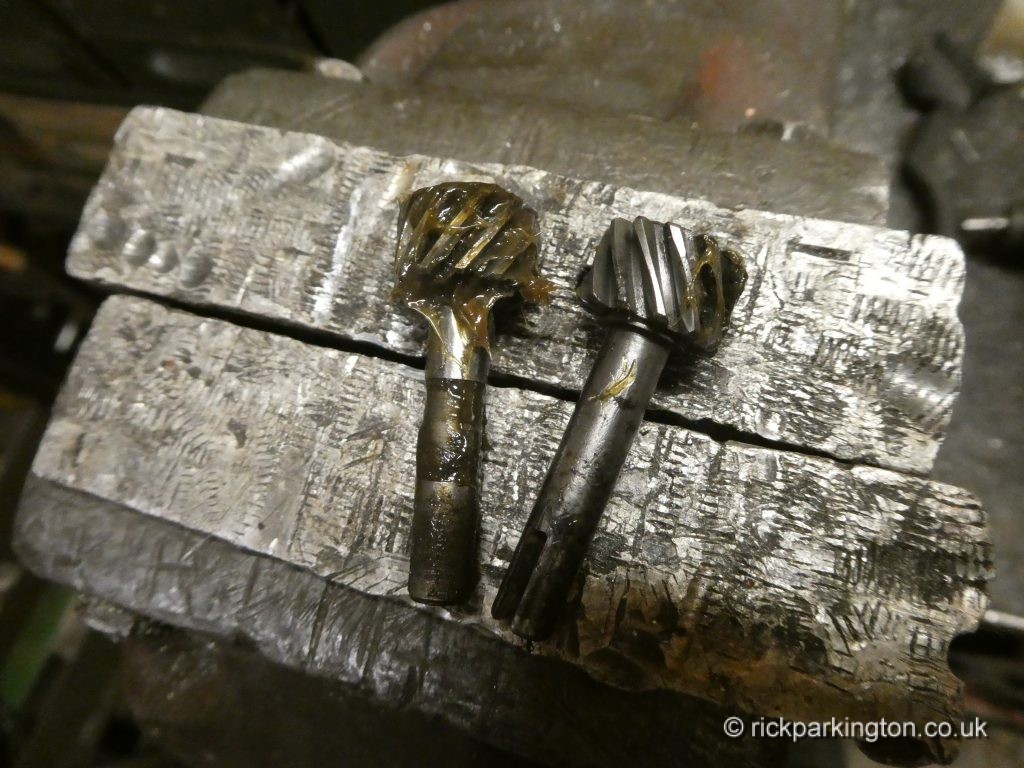
The gears I have used are from a clockwise box – but with a bottom entry cable, if you look back at the earlier picture, the Excelsior’s box is top entry (to clear the rear wheel spindle nut) so you need an anti-clockwise gear set. Shifting the cable position reverses rotation – I ran into this problem with the Norvin, whose Norton rear wheel is reversed to suit the Vincent’s right side chain. The reason there are so many variations in these older right angle boxes is that most were fitted to front wheels and could be left or right, as well as rears later on. Luckily I have an anticlock box with a short spindle so I can swap some more gears around to get the Excelsior working but that was a day I could have done without.
Speaking of days we could do without, I don’t want to go on about the current situation except to wish everybody well and hope you are healthy and finding things to keep you occupied and entertained. Like many people involved in old bikes, I’ve got enough jobs to keep me going for quite some time but I am very thankful my workshop is just outside my back door. Take care, Rick
EPILOGUE:
Okay so yesterday I decided to strip the gears from one of my boxes and swap them over. All I needed was a short spindle type with bottom cable that turned anti clock; in the Excelsior’s top cable box they should go clockwise. That went okay.
Incidentally if you strip one of these boxes, there’s a split pin that retains the cap over the driven pinion and the one over the drive pinion is pressed in a caulked in place. I find (obviously having removed the split pin) gingerly tapping the end of each spindle with a flat ended 1/ 4″ diameter rod will push out the caps safely. You can put the caulked one back in another orientation and caulk it again. Mind you, this box has been apart so many times I’m running out of room!
Only thing was with the new box, the hole for the gear retaining pin was farther up. The spindle is hardened and not easy to drill and besides, on the box I had built the gear was rather hanging off the end, which didn’t seem right – although it seemed correct to mesh with the cog in the hub. Anyway, this was a standard box and turning the brake plate on the wheel it seemed to operate the gearbox so I fitted it all back on the bike.
Didn’t work. Off again, looking at drive cog it is screwed onto the hub so using a copper drift I tried to punch the teeth sideways to shift it but nothing doing. Instead I backed the drive box locknut as far as it would go and put it all back together again. Still not working. Off again, this time I removed the lock nut on the drive altogether, allowing it to screw in a good 1/ 8″ further. Surely this time… fitted it back together and success, speedo now working – but there’s a cyclic clonk from the rear wheel too loud to ignore.
All apart again. Incredibly the ‘soft’ copper drift had actually bent one of the drive teeth slightly! I part straightened it and part needle filed it and put it all back together, a broken man, and FINALLY it seems to work. There’s probably a moral here somewhere but I’m too beaten to think of it!
Cheers R
Having ridden around on my Velo for about 7 years with a broken speedo drive I learned to live without one. I don’t think that there is much risk of getting done for speeding on the Excelsior anyway!
True – but the trouble with working on a bike for a teenager is you feel kinda morally bound to at least try to make it legal! Aah, things were different when we were lads…
Cheers R
These days youngsters download a GPS Speedo app with a nice vintage clock face and gaffer tape their phone on top of the speedo.
Ah, so that’s why how the glass on these I phone things gets broken…!
Hi I’ve got the same problem with my 38 bsac10.can you tell me where I’d get hold of an opposite drive shaft to mine
Andy