
Of course at this time of year our thoughts focus on the unwanted, the lonely and abandoned. Yes, many bikes have suffered this fate over the years. But what about ex TT machines? They must be out there somewhere, surely…
But let’s be serious.
Imagine I am a 1920s manufacturer. I won last year’s TT with a bike which was basically a pretty complicated version of my standard engine in a set of stock cycle parts. If I sell the bike locally there are two potential problems, first some smart-arse private owner might use it to beat my this-year’s TT racer. Secondly when he blows it up he will expect me to supply him spares and half of them were one offs. Besides, when he pulls the engine apart he will find out all my tuning secrets. So I can either sell the bike abroad (as far abroad as possible) or I can just remove the racing engine, fit a standard one and sell the bike as an ex-demo roadster. Selling abroad has its advantages, after all if the bike is raced very successfully in ‘the colonies’ – Australia or South Africa are a good choice – then it can only help my sales over there. On the other hand, the TT may have just about finished that engine anyway so perhaps just breaking it up and flogging it is the better idea, besides I may be able to use someof the carefully hand fettled bits in next year’s engine…
You can see the problem. In the case of bikes that used proprietary engines, like my favourite Blackburnes, it was even more tricky. They had no control over the actual success of the bike they supplied engines to. Suppose Donkey Motorcycles Limited wanted a Blackburne race engine for their star rider George Formby, who they tell me is a rising star on their best machine… George comes in last place and I am a laughing stock. What’s worse, the little rat has friends at JAP and he lets them pull my engine apart in the pits and copy my cam design and porting…
Again, you see the problem. Blackburne were careful who got their engines. Manager Ike Hatch supplied Super Sports engines to those who wanted them but TT engines only went to manufacturers – and riders – whose ability he was satisfied with and even then they had to hand their engines back to Hatch at the end of the season; which, ironically, means that an ex-works bike is more likely to be genuine if it doesn’t have a racing engine… In his early days, Irish racer Tyrell Smith raced an OK Blackburne and although it was quick, when he was working on it Wal Handley told him ‘he’d never get it to really go without a ‘kidney’ cam. (Blackburne racing cams are kidney, not egg shaped). Eventually Tyrell obtained an proper works TT engine via his friend Paddy Johnstone, at that time Competition Manager at Blackburne and found it was a very different thing. Cotton and Rex Acme were long standing customers of Blackburne with excellent riders like Handley, Johnstone and Stanley Woods getting the ‘best’ motors.
Then there was Jock Porter, more or less a one man band from Edinburgh.
Jock Porter’s Motor Mart at the top of Leith Walk was, I believe, still there in the sixties but long gone by the time I arrived in Auld Reekie. Porter manufactured New Gerrard machines – Gerrard being the name of his son – initially from a works in nearby Gayfield Square but latterly much of the production was sub-contracted to larger premises in Nottingham. Porter was a successful rider at home and in the Island and most of his early bikes used Blackburne engines. Some years ago I was contacted by Joe Gray from the Shetland Classic Motorcycle Club. Joe compiles an excellent page on the club’s website called Rare Bikes in Shetland in which he turns out an old bike photo and writes what he knows about the history of the bike shown. He wanted to know if I could shed any light on a bike that used to be on the Island in the 1950s and was said to be a New Gerrard.
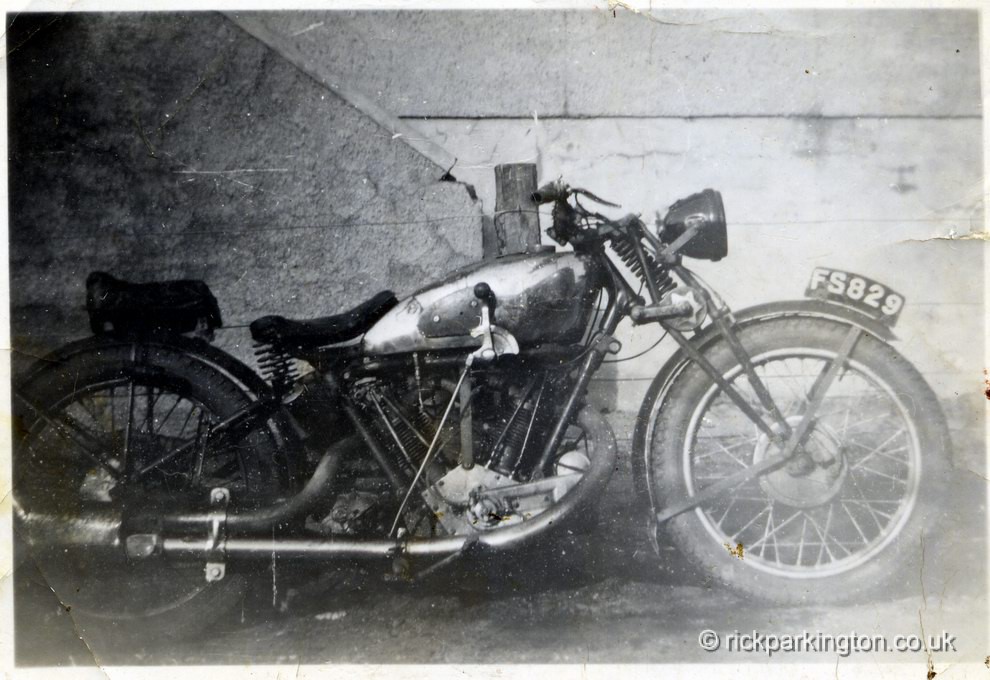
Well it had an Edinburgh number, right enough, and the engine was very clearly a Blackburne OHV twin but was much older than the saddle tank chassis in which it reposed. The engine was probably aroud 1923/24. The bike as a whole looked 1930s. Besides I couldn’t recall seeing Porter on anything other than a Blackburne single.
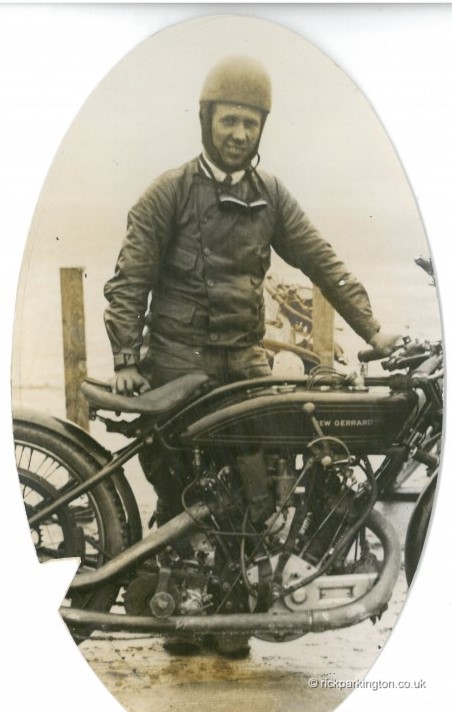 But I was wrong, this picture from a Lodge Plugs advert, shows Porter on a New Gerrard that he sand raced at St Andrews on 12th July 1924 which has a very similar twin motor, note the non-standard magneto chain cover. This is an early 700cc unit with parallel tappets – initially Blackburne OHV engines shared the tappet layout of the side-valve engines, which accelerated wear on the valve gear. It wasn’t until 1924 that production OHV motors had tappets angled to match the pushrods.
However, the frame is not the same as the Shetland bike, which appears to be duplex, with the front exhaust pipe running between twin down-tubes. Perhaps the engine had come from Porter and been fitted to an anonymous frame, retaining the registration details of the New Gerrard, as was common in those more relaxed days. It seemed like that was the end of the story, after all it was a long time ago and the Edinburgh Registration records no longer survive.
Then last year the discovery of an incomplete OHV 500cc twin Blackburne engine on Ebay stirred things up a bit more. Blackburne didn’t make a 500cc twin – other than the few made for the 1926 Senior TT. Blackburne were very successful in all TT classes barring the senior for the simple reason that they hadn’t made a 500cc OHV engine of any kind since the 1921 TT (in which all retired). My personal opinion is that since Blackburne were serious exponents of modular design – all engines from 175cc OHV to 550cc side valve used the same bottom end – perhaps a 500cc OHV top end was just too much without a redesign. Anyway for 1926 they redressed the balance with a 500 twin, one such being fitted into Wal Handley’s Rex Acme. By all accounts the bike was a complete brute, the Rex chassis is excellent but very light and the frame of Handley’s machine appeared to be based on a very early Rex frame with a peculiar twin down tube arrangement and proved hopelessly inadequate, Handley’s colourful progress round the track and his death-defying grapple to second place making their way into TT legend.
But I hadn’t realised Porter was also racing a Senior New Gerrard (and Cotton too had one of the twin engines) until I saw this picture of Porter’s machine in the September 2015 issue of The Classic Motorcycle…
 and I realised that the chassis was remarkably similar to the bike in the Shetland picture. Allegedly Porter had retired early in the race due to appalling vibration and in fact Handley’s was the only twin to finish. Now as I said at the start, Blackburne racing engines remained Blackburne property and were returned at the close of the season, so plainly the bike would have lost its engine, and since Porter had his old 700cc twin lying about, fitting it to the TT bike was the obvious thing to do. As you can see, in Porter’s day it had Webb forks and a Burman racing gearbox but these were parts he would most likely have kept for other projects; but that strange duplex frame – whose front tubes, interestingly, are a remarkably similar design to those of Handley’s Rex, also pictured in this feature – is the giveaway that shows these two frames to be one and the same. I thought I should get back in touch with Joe Gray and advise him that the Shetland bike had once been not only a New Gerrard but a very unusual, unique in fact, TT bike, and, er, any chance it might still exist?
Joe came back to me say sadly, no. The man who gave him the photo said it had been broken up for scrap in the late 1950s. But he did have a bit more information to share. Evidently after our initial correspondence, Joe had placed his query in Old Bike Mart and somebody had forwarded a picture of the bike as it had arrived on Shetland in the 1940s.
![Gerrard Dad[1] crop](https://rickparkington.co.uk/wp-content/uploads/2015/11/Gerrard-Dad1-crop.jpg) and There it is; the Missing Link. This is clearly the 1926 TT New Gerrard but fitted with the diamond forks and the Edinburgh FS series number.
and There it is; the Missing Link. This is clearly the 1926 TT New Gerrard but fitted with the diamond forks and the Edinburgh FS series number.
Mad things happen in the old bike world. Imagine if that chassis had still been somewhere on Shetland and that Ebay engine could have been fitted to revive a unique TT bike. Sadly not this time.
But before leaving you, here is a truly batty – but non-motorcycle – story to make up for it (well, a bit).
Judy was at the Customer Service desk in our local supermarket. His pen having walked, he foraged behind the counter. “Ah, secret stash of pens eh?” Judy asked. “Yes there’s everything in here,” he replied, “Lost property…look at this,” he held up an old colour photo found outside the shop and read off the back. “Foreman family Christmas 1977″ whoever they are.”
“I know who they are!” replied Judy, a bit shaken. It was a pic Judy had given to a friend from Suffolk at New Year. She later told us she had placed it inside her old 2015 diary and hadn’t even noticed it was missing, it must have slipped out on a visit to the shop.
Freaky. Perhaps I could get Judy to just nip up to Shetland and have a look for that New Gerrard…
Cheers Rick
Can Judy call in on the way to Shetland to help Elaine find her glasses?
Ah, the magic may not work for everything, she usually has to borrow my glasses and that only works because I have about 20 pairs lying around so I can find them…!
Hi Rick, Not sure if this helps? but in L.R.Higgins book Britian’s Racing Motor-Cycles (c’1952)it mentions that New Gerrard in 1922 used a Blackburne engine for the Senior which was a 498 cc V twin. If the picture shows an early engine (parallel tappits etc) maybe this is a smaller capacity unit and not the normal 700cc V twin? The rocker standards are the early type without the strap to tie them together, but the barrels do look bigger than the 248cc type, unless they used the same casting, and just bored them out to 60mm instead? The exhausts are push on and big (2″?)which is suprising for 1922. The later 498cc V twin, as used for the 1926 TT had steel barrels with fewer fins on them, and the heads used the needle roller rockers, and the 2″ push on exhausts. My notes say the 1926 engine had ‘inside flywheels’ which suggests there wasn’t an outside flywheel. Do you know if this is correct?
Also, I have a note that in 1927 New Gerrard were entering the TT using the new o.h.c Blackburne engine (Atlanta?)I couldn’t find any information to see if this actually happened, but the Atlanta engines were not so good, and didn’t last that long. I hope this is interest? Graham
Hmmm, good call Graham, thanks for that; I didn’t think to look there.
I see what you mean, although I’ve noticed that some of those 50’s books seem to be written more from memory than research (no offence to Les Higgins!) I’ll need to have a look at the relevant TT numbers of the magazines I think, but in the meantime I had a look in ’50 Years of TT History’ which says that in 1922 and 1923 Porter rode a Sunbeam in the Senior. He is recorded as riding a New Gerrard in the 1925 Senior (as well as the 1926 in my post) but it’s always possible he entered the 350 bike – as Howard Davies famously – and successfully did in 1921. The story continues! Cheers R
Hiya, I believe Jock Porter’s shop was on York Place; might’ve been on the side of it that was knocked down to make the big roundabout when the St. James Centre was built. Edinburgh & Leith Street Directory is your friend here. Alan Bennett had friends on Shetland who were into bikes (did you meet them in the flat?), but there was a fair amount of scouring up of old stuff already done some time ago I think. Nothing much is chucked up there unless it’s utterly beyond redemption. The only New Gerrard I’ve seen is the one in the museum – the only extant (almost) completely Scottish motorcycle, as it has a Glasgow-made Barr & Stroud sleeve-valve engine.
Yes, I think so, Derek. VMCC Blackburne and OEC specialist Martin Shelley told me that back in the seventies a crate was found with (I think) a brand new JAP engine inside left over from the shop! There was also an address in (nearby) Gayfield Square which may have been a workshop.
There is another New Gerrard in Glasgow Transport museum about which there is something to say; that alongside Graham’s comment below suggests I should do a follow up post on this subject methinks…
Cheers R
hi rick, i met the owner of the new gerrard in the 1980s,the bike had blown a piston and been dumped over the cliffs near his house after a shed clearout.he gave me a binks carb from his shed it was all that was left he said he had given the mag to joe years before.i still have the carb . cheers art
Hi Arthur,
Really sorry I missed your message. Not sure where I went wrong there. Interesting what you say and certainly backs up the original story. Thanks for getting in touch!
Cheers Rick
Hi Rick
Picked up a copy of January’s Classic bike and very much enjoyed Alan Cathcart’s piece on the AJS Porcupine. Particularly interested in a reference to Ike Hatch. I know that he was a designer at Blackburne and may have been involved in the Excelcior 4-stroke engines. Didn’t realise he was also at AJS. I’m always interested in anything Blackburne and particularly the design side. There are only snippets around about Hatch, do you know much more or any sources? It could make an interesting article for the Cotton magazine that I write for.
Chris Sawyer
Hi Chris, well being employed by the mag, naturally I still haven’t received my copy! So I haven’t yet seen the article, but H.J Hatch came to Blackburne from JAP in 1918, taking the role of principal designer. His first job was to create the 350cc version of the existing 500cc side valve engine and from there he developed the highly successful OHV motor and was involved in all subsequent Blackburne productions including the ‘skew gear’ engines from 1928 onward and indeed the Excelsior Marvel and Manxman. Later I think he was involved in the Brough Superior Golden Dream and certainly was behind the AJS 7R3 – the three valve racer. What I find interesting is that most of his exclusive designs were flawed and – to be frank – plug ugly. The OHV Blackburne (and I guess I would say this!) was close to perfection in its time but it was the joint achievement of Geoffrey De Havilland who came up with the basic side valve design, Alick Burney who refined that design and made it a commercial proposition and Hatch who created the OHV top end. Anything that was designed by Hatch alone seems to have missed the mark. The Marvel was way too complicated and Eric Walker at Excelsior allegedly took charge and co-designed the more successful Manxman. Anecdote suggests Hatch was a bit humourless, the ‘Ike’ moniker referred to a music hall comedian of that name and was not to be uttered in his presence and there is an amusing story that he was not a fan of Brooklands seeing it as a junket for the boys of little value. Evidently he was invited down to see the serious side but upon arrival found pandemonium with a car on fire in the paddock. Reports vary whether it was the great joker Freddie Dixon or Blackburne comp manager Dougal Marchant who thrust an extinguisher into his hands and shouted they were off to the clubhouse for help, but it was a giant practical joke and the extinguisher had been filled with petrol! Hatch left and never returned – which may explain why Marchant left Blackburne for Motosacoche…
It is one of the saddest things to me about old bikes that the people who were involved in this fascinating period were brought up in a world where it was considered inappropriate to talk about yourself, so while we now have people on social media telling us what they had for breakfast, the really interesting peoples’ stories died with them.
Cheers Rick
I’ve just found this page ,,, I used to have a chater Lea cyclecar fitted with a Blackburne Tom tit aero engine ,, I think about 650 cc it was designed to run inverted but I modified the oiling to run in conentianal heads up ,,, sadly I had to sell it to finance my next cyclecar which is a recreation of the Jappic cyclecar that runs a 1924 sorm twin port 350 jap
Hi Adrian, yes I have seen pictures of the Chater Lea – and believe it or not, your name came up in conversation this very morning – I was on the phone to Martin Shelley who mentioned you and the Jappic, it’s small world!
Cheers Rick