
Received the following carb question from Andy…
“Hi Rick, hope you are well, maybe you can help me… again!! A mate has owned a Sunbeam Model 95 for 13 years, it is stored at my house at the moment, I decided it was time it was on the road so suggested while it was here I recommission it for him (foolish)… The carb was gummed up solid but he had a newly refurbished TT item on the shelf, the mag spark was poor and he also had a re-con mag so I fitted them both, checked all the usual things and tried to start it. I’ve kicked myself into a puddle but it seems completely dead, it may occasionally kick back at me, trying to break my leg in the process, fuel is literally pouring out of what seems to be an air hole under the mixture screw, I turned the fuel off and left it and when the swelling had gone down a little I decided to try again, I double-checked the timing (with my new timing light from the Mag Guys) it was perfect, the plug is sparking but despite this comes out soaking wet, I’m a little flummoxed. I’ve not actually been defeated before but to be honest the TT carb is a new one on me. I’ve checked the settings in the Amal book and it all seems ok, I am unsure about where to set the mixture screw however, do you have any ideas ?? Cheers, Andy”
Well, first off almost all carbs want the pilot screw setting at about one and a half turns from screwed fully home (be gentle, the seating is delicate) and you start fine tuning from there. On the TT carbs, the screw regulates fuel not air supply as on most road carbs, so unscrewing the will richen the mixture. The carb Andy is talking about is an AMAL TT but it’s based on the needle-less TT AMAC. These carbs were developed from 1924 for TTs and other racing. Each year a model would be released for the TT and the following year it would be available for sale. A 15TT25 is a size 15 – 350cc to 500cc models – TT specification, made for the 1925 races but available sometime thereafter.

The hole under the mixture scew is one of three that run radially around the base of the mixing chamber (ie the carb body). These holes seem to form part of the primary air supply. In it’s simplest form, a carburettor’s air supply comes in at the bell mouth end of the venturi, drawing petrol up through the needle jet as it passes the top. This is ‘venturi effect’ – the same as filling a bottle to the brim with water and then blowing over top to produce a spray; like an old-fashioned perfume atomiser. To refine venturi effect there is a primary atomisation where a small air supply is introduced to the petrol before it reaches the jet, aerating the fuel before it reaches the throttle-controlled air-stream.
So these holes are there to draw in a bit of air…
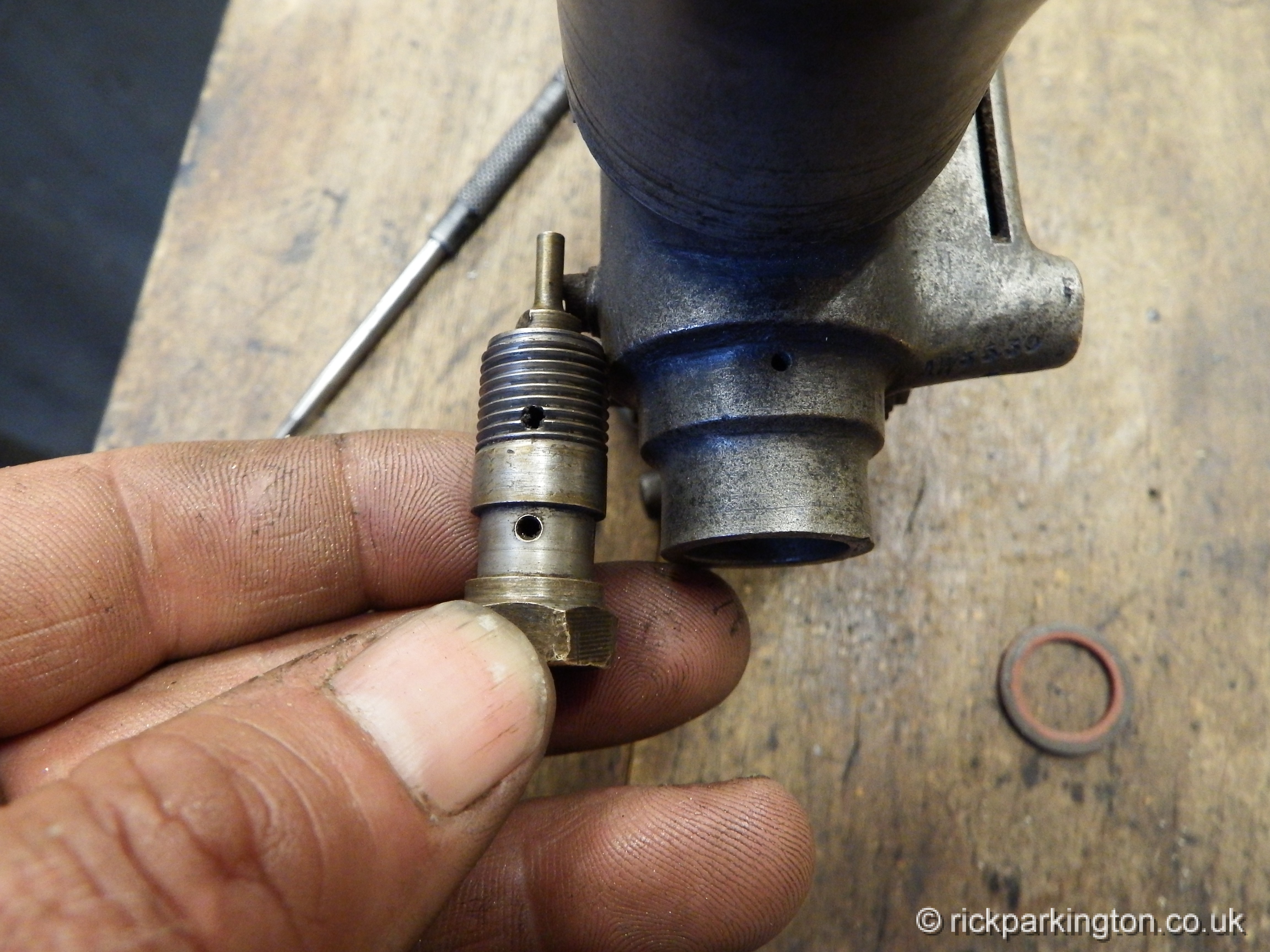
…and they match up with the upper holes seen here in the jet holder. Clearly these holes need to be situated above the normal level of fuel in the carb so if Andy is getting fuel leakage from here it suggests the fuel level is too high.
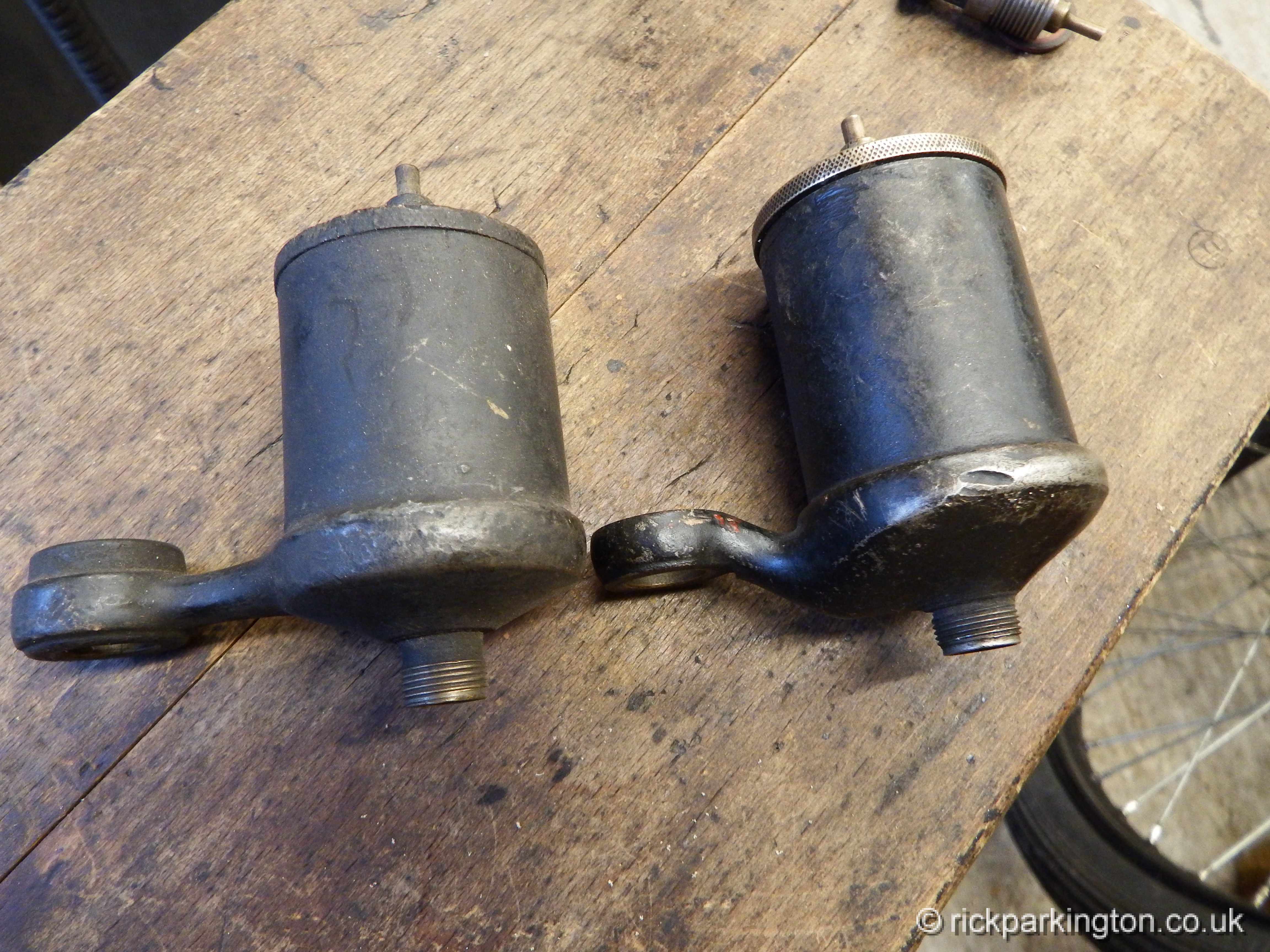
On an AMAC, I would wonder if the wrong float chamber is fitted. The one on the right is a TT type, its bowl sits lower in relation to the mounting compared to the one on the left. It’s also not unusual to find a float or needle from another make or model of carb fitted, which is all very well if you realise it’s wrong but with scant information and very little direct experience available – you’re not going to get far asking your local bike shop – it’s a potential minefield.

Here’s a good example; the needle on the right is a proper AMAC one, it has a wide groove to accept the funny shaped needle clip. The needle on the left is the one fitted in my carb; it’s am AMAL one with a thin groove which has been roughly filed to take the clip. Luckily, having an original – although worn – needle allows me to check the groove is in the right place.
As it turned out, Andy did the sensible thing and went back to the old carb. That had caught fire in the past and comparing the two, he found that the float height was much higher on the old carb, causing that one to leak too, a spitback on kickover had ignitied the surplus causing the fire. He altered the float setting and fitted the old carb whereupon the bike ran fine. Looking again at the TT carb Andy spotted that the float needle was slightly longer than the one on the other carb and could have meant the tickler was permanently slightly in operation. After filing a bit off the needle he was able to reinstate the TT carb and the bike still started and ran well. Job done, but there’s a moral to this story which is never to asssume that the bits fitted are the right ones… There are a few little reprint carburetter booklets about and some of them have scale illustrations of needles that will help spot the rogue. Remember, these are seas rich in Red Herring!
Cheers Rick
Hadn’t realised that the pilot screw on a TT worked in reverse? That’ll explain some of my head-scratching…I fitted a 15/25 to my Sunbeam a few months ago, a bit OTT for a sidevalve but couldn’t resist..
Thanks for passing on my details to Gavin, us tatty flathead riders need to stick together !
Just the thread…I have just bought an AMAC on ebay…CAVEAT EMPTOR!
All supposed to be there but when I opened it up…no needle. Where can I obtain –
“There are a few little reprint carburetter booklets about and some of them have scale illustrations of needles that will help spot the rogue” – please?
Aha, good question Jon, well I know you can get a copy from Elk Promotions PO Box 85, New Romney, Kent, TN28 9BE http://www.elk-promotions.co.uk I have one right here. Part number 23AM1 it is an Amalgamated carburetters Ltd book covering the individual companies that amalgamated (Amac, Binks and B & B from 1923 t0 1930.
Bering in mind that a ot of AMACs don’t have a needle… but you’ll know because the needleless AMACs don’t have a hole in the slide to fit one either.
Cheers Rick
Did a club run yesterday on my BSA L23 with Amac carb and I was struggling to get the mixture right with the two slides. Running up to about 30mph was fine but as I tried to increase the speed the bike started spitting and back firing to the point where no amount of slide fiddling would improve matters. I found that the inner slide required very little movement from tick over with the outer slide creating the acceleration. Can you advise on the best set up/operation for the Amac carb please?
Hi Steve,
Sounds like I’d better do a new post…
Coming right up!
Cheers Rick
Hi I have a 1927 Model 21 Side valve 500cc Raleigh and the Carby should be a is a Amac Type 25 N.Y.F.J and I was wondering where I can find one
Also looking for a mechanical oil pump for same or a drawing of parts with measurements so as I can get one made or some pump that would work
Thanks Colin [Australia]
Hi Colin,
No easy answers to this one I’m afraid. AMAC carbs, especially in the bigger sizes, are not easy to find anywhere. These days all brass carbs are perceivedas valuable and tend to go on Ebay when they are for sale. In the short term a post war type 6 arb is probably your best bet, from a Norton 16H or similar.
Pumps can be aproblem too. NOt sure what was fitted to the Raleigh but most were made with cast Mazak bodies, a high zinc aluminium that is good for fine die casting but severely corrosion prone and becomes crumbly with age. Consequently it isn’t easy to find these in good condition either. Jiri Horice’s Czech company Vintage Replica (www.vintage-replica.cz) make a copy of the Best and Lloyd pump with a stronger brass body. I haven’t used one myself by Jiri’s stuff is usually very good quality and reasonably priced. The other option is a Pilgrim pump which are the most common, variations of which were still in use on Speddway engines into the 1970s.
Cheers Rick
Hi Rick,
In reference to your post on Amac & Amal float needle clips, i have had a number of the Amac type made to the original pattern.
Regards Joe.
Hi Joe, well worth knowing. If anyone needs one, contact me and I will pass on Joe’s details.
R
Hi Rick,
Have only just found this post and am in dire need of a clip if it’s not too late!
Regards, Pat H.
Pat, Joe sells on ebayUK. His seller name is b561. He makes some great stuff!
Please pass on Joe’s email address as I can’t find him on eBay and want to buy some AMAC spares
Hello Richard, yes Joe’s address is Joe.kickstart@ntlworld.com
Cheers Rick
Hi Rick,
Wonder if you can help, I’m trying to restore a 1926 racing machine with a V11B 350cc villiers engine, however I’m struggling to find a carb that will work, I’ve Been told a AMAC TYPE 15 HYDM will fit but I haven’t been able to find one, can you tell me is there an equivalent I can use that’s easier to get hold of? Or where I can find a AMAC TYPE 15 HYDM
Cheers Colin
Hi Colin,
Unfortunately the 15 size AMAC is the ‘big one’ suited for 500cc 4 strokes making it hard to find and expensive.
In the short term it would probably make sense to go for a type 6, clip fitting Amal which depending on stub size should be fairly easy to obtain – especially a zinc (rather than brass) one. I have been using 16H Norton carbs on the BSA flat tankers I’m trying to revive 276AE type; these have a 1 1/ 8” stub and only slightly smaller choke bore. If you get one of these, the parts availability makes it easy to tune the engine so you will know what to expect when an AMAC eventually turns up; this is an advantage as with vintage engines you never know if the carb is wrong or you are just expecting too much!
Sorry not to be more help!
Cheers Rick
Ref Fuel leaking from the little holes in TT carb body. I have nailed it.
1. Remove the float chamber lid/
2. Carefully lift the Aluminium component off the float and centre spindle.
3. You wil find a lovely ring machined into the conical section.
4. Its not meant to have it. Its wear.
5. Place it in the chuck of a hand held battery drill and with it running hold the conical portion against a piece of medium then fine emery cloth/paper keep moving while running until the ring is removed and the area is satin.
6. Reassemble.and job done. Simples init 🙂 Took me nearly two days messing around to finally discover and fix it.
Hi Philip,
Yes good point and a neat way to fix it!
I guess that’s an Amal TT rather than an Amac? I don’t think I’ve seen those alloy float needles on vintage carbs, only later later racing carbs. I
guess there are two potential problems here, one is that the ridge may prevent the float needle from sealing correctly – which I guess was your problem – the other is that it will enable the needle to sit slightly higher in the jet, which effectively raises the float height. This won’t have been your problem because by smoothing it you have reduced the taper to the level of the wear so the needle will remain in the higher position. It’s only a small amount but float height is supposed to put the fuel just below the top of the needle jet in the mixing chamber so if it’s already a bit on the high side a worn needle could cause overflowing.
Thanks for passing that on
Cheers Rick
Hi Rick, I have just aquired an Amac 15HYDM type carb with a large bell mouth brazed on then machined. a friend of mine has one that has 3 1/2 OH stamped on it and he claimes it is a TT.I also spoke to a guy in NZ last year who also claimed it was an Early TT.
Are you familiar with this type?
Regards Joe.
HI Joe, yes that sounds like what I believe was the original TT Amac from 1923 – before it was called a TT and acquired the external air control. This has been a stupidly busy few months but maybe I should do a post on Amac track carbs and put up some photos. Nice find and pretty rare I’d guess!
Cheers Rick
Hi Rick,
Many thanks, That is more than good enough for me,i appreciate you taking the time to help.
I found it on ebay of all places. look forward
to an article on track carbs.
Once again thank you for your time.
Hi. I’m just beginning the restoration of a 1951 Jonghi 125cc E type twin port The carb fitted is a Amac 923 (25mm manifold). There was no needle jet when I took the carb apart, I read on here somewhere at some Amac carbs were not fitted with a needle and it should be easy to tell if it doesn’t require a needle as there would be no place or position for the needle to fit into. This isn’t very clear to me whether mine should or shouldn’t have a needle
– do you or know of any where I may be able to find out ? Any info about this carb would be great.
Many thanks. Cheers Clive
Hi Clive,
Yes that’s a bit mysterious. The needle-less AMACs date back to the 1920s. AMAC were absorbed into Amal in 1928 so they didn’t really exist in 1951 and I guess the name was used for export products in some way. Also AMAC used letters, rather than numbers for identification -eg HYDM so 923 doesn’t relate and it doesn’t sond like a 20s carb that’s ended up on your bike. I had a look in the Amal fittings list for 1940to 1954 and there’s no mention of Jonghi in there – or a 923 carb, I guess with Johngi not being imported here there was no reason to include it although there are other unlikely European bikes fitted with Amal carbs listed. I think the Vintage MCC library has some of Amal’s old paperwork so it may be worth trying them or Burlen Fuel Systems, who took over the Amal name. Sorry not to be any more help! cheers Rick
Hi Rick I have a Rudge 500cc 1926 fitted with a 1/32″
15TT25 carb. When engine runs at low speed the
spark plug is a lovely colour but open it up
the plug soot’s up. original main jet was No. 48
now No. 44 but still the same. Should I use
a smaller jet and if so what size please.
Cheers
Andy
Hi Andy,
Yes, a smaller jet might be the answer. My 1927 350cc Rex Acme has a 15TT25 and is running a 39 main jet. On that bike it runs pretty well on the road but for flat out track use I find it is a bit quicker flat out with the ‘choke’ shut, but when I tried a larger jet it was too rich lower down. 39 is about 150, 44’s more like 180 so quite a big difference.
It’s also likely that, being a fuel rather than air screw, pilot adjustment will affect more than tickover although if the bike runs well at low speed that’s probably not the issue.
Hope this helps
Cheers Rick
Hi Rick,
I have a 1950 Monet Goyon R4, 250cc OHV four stroke. Its specs say it came with an AMAC 6/015 carb. Right now my bike has a Mikuni carb on it and I want to find a period one. I assume the AMAC 6 is equivalent to the AMAL 6 and AM=AL 276, more or less. What does the 015 refer to? What is the AMAL equivalent. I should also mention the original had a horizontal mixing chamber. There isn’t room for a vertical 276.
Thanks,
Greg
HI RICK,I HAVE RECENTLY AQUIRED 1928 BSA SPORTS IT CAME WITH A AMAC BRASS CARB NUMBER 5/015 WITH A VERTICAL STUD FITTING I THINK IT MIGHT BE OFF A CAR I ANY INFORMTION WOULD BE WELCOMBE,PS I NOW HAVE THE RIGHT CARB FOR BSA,MANY THANKS Dale