
This is a rather long story and if you have no interest in BSA Gold Stars you might be better off going back to browsing Ebay. Below is the full, uncensored story of my life with BSA’s most celebrated single and I decided to post it here is partly because anyone trying to get on with a Goldie for the first time might find it useful and partly because I think it’s a sort of testament to something, maybe a record of building unfamiliar bikes from scratch in pre-internet times when all your knowledge came from old books and magazines and you had actively to seek out people to answer your questions instead of finding them all lined up on here like a row of wise monkeys. Besides it’s too long to go in the My Bikes section! Whatever, if you have time to read it I hope you enjoy it.
.
Who has never fancied a Gold Star? When I was a schoolkid I remember looking at the restored Goldie in Maidstone Honda dealer Paul Smart’s showroom. By the time I was riding on the road and obsessed with the Rocker era and the 59 Club, it was my dream bike. ’61 Bonnies didn’t do it for me, one Triumph twin is very like another, it had to be a Goldie. But they were too much money, I didn’t have it and even if I had, spending that much would spoil it. I wanted a fast cafe racer not an investment that I daren’t rev too hard. In 1984, I was just about to turn twenty when I got a job in the Parts Dept of Paul’s shop; the Goldie had gone but poking about in dusty corners I found that there were odd boxes of Gold Star bits left over from the restoration. It was mostly odds and ends but there was some nice stuff; a lovely Taylor Dow alloy tank, a Superleggera fork yoke, alloy engine plates, bits of an RRT2 gearbox, a set of A65 double damped forks and loads of fiddly little bits and bobs. Then a few years later, digging about in the shop’s offsite store, I spotted a BSA frame and was surprised to find a CB32 prefix, meaning that it was a genuine Goldie.
But there was no engine or any major parts. I had a couple of bits my uncle had given me – a rocker box (missing the exhaust rocker) and a GP carb – but assuming I could buy these bits, would it be possible to get the rest? There was a Goldie engine advertised in CB at the time for £1750: scary stuff so I decided to ring George Prew to see if he thought building a bike from bits was practical. He said it was well worth getting the frame but also told me he had already bought that engine and not only had it cost him another £250 to secure it, he’d had to spend £400 on cylinder head repairs. This was well out of my depth but it spurred me to negotiate for the bits at work. I ended up doing a swap for my Honda TL125 trials bike; my boss Roy Francis was building up a collection of trials Hondas so everyone was happy.

March 1990, BSA Gold Star project as acquired.
The engine was clearly going to be a problem but soon after, I saw a Goldie replica (B 31 frame/Goldie engine) advertised locally for a reasonable price. Maybe I could just swap frames and turn it into a genuine Goldie. I went to have a look and it was very pretty but the engine was a monster. It was an ex grass-track motor, early ZB bottom end with a DBD top with the fins all sawn off! The vendor told me that repro heads and barrels were available to sort it but when I thought about it I realised it was a bad idea. I only really needed an engine, by the time I’d bought a repro head and barrel and found the right bottom end all I’d have left was the rocker box and I’d got one of them already… So what about these repro parts? I started to wonder what else was available. Looking in the comics, it turned out that ‘Britain’s Gold Star Service’, formerly run by Ken Gardner and sort of the last knockings of the Eddie Dow concern, was now part of Chris Williams’ Autocycle Empire in the West Midlands. I rang Chris and asked him how feasible it would be to construct a complete engine entirely from repro parts – and how much it might cost. He told me nobody had done it before but there was no reason why it shouldn’t work. Heads were not currently in production but were on their way and most of the rest was already available, barrel, crankcases, crank… The crankshaft is the Goldie’s Achilles heel, a riveted up thing derived from the 1920s engines. Chris had liaised with Alpha bearings to produce a greatly improved pressed-up (not riveted) crank using a Jawa speedway-derived, needle-roller big end. The crank I think was £500 and having just been offered a completely clapped out (although allegedly ‘ex-Al Gunter’) crank for £350, this didn’t seem untoward. The barrel was £195, crankcases a further £500. With the parts I already had it looked like I could build a new and improved engine for the £2000 George Prew had paid for that knackered original. It seemed to make a lot of sense. I converted my life savings into a building society cheque and posted it off to Chris.

Alpha BSA Gold Star Crank. A thing of beauty
At the time, I looked up the Honda prices for similar XBR 500 items and found they were much the same. These were the days when the overall opinion was that ‘60s bits should be 60s prices’ which was pretty stupid and made life difficult for people to make new parts of any quality and of course the same crowd were first to complain that ‘all the pattern bits were rubbish…’ But it seemed to me that to be able to sell limited production Goldie parts for the same price as a current Honda equivalent was good going.
I made a bit of a mistake when I compiled my parts order. When building a Gold Star from bits the first thing you need is a parts book. The second thing you need is another parts book. The first for a Goldie, the second for a B31. I didn’t realise that many of the ‘Gold Star’ parts I ordered were all straight B31 bits, Chris didn’t take advantage but some would have charged Gold Star prices.
The heads were ready in time for me to pick mine up at the Brands Hatch Festival of 1000 bikes in 1994. I also wandered over to the Gold Star owners club, thinking I should join but to be honest I was disappointed. I asked a couple of questions but received rather dismissive answers. Something bad seems to happen when people sit in deckchairs inside a gazebo, maybe it’s a territorial thing but it afflicts most clubs and makes the public image very unwelcoming. But worse than that, with £550 of my savings converted into a Goldie cylinder head, I looked at the row of identical, immaculate, glittering Goldies and to my horror realised that I didn’t actually like them or want one. They were too showy, like a Rockola juke box or a Cadillac, I’d been dreaming of the bikes I saw in the ‘Rockers!’ book or 1960s copies of Motor Cycle Mechanics. I wanted the Ton-up experience not a Solvol Autosol habit! It may sound silly but it was what my mate Richard calls ‘Buyer’s Remorse’ and I felt pretty despondent until I spotted this very period 350 for sale in the car park which restored my faith.
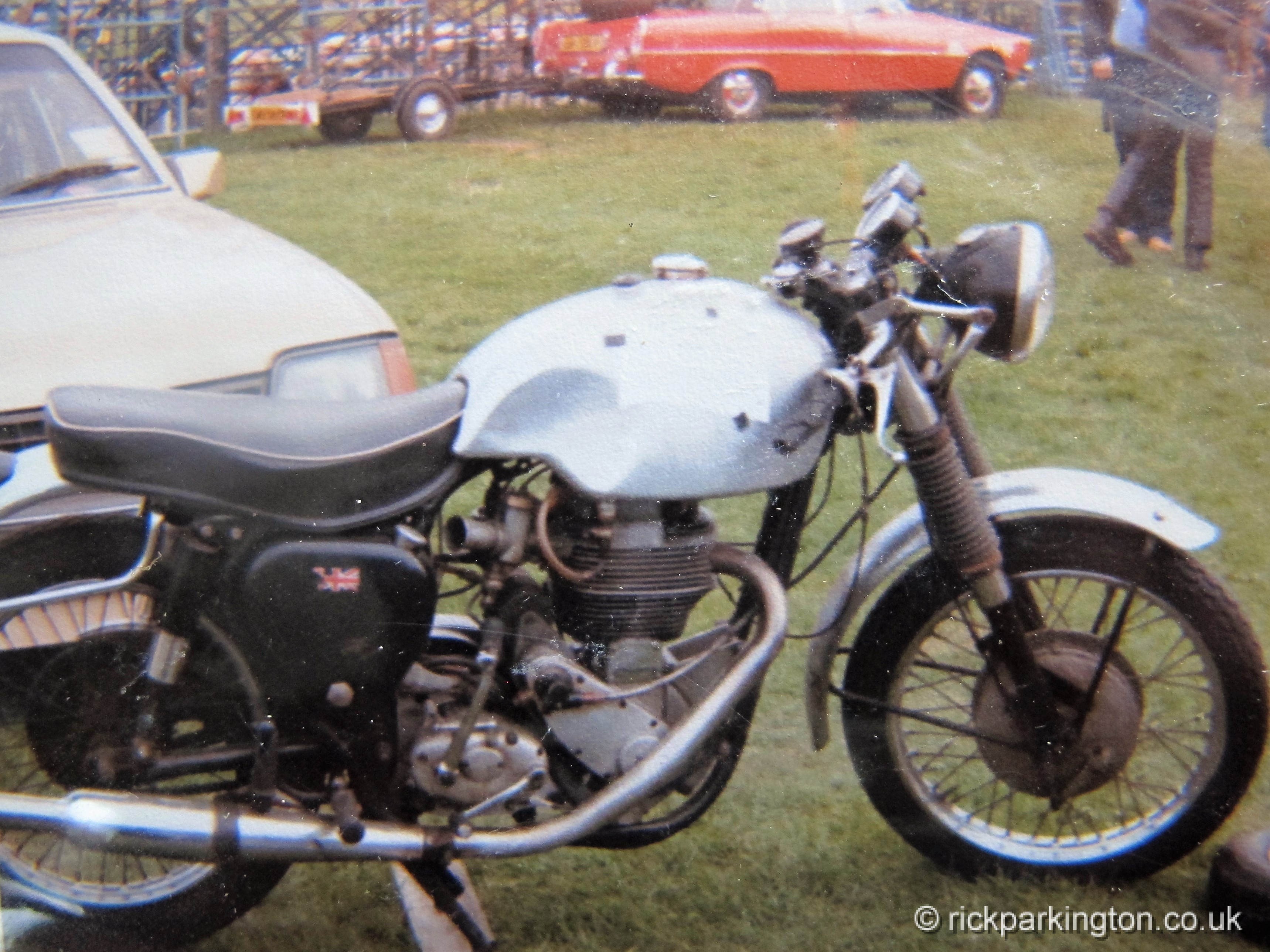
I put the engine together in Kent, shortly before the major interruption of moving to Scotland, and it wasn’t until 1995 that the bike was finished.

Beginning the build in my tidy ‘study’
Come the time to try firing it up, it made a horrible ringing/scraping noise from the barrel, a bit like the film sound effect when somebody draws a sword from its scabbard. Squirting oil in the plug hole made no difference but it didn’t seem to be ‘tight’ and after running it a few times round the block I began to wonder if the noise was coming from the crank shock absorber (I’d never had a bike with one before) or if it was simply the noise of running in with a very acoustic big fin barrel. After a couple of hundred miles the noise hadn’t stopped so I lifted the head. Not good. A big score in the liner: the end was missing from one half of the 2 piece oil ring and the broken end was the aggressor. It was now a couple of years since I’d built the engine but I did recall something odd about the ring when I fitted it. Since there had been no broken off bit in the box I think I’d assumed it was part of the design and unwittingly fitted a ring with a bit broken off the end. Idiot; what do they say about making assumptions?

Starting to look like a bike…
So I honed out the score with one of those three stone cylinder de-glazers but back together with new rings, it was a bit smoky and stayed that way. Pulling it apart again I found the ring gap was greater in the middle of the stroke than top and bottom. With honing, you pass the middle twice for each time you reach the ends so you need to pause there to accommodate. I’d made the bore barrel-shaped causing the rings to ‘pump’. I’m told those hones cause a lot of problems in inexpert hands; this time I took the barrel for professional honing after which all was well – and there was enough bore clearance not to fear seizures…
Performance was a bit disappointing though, after running-in the bike felt a bit stifled but admittedly the silencer fitted was an autojumble buy and was pretty muted. A mate gave me a tatty (and baffle free) Goldie silencer and it went much better. Everything was at last making sense. Now, you remember I said the exhaust rocker was missing from my rocker box? Well back then rockers were unavailable (I did pick up a NOS one for £2(!) at an autojumble but it was another inlet) To get around it I found B33 rockers will fit but since they have a ball, not cupped, end for the pushrod I needed to swap the pushrod ends to suit. The modified pushrod was slightly short to get the right clearance with the eccentric spindle adjustment so I packed the end cap with a couple of tiny washers. I wasn’t sure how well these would wear so instead of riveting the cap back in place I left it loose so I could replace them – it couldn’t fall off.

Early days. Blued chrome highlights restrictive silencer baffles.
Gradually the bike got better, although it was temperamental and I was on a big learning curve with the GP. Nonetheless it became my daily bike and I loved it. It also went pretty well… One day on the Edinburgh City bypass I was chasing a guy on a modern Triumph triple, caught him on a roundabout and as we both wound up on the exit the Goldie kept with him very well until BANG! Flat out in third something bad happened. I rolled over to the hard shoulder with no compression. Back at the ranch I found the exhaust valve had bitten a mighty chunk out of the piston.
But why did it happen? As I picked up the pushrod, the cap fell off and as I pressed it back home there was a squelching noise. Ah…being the bottom cap, it sits in oil and was sucking some in that it couldn’t squeeze out quickly enough at high revs. To my cost I had inadvertently made my own hydraulic tappet! Around this time I changed the alloy tank for a standard steel one from an A10. For some reason the Goldie didn’t seem to handle as well as my A10 had done and the tank, pretty though it was, sat much higher on the tunnel than a standard one and made the bike feel ungainly .
At Stafford Show I got in early and picked up a complete rocker box for £125; it seemed a lot just to get the rocker I needed but later that day I heard a delaer had paid £250 for one. I learned that things don’t have to be cheap to be bargains..
That got rid of the dodgy pushrod. With a new piston fitted the bike was going well and I went back to trying to sort the carburetion. This is a bit of an issue on a Goldie. Thing is, near home there was a good and fairly quiet long straight but to check the carb properly you have to be going well over the speed limit and that means making a lot of noise on a Gold Star. More than one or two passes is likely to mean somebody ‘phones the law. But meddling with the carb on one of these can also make it refuse to start or irretrievably soil a plug so you don’t want to be doing carb tuning in some deserted outpost. I used to regard our late summer Lothian and Borders Classic Club ‘Dam Bike Run’ around the dams and reservoirs of southern Scotland as the pre-Manx fettling run and this year something interesting happened. Part way round, my battered silencer broke in half. This left the bike on a short mega and turned it into a complete maniac. It was staggeringly fast. The megaphone effect meant it spluttered and coughed between 40 and 80 but once you got to 80 it just took off and didn’t stop. Now I knew why Gold Stars were legendary. More importantly, this indicated that the fault was in the carburetion, too rich presumably if it ran so much better without a silencer. So for the 1999 Manx GP, I took a pocket full of jets and looked forward to a week of carb tuning on that wonderful Island where going fast and making noise is all accepted as part of the fun.

Away out on the Mountain. At The Bungalow 1998
Unfortunately the fun didn’t last long. We arrived Saturday and on Sunday night we were all having a bit of a dice coming back to Douglas from Peel and – again at peak revs – the Goldie went very sick, smoking like hell. I limped back to the digs. No compression again. In the light and shelter of the supermarket multi-storey I stripped the top end. A burr around the piston crown revealed it had been touching the head and had finally transmitted the blow through the rings to the ring lands which had completely collapsed on one side. A replacement piston arrived on Friday morning, or last day, and after enjoying my afternoon on the bike we all rode over to Peel for a final meal of the holiday. When we came to go would you believe I had a nail in my back tyre! My mate Peter kindly rode back to Douglas get my spare tube so I could fit that and ride home to Scotland.
Back home I decided to check my car park rebuild and disaster struck. I thought I could detect some play in the big end and from there it got worse. The cams and followers were badly worn and when I separated the cases I found the outer race of the timing side main bearing had blued and cracked and the timing side crankcase had a crack from main bearing to camshaft spindle.I rang Chris Williams to see what he made of it all. “What end float did you have on the crank?” he asked. Er…what? It doesn’t mention end float in the BSA manual, I just assumed that since it turned beautifully freely when assembled, that it would be okay… “You need 3 thou.” Was his reply. He also thought the other wear was probably due to the cheapish oil I was using. Now what? My mate Derek Coghill came to the rescue. He turned me out a set of M33 cases and luckily for me the Goldie timing side is more or less standard BSA single – it’s the drive side that’s substantially different, reinforced with a larger bearing. But would the cases pair up?
This time I rebuilt the engine referring to Phil Irving’s ‘Tuning for Speed’ rather than the rather basic BSA handbook/manual. Ah yes, 3 thou end float says Phil. But he also said when mating different cases, make up a mandrel to represent the crank, ie a bar with ends concentrically turned to match the main bearings. Then fit it in place of the crank and tighten everything up. You’ll feel any tightness much easier with that than with the weight of the flywheels helping it roll along. This checked out fine. The cylinder base was very close too, needing only a few thou taken off with an oilstone. The mag platform needed machining to level up and I did this on the work’s Bridgeport mill. I was impressed that one case made in 1951 aligned so closely with another made in 1990. One bonus, the new case had ‘feed’ and ‘return’ cast into the oilways, it had always been a disappointment that this was missing from the repro case.
I did a few other Irving mods, making a couple of dowel bolts to aid rigidity etc, spoke to a laser cutting contact to get a 0.020” cylinder base shim cut to relieve the piston clearance problem and put it all back together.
But once back together and run in, it didn’t seem to go anything like so well. At first I blamed the new silencer I’d fitted after the Dam Bike Run. Due to the Isle of Man blow up I hadn’t really had much chance to open up since the megaphone incident. I made the daring move of fitting the absurdly loud mega and going for a risky test ride on the local straight but no, something had changed; the bike felt ‘flat’ – like the valve timing was out. Checking the openings with a degree disc they seemed to be quite a way out even though Chris Williams said they were made to BSA diagrams and anyway a few degrees here or there would make no odds. I wasn’t happy with this. In Arthur Lupton’s book ‘Goldie’ he tells how one member of the team (Roland Pike, presumably) became obsessed with perfecting cam timing. I couldn’t see him being happy with this sort of discrepancy.
At a local jumble I spotted a second hand but unworn DBD inlet cam in a box of bits. Fitting it, I found it timed up on the dot, which seemed to prove my point and even with the dodgy exhaust cam the power was much better. But it still wasn’t quite as good as before so I was delighted to pick up an exhaust cam at Stafford a while later. That opened spot on too. But strangely, when I next got a chance to open the bike up, I had a feeling the power wasn’t so good. Maybe I should go back to the carburetion.
The loose bore meant it was no surprise that the plug was always black but with fuel or oil? The bike had always seemed too rich but weakening the main jet from standard just made the engine ‘pink’. At about £30 quid a go I wasn’t keen to start buying slides of every cutaway but I bought a new standard one and then began cutting back my original to see what happened. Trouble is the old one was badly worn so it wasn’t a direct comparison. I noticed that I had accidentally set the float height about 5/ 16” lower than it should have been and although, strangely, that appeared to have no effect on the overall mixture, it certainly improved starting which was now reliably one or two kicks, hot or cold. I’d never had the expected trouble with tick-over; using the friction adjuster on the throttle (there’s no throttle stop screw on a GP) it would always tick-over reliably under 1000 revs and sing the pilot screw you could weaken it down to 500rpm but at the expense of a clean pick-up.
The needle and jet is the main governor of everyday riding and it seemed moving mine up and down made little or no difference, I felt I wanted a couple of extra grooves in the needle and I found that GP, Concentric and Monobloc needles all have the ‘jet’ (restricted) portion at different levels, if you modify the spray tubes to the same heights you can effectively move the jet in relation to the needle groove. What’s more, a 376 Monobloc needle has a very similar taper but starting higher for the same overall length. Crazy as it sounds, by mixing and matching I found I could create over 20 consecutive needle positions! But it didn’t solve my problem.
So what about float height? It was such a faff to adjust; wouldn’t it be great if I could alter it as I rode along… Then I could take the bike up the motorway instead of all these short hops up and down that were annoying the neighbours. I spent ages making a cable operated doofer that raised or lowered the float from the handlebar but again, I didn’t really learn anything from it.
I fitted a 1000 series Concentirc for a while just to try a completely different carb, it had occurred to me that maybe my GP had been modified, that’s the trouble with the Goldie’s 65mm stud centres and 1.5″ choke, you can’t just swap carbs with another of your bikes. Again it made no appreciable difference and made me ever more sure this was an engine problem.
In 2005 I rode the Goldie to the International West Kent Run from Edinburgh,on the way I holed the piston chasing a TVR down the fast lane of the A1M at a steady 85. I had a spare with me – the Isle of Man incident had taught me that you can borrow tools, a workshop or a bed for the night but you’re best taking your own spares…
Replacing the piston took three hours and would have been quicker were it not for the amount of people who pulled up to see what was going on. If that sounds a bit flash, bear in mind the Gold Star is a very easy engine to work on – racers have to be. First time I took the head off I couldn’t believe how difficult it was to remove the rocker box with all those stupid studs! I slotted the ends to make it easier in future and noticed the manual kept pretty quiet about it. Later I learned my mistake, the rocker box comes off with the head, there’s no need to remove it first. Anyway as I was wiping my hands an old Sarf London type chap pulled over and asked what was wrong. When I handed him the old piston he said, “You ain’t chainged a faaaaakin’ piston, ave yer?!”
The piston was a GPM and there was a crack from crown to gudgeon pin that had simple begun to burn. The verdict was that it was a casting ‘hot fault’ that had caused the crack before burning through, so at least this was not really the bike’s – or my – fault.
I rode home again, using a lot of oil; the replacement piston – a forged Omega – and its rings were second-hand, so when I got home I stripped it again and fitted a new set.
I had a couple more bizarre experiences for the record. Once almost home on the city bypass I came to a 50mph restriction slowed down and retarded the ignition slightly, the bike coughed. Bad sign, the more I retarded the spark the more it misfired until eventually it cut out at anything less than full advance. This is generally a sure sign of magneto failure, damn. I pulled over at a mate’s and pulled out the plug. Sure enough, no spark…er, come to that no electrode! The tip had burned completely off an N4G platinum tipped Champion plug! I guess it needed an N3! I banged the earth electrode against the wall to shut the gap and it fired first kick and ran fine.
On another occasion I completely lost drive riding in traffic. It hadn’t jumped into neutral and the chain was still on…but as I freewheeled slower with the engine revving impotently suddenly it leapt forward again. I realised the clutch had jumped off its taper and somehow re-seated itself on the taper, very odd. Investigating I found a curious problem. When I built the bike I fitted a 4 spring Triumph clutch. To do this you need an adapter that used to be available from Eddie Dow, I got mine from Chris Williams. But I could see that my clutch sprocket teeth were worn on one side. The clutch clearly stuck out further than the engine sprocket so I guess the misaligned chain had reeled the clutch back inward until friction stuck it back on the taper. I had never thought to check the chain line when I fitted it – it was all standard stuff (assuming again).
Chris’ adapter must be wrong…but the difference was at least 1/8” and I couldn’t see how it could be made any differently, there’s not enough material in it. Then somebody gave me an original and it was identical. To make it work you’d need to space out the engine sprocket by nearly 1/ 4″ which would make the crankshaft shock absorber spring virtually coil bound. Thinking about it I realised what was wrong: the Triumph clutch was fitted to late twins and singles and the adapter is, in fact, a factory BSA part. However, the chain line on an A10 is different to a single. Twins have a small, maybe 3/16” spacer where the chaincase lug bolts to the frame gusset that is not found on a single because the twin engine is wider. The clutch adapter pushes the clutch out to suit the A10 chain line not the single’s. The only singles fitted as standard with the Triumph clutch were the alternator models which don’t have the engine shaft shock absorber so this adapter can never have been any good. Writing this, it occurs to me that I could have spaced out the sprocket and replaced the spring with a spacer, locked up solid because there’s already a rubber shock absorber in the Triumph clutch; but I have never heard this said before, certainly not at the time. Interestingly, looking in my mid 60s Eddie Dow catalogue, the clutch adapter is listed for the twins but not the Goldie…
The next weird problem was another phantom compression loss, this time at traffic speeds with no nasty noises. Removing the tappet cover revealed the cause. On a BSA the round-footed tappets are offset to the cam lobe so that they rotate to spread wear. One of my tappet guides had worked loose and slowly followed the rotating tappet until it had unscrewed enough to hold the pushrod open. While it was easy to screw it back with a pair of pointed pliers to get home, it would require a top strip to tighten it fully. As a quick fix I made up extended bottom screws for the tappet cover that rest in the spanner flats to prevent the guides turning. This held until the next top strip – but I have left the extended screws in there ever since, just in case.
I did a deal for an RRT2 gearbox to replace my STD one but found it hopeless. With a passenger, it was impossible not to make a ridiculous racket pulling away in what’s laughably called ‘first’. I had a fair bit of BSA gearbox stuff at the time and found that you can fit a STD first in an RRT2 box as long as you also fit the third gear pair. That’s necessary because the dogs between the two are incompatible but the good news is that a STD third has the same number of teeth as RRT2 third. What you get is a first that is 30% higher than it would be in a standard box because it runs through the top gears (themselves a different ratio to standard) and is in fact the same internal ratio as a SCR scrambles first. I can recommend it, there’s a bit of a jump between 1st and 2nd but it’s nothing compared to the ability to pull away cleanly.
Around 2012 I got talking to someone steeped in Goldie lore who suggested the magneto might be the trouble and in fact it failed soon after, the original Bakelite slip ring proved to be ‘leaky’. Replacing it got the sparks back but made absolutely no difference to performance and to be frank I was starting to lose interest. Over nearly two decades the damn thing had only ever really gone brilliantly that one time on the megaphone. Since then I’d got more into pre-war bikes, first with the 1932 Sunbeam, then the Inter Norton and they just seemed so much more rewarding.
Last month I decided to have another go. Maybe with another 20 year’s experience under my belt, I would spot something I’d missed before. Incorrect valve timing really knocks the punch out of an engine and I was sure this was a timing issue. I set up the degree disc and rechecked it. As before I found the inlet was spot on. So too was the exhaust opening point…but it closed 15 degrees too early. Not sure I’d ever looked at that, assuming opening was the most important. But I had read in Tuning for Speed recently that the overlap is the most important part of the timing event and should be prioritised where there are inaccuracies. Overlap is the period when both valves are open at once – the exhaust still closing as the inlet begins to open.
It’s an idea that dates back to 1910 or so when Brooklands riders George Stanley and Victor Horsman accidentally mistimed the valves on George’s works Singer and found a power increase. Thinking about it they realised that the exiting gases helped suck in the inlet charge to create a kind of reverse supercharging effect. After that Stanley used to pop off the timing cover and remove the cams in the paddock in case anybody turned the engine over and noticed both valves open at once.
So was the loss of 15 degrees overlap a problem? I needed to compare it with the cams I had before but that was another problem. I’d sent the originals back to Chris for hardness testing when they wore and didn’t get them back. The replacement set I had sold on to a mate looking for cheap cams for a B33 project so I had no idea what figures I’d had before. I ordered another cam from Phil Pearson but even this turned out to be 10 degrees short, unfortunately he no longer supplies Vernier cams, which would at least allow me to adjust any discrepancy to the opening rather than closing point. Phil reported that he had no problem with them but it did occur to me that while racers probably use special cams, few road riders these days really thrash their Goldies so maybe nobody had noticed, seemed a bit far fetched though. I asked all sorts of people involved with Gold Stars and camshafts but couldn’t find anybody who could definitely say whether this was likely to be my problem and it seemed incredible that with a bike so popular, with so many experts, tuners and specialists, nobody could say if a 10 degree shortfall mattered! Digging through some old notes, result! I found an old bit of paper upon which I had written the timing figures of the last set of cams; remember I said I thought it had been better with just the exhaust cam from that pair? Well guess what, that cam opened way out but closed bang on 55 degrees. The plot was thickening…
But when I spoke to Jan de Jong at ABSAF he told me to check the peak lift occurred at opening midway point, conventional thinking on most engine – but contradicting Irving’s dictum that correct overlap was crucial. Moreover de Jong seemed certain that my 20 thou base shim was the problem, interfering with the cylcinder head ‘squish’.
 This was a new thought, after all the shim has been in it since the Isle of Man blow up when the problem appeared. I spoke to local tuner Ron Lewis who has done a bit with Goldies and he told me that the affected area is the base slope of the piston dome and its relationship to the combustion chamber, it exists to squeeze out any mixture lurking around the edge of the combustion space and fire it into the main arena and shouldn’t exceed around 40 thou. I put two pieces of 0.052” solder across the crown of the piston in an X form and replaced the head. After turning over, the solder was untouched so the gap was certainly too wide. I removed the shim and tried again. This time the solder got nipped at each end and measured 40-45 thou.

I’m going to wind up here because the next step is to find another way to keep the piston clear of the head, put it back together and try it. I’m still not happy with the valve timing but you should only fix one thing at a time.
I wonder how I will feel if this is the answer. I can’t see me riding the bike as hard as I used to now, I’ve had enough accidents over the years and am happy getting my kicks at 60 on a flat tanker. Even Ron Lewis suggested Goldies are better with Scrambles cams, although he also understood why I have to solve this problem. As far as I’m concerned this long story won’t be over until my Gold Star goes like a Gold Star. I’ll keep you posted…
Cheers Rick
Blimey Rick, I know you’ve had issues but flippin eck …… when I raced with the crmc there are a few people who campaigned them, I’d be trying to have a word with some of them
Hi Rick, thanks for sharing your Goldie experiences. I’ve trodden a similar path. Just like you I wanted to have an ‘authentic’ used looking Goldie. I Bought a ’54 one fitted with a B31 motor something like 10 years ago. A couple of years later I found a CB32 unit to drop in. Making it run well has been a constant struggle and it has slowly gotten closer to right as my engineering abilities have increased over the years. I’m feeling that the end is nearly in sight with mine. It’s nearly there. Hoping I like it when it is fully sorted, so far it has been a pig! A real love / hate relationship. Cheers, Richard
Gad to know I’m not the only one, Richard! I guess if I hadn’t had that moment when it all went right when the silencer broke I would have dismissed the bike as a bullshit myth long ago but knowing it can do it just drives you bonkers!
Keep the faith!
Cheers R
The Gold Star did go very well when it was going , but the fact you always carried a spare piston ‘just in case’ showed how much a work in progress it was. Maybe using the other half of the B33 cases that Derek gave you might solve the problem…….
Hardy ha-ha. I seem to remember picking up a Velocette that had a holed piston some years ago. People who live in black and gold houses shouldn’t throw stones!
That’s true, but who set the timing on the Velo in the first place……..
Best wishes
Raymond
Blimey that’s an obscure question all these years after; I don’t remember doing anything to it before the piston replacement but that sounds like an accusation, so maybe I’m wrong!?
Well, it was over 20 years ago, and I didn’t know one end of a magneto from another. I think it got set fully retarded instead of fully advanced and I was too dim to realise that the pinking wouldn’t just go away if I thrashed it harder. Mind you, the Venom still had piston you put in it, so that’s not bad going.
Oi, you two! Cut that oot!
A row of wise monkeys! You have a row of wise monkeys!? Where can we get some? My monkeys are dumb as dirt.
Maybe you’re just a better judge of monkeys, Johnny!
I’d forgotten about those crankcases. Did it replace the one with the circular dunt in it?
You neglect to mention that you fitted tyres to it that I’d rejected as not good enough for the M20…
Well, I only fitted them for the running in period, at least that was the plan. I ought to check, maybe they’re still on there!
How horribly familiar that tale is! I got my Goldie “cheap” in ’89 from Andy Tiernan & a right pile of s##te it was too! Shabby with a dented 2 gall’ catalina / scrambles tank in metallic red & reputed to have previously been owned by a US airman. You may remember it as we’ve met a few times- the 1st I think at the Manx in ’97 when you broke your leg… It originally had a very early “5 stud” CB32 motor but the frame was ’58. I eventually rebuilt & sold the motor & traded up to a DBD from a local guy in the GSOC which turned out to be ’58 as well. The troubles I’ve had with this bike… endless – a tale at least as long as yours! It could be a very pretty exhibit if I didn’t insist on riding it. The stuff I didn’t know when there was no interweb. I’ve been thru’ 1 original crank – now Pearson, pattern cylinder studs sheared & destroyed the barrel, pistons – at Monthlerey one cracked & holed exactly like yours & I didn’t have a spare.., several mag & dynamo “rebuilds”, all sorts of regulators, wiring looms etc. But when it ran well… fantastic. Tend to agree with Ron – I’ve got scrambles cams in it now which suit a std box. It gets a bit breathless at the top end but is nicer for day to day riding. I go racing for all that 7500 rpm stuff!
Hi Rob, yes of course I remember. Glad to know I’m not the only one! The annoying thing is they are such excellent bikes underneath it all. I often feel if I made mine into a tourer it would be a really capable bike for modern conditions, being designed for sustained high speed use, but I fear I would just end up with a slightly faster B33 and I’m not sure how well the huge ports – and the combustion generally – works with a detune. Besides without doubt they look best with clip-ons; although I also have considered going street scrambler instead, another look that really works…
Onward and upward!
Cheers R
Slow Replies R Us.
Yes, those big ports aren’t designed for pottering & made worse by a GP carb but a MK2 concentric helps it fuel a bit better, not least in starting… I read somewhere that the scrambles/motocross riders at the time complained the late big fins needed too many revs for mud plugging. But with scrambles cams it’s not too bad on the road, a bit more mid range.
Mine’s only ever had “ace” bars which are pretty comfortable but I’ve been thinking of trying some clip-ons on it for a lark. Probably “street scrambler” bars are the most practical (& trendy at the moment) for today’s traffic conditions but the Goldie isn’t really a practical or sensible bike. I can’t recommend a Catalina tank tho’, pretty tho’ it is; 2 galls is not enough for a 500 that is happiest being thrashed & guzzling fuel!
Winter rebuilds ahead. Just dragged all the mouldering parts out from under the bench, to fit the refreshed crank that’s been waiting patiently all year.
Last time I rode it I’d moved the dynamo out of gear as the battery was kaput. I had a great ride for an hour or so, got back & found the dynamo had vibrated back into gear, out of mesh, taking all the teeth off the mag fibre pinion. Typical. It was done up tight! So there’s another job to do…
Hi there, a really good read. I can really relate to your struggle, I’m just beginning my learning curve from the same books, and probably a lot less wise old people now than there were back then. in april this year I decided that I would finally build a big fin goldie engine from autojumble bits which I had been gathering over the last couple of years, in order to race it in a beginners flat track event called dirt quake at kings lynn. being a penniless part time mechanic, I too managed to build up the engine for about 2500 pounds, with almost all the parts being secondhand or home made, with the exception of new main bearings, a carillo rod, and an alpha big end from a b31, with home made bigger nuts. I did actually get a set of real dbd34 cases from Bob Light for 150 pounds but noticed the same crack between bearing and cam spindle, so I used a set of b31 cases. I bought a set of dbd flywheels for 30 pounds with horrific damage from a broken crank pin and managed to repair them but in the end decided to use b33 flywheels so that the shafts fitted the standard bearings and cases. I turned down the flywheels to clear the piston with the short rod, and also clear the head bolts when they are undone. At first I used an absaf Vernier cam and one copy of that made by Bob in Petersfield, powerful but the wear and noise in the timing case was horrific so I settled for some early zb scrambles cams, 2436 and 2438 I think, secondhand absaf followers and home made pushrods, running a 389 monobloc, with a small inlet port head, timing set to tdc at full retard with tight wire advance on an old mo1 and an original but rusty goldie silencer. the bike feels pretty darned quick compared to a b31/33 but whether it’s as fast as it should be I have no idea. I had 21t on the crank a standard gearbox and a sidecar 46t rear sprocket, the bike pulls very strong at 70 but feels like its revving too high. I too had the same triumph clutch problems with alignment, secondhand absaf 42 cams which didn’t time up properly. I balanced the crank as per tuning for speed, at 58% and it ran smooth. I covered about 200 miles on the road before I took the engine out of the swinging arm bike and put it into a 51 rigid b31 and raced it. the gearing was similar but the wide step in the early rigid box ratios meant the whole circuit was done in 2nd, unfortunately hitting valve bounce at the end of the straight, however the engine held together although it smoked during the race but not at normal road revs, so I suspect it needs a timed breather, and maybe the secondhand piston and rings in a worn old bore could be something to do with it. the valves and springs were in the head when I bought it, are original and the springs probably want changing which could increase its (unknown) peak revs just need to swap it all back into the swinging arm frame…
What an adventure! Well I liked watching and listening to Goldstars but only had enough for a B31 rigid from 1949.
That said and done I was fortunate to know pals that raced ‘Poorman’s Goldies’…aha! What does that mean? With the combination of a Bonneville piston,rebored cylinder,scrambler and touring cams,polished flywheels,polished inlet,a funky oversized exhaust valve and a 23 tooth egine sprocket….my little lamb grew teeth as sharp as a wolf!
Pointless asking me what goes where and how because this is my little secret recipe to outpace a Yamaha 1100,Kawasaki 1000,a Bonneville 850 with a Weslake head and a Norton Commando on any country road with corners and bumps….I always got to the pub first and they always asked,”Bloody ‘ell…what have you got in there!!!???”. I just sipped my Tetleys and said,”Mums the Word!”.
Reliability was the key word for me,so I got the performance,handling with the little rigid frame,and just pottered along peacefully until some flashy biker pulled up along side and began smirking at my old lady….she hates that,and so we just blew into the wind and never see them again!
A Wolf In Sheep’s Clothing is a great bike to have…better that than a Fancy Nancy that doesn’t go.
I might add that ‘Tuning For Speed did help with the choice of oils and making good clearances.
Happy Riding Rick!
What an adventure! Well I liked watching and listening to Gold-stars but only had enough for a B31 rigid from 1949.
That said and done I was fortunate to know pals that raced ‘Poor-man’s Goldies’…aha! What does that mean? With the combination of a Bonneville piston,re-bored cylinder,scrambler and touring cams,polished flywheels,polished inlet,a funky oversized exhaust valve and a 23 tooth engine sprocket….my little lamb grew teeth as sharp as a wolf!
Pointless asking me what goes where and how because this is my little secret recipe to outpace a Yamaha 1100,Kawasaki 1000,a Bonneville 850 with a Westlake head and a Norton Commando on any country road with corners and bumps….I always got to the pub first and they always asked,”Bloody ‘ell…what have you got in there!!!???”. I just sipped my beer and said,”Mums the Word!”.
Reliability was the key word for me,so I got the performance,handling with the little rigid frame,and just pottered along peacefully until some flashy biker pulled up along side and began smirking at my old lady….she hates that,and so we would just blow into the wind and never see them again!
A Wolf In Sheep’s Clothing is a great bike to have…better that than a Fancy Nancy that doesn’t go when you want her to go.
I might add that ‘Tuning For Speed did help with the choice of oils and making good clearances.
Thanks for sharing your adventures.
Happy Riding Rick!
Great story, Keverne!
Takes me back to ‘the War years’ – that is, back when those of us on British bikes were fighting a silent war with the Japanese, always trying to stay in front or get past a modern bike – especially if it had overtaken you!
Finally seem to be getting somewhere with my Goldie now but it’s been a long road!
Cheers Rick
For some reason or another I ended up buying gold. I’m not not too sure if it was the right decision but a year on I am still very keen to put the array of parts together which some day might resemble somthing that looks like the bike of my boyhood dreams. It’s a CB34 with oval crank and short stroke rod sounds cool but everything is shot. I probably should of bought the Vello Thruxton but not being an engineer opted for the everymans goldie. I will get to the point, the thing is I have had dozens of bikes over the years some better than others. I sold a perfectly good Norton to buy the ratty Goldie and the beeza keeps me awake at night and not in a good way. I love the bike though it’s become an extension of my own chalenges and I can’t wait to get back in the shed with it even though progress seems miles away yet. Cheers Rick you have encouraged me to challenge myself.
Hi John, yes it’s a difficult road… But there is definitely something special about a Gold Star. A friend of my Dad’s had the money to indulge his taste in E types and Lotuses but I rather liked the way that whenever he spoke about his Gold Star, he had the sort of shy smile and far away look that one associates with recalling a first love.
The mistake I made with mine was underestimating it. British bikes are simple and with a reasonable understanding of how they work it isn’t difficult to get them working well, but it’s a mistake to think of the Goldie as a ‘hot B31’, it is in a way but the development applied to extract the maximum power out of such a simple engine made it much less forgiving – and this isn’t really made clear in the workshop manual, which was after all written for people who had bought one new not somebody trying to piece one together from weary parts decades later! It was only talking to people involved in racing that revealed where I was going wrong; I imagined their knowledge was all about squeezing out the last drop of power but I think the Goldie needs to be spot on to go right on the road as well as the track. Because I am always careful about engine settings I thought that was good enough but it would never have dawned on me that a 20 thou base shim could make such a huge difference to the power.
So best of luck with it and give me a shout if you need advice!
Cheers Rick
Thanks for the reply Rick it makes sense what you say. I must add this though before my memmory fails me. After my previous message I remember a moment that our paths crossed it was a very brief moment at the old Bonhams auction which coincided with the Banbury run. We stood side by side looking over which I think was a 61 DBD, that was placed on a plynth in preparation for the Bonhams Stafford show. I commented that we never have enough to do do we. Anyways I won’t hold you up but thanks and I will most certainly seek your help if I get to out of my depth. Thanks John
Ah yes, that was the scruffy one wasn’t it? I know the person who bought that bike and he is planning to leave do a sympathetic rebuild – no doubt trying to steal my tattiest Gold Star title!
Cheers R
Great read, I’m enthusiastically about to dig into a rebuild of a 1946 b31 that I have just picked up, my first bike older than 1970 and 30 years older than me! I want it to blat around the twisty back roads of North Wales so am looking forward to my own journey and it will be ridden with enthusiasm once completed. What was the result of the reduced squish? Is there any words of wisdom in addition to the above as it’s not a goldie? Thanks for the book advice too
Good man, Nick. Well, the result of the reduced squish was positive; it definitely restored the fire in its belly however then the carburetion took centre stage. i had a go on a dyno at Enfield specialist Hitchcocks and then realised I hadn’t prepared adequately. Further carb effort saw it starting and running well low down but needing more effort at the top end, then winter, then last time I dragged it out it wouldn’t start (I think it’s sensitive to stale petrol). Trouble is with too many bikes there’s always something else crying out for attention so it has returned to the back of the queue – but hopefully there will be more to say before long.
Sadly it seems just becasue you make a great discovery doesn’t mean you have solved the case…
B31? Far superior. Clearly BSA made the Goldie simply to showcase how good the B31 and B33 were, once upon a time there was a tortoise and a hare…
A rigid B31 is a lovely bike – they are tuneable too; ‘touring’ Gold Star cams are often recommended to put a bit of pep in a B31’s stride and although the bottom end is weaker than the Goldie, with a 350 this is no problem. I think you will have a lot of fun with it while I am busy struggling with my lah-di-dah Goldie!
Cheers Rick
One would think that having had a goldie since 1976 that i would be up to speed with it , Noooo. Slack wire advance or tight wire. Bloody awful spit back. Retimed it with tight wire this time and transformed.
I do think the 350 with 10 degree advancer were sweeter though.
Good to know I’m not the only one who does things like that Dave! Glad you sorted it.
Cheers Rick
The above read was well worth missing game 4 of the World Series! I started reading 5 minutes before the start of the game and have yet to turn on the TV!
It looks like I will be in for an adventure as I have recently begun work on a 55DB Scrambler that I bought cheap 25 years ago from a friend who found it half buried next to a barn outside of Mule Shoe Texas.
This thing is more than raced into the ground it has been destroyed over the years as a desert sled with large overlay sprocket wielded over the stock rear sprocket, raced in S Calif. and ending up in an LA pawn shop. At some point years later the brother of the pawn shop owner moved the bike to Mule Shoe to beat around on eventually abandoning it along side his barn. When I bought the bike it had the GP carb head, with plenty of broken fins, locked up motor no fenders, straight pipe, mystery gas tank and plenty of rust and dents.
I recently began the journey of a thousand miles, by removing the engine from the frame and the head from the engine. I had to take a Dremel grinder to the piston and cut enough out to get a hacksaw blade inside it to cut slots in the rings which I then chiseled free of cylinder wall. Once opened up the internal components were akin to glorified scrap metal. The Rod was a rust ball and the timing side end of shaft had been pounded on bending the shaft out of true by 4 thou. The cases inside were peppered with pits from something letting go back in the day and where the mag sat loose in it’s clamp, jumping around, the rear cylinder fins were worn away by a 1/4 in. as was the base, shimmed up by several none effective flatten beer cans. All of the rocker and cam shafts are loose from wear and need replacement. The oil pump is shot as is everything clutch/gearbox wise and so it goes.
(If anyone knows if new shafts/pinions are available, tappets etc let me know).
I have sourced a decent scrambler head, I think its a 1 3/16 choke which I would like to pair with a 1 1/8 tt carb, if that makes any sense for building back the bike as a roadster with the std transmission ( anyone mess with the tt carb? I am all ears if there is info on setting this up, otherwise I guess a monobloc would be ok.
The big thing will be getting the mill and trans back in shape and this hinges on finding new parts. If this mile stone can be gotten to the rest of the bike should be less demanding until it becomes a running machine. Judging from Ricks piece and others, that when fun begins in a different level!
By the way if anyone happens to be in St. Louis Mo. Check out the bike muesum at Karl Donelson Cycle. Its crammed with dirt track / flat track racers from the Fifty’s and Sixty’s. There are several Gold Stars, an Aldana Norton, K model Harley’s etc. Nothing restored, as rigged and raced and mind blowing cool!
Wow! Looks like I’ve had it easy, Ernie! I’m just about to start on a scrambles Goldie for someone – similar story but nothing like so bad, this one turned up dismantled in a damp garage but looked worse than it was – the alloy was all furred up and water had got in to the timing chest but hadn’t done too much damage. The owner had died and his son in law was about to scrap the bike but luckily someone stopped him and I’ve got the job of rebuilding it.
As to your problems, one good thing with Gold Stars is that many parts are shared with the iron B31/B33 – things like cam spindles, oil pump and drive and the timing gear outrigger. Most other parts are available from specialist suppliers – although the guys I bought stuff from back in the 1990s are mostly all past retirement now so I suspect parts supply, particularly for the big items – will wind down, sooner or later so I’d start buying what you need now. I’m not sure how easy it is to get a new standard-type mainshaft for the crank. The crank is in theory the weak point of Goldies (see my ‘Starstruck’ post ) and it’s more usual to fit a newly made crankshaft than fit new shafts to old flywheels, partly because the large diameter flange on the shaft makes it costly to reproduce. Besides judging by the rest of your engine, the shaft/flywheel fit is probably compromised anyway making a new crank probably the best idea.
But good luck with it and if you need any advice along the way please get back in touch!
Cheers Rick