
Been a busy couple of weeks; after Stafford Show I spent a week driving around the country, work taking me as far north as Durham…
Which of course left me short of time to get prepared for the next event, which was the annual Ixion Run at Bexhill on Sea.
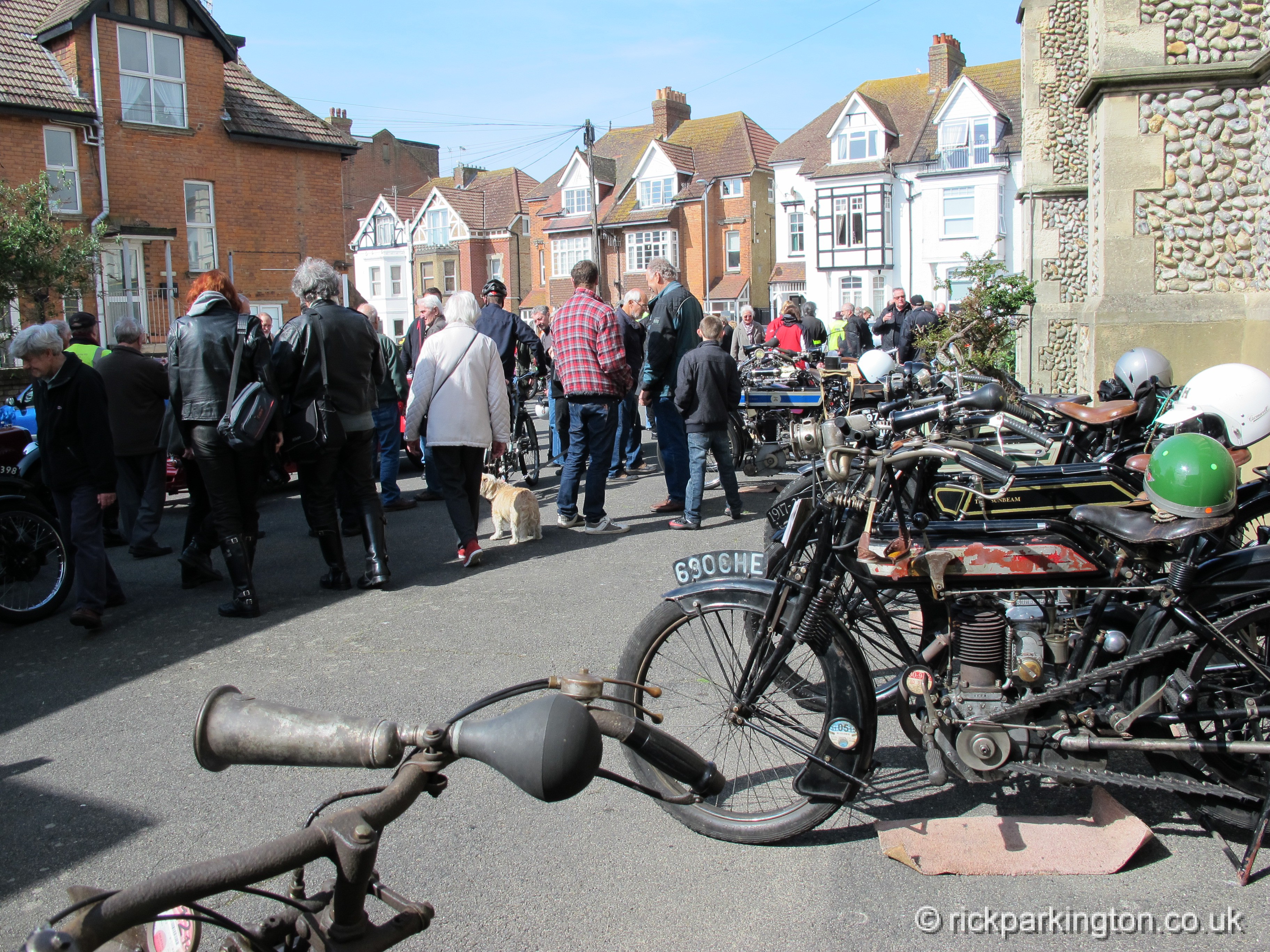
I’ve mentioned it before; Ixion was a by day a clergyman, Rev Basil H Davies, but in his spare time a motorcycle journalist and pioneer rider of the Edwardian days. His writing is timeless and his witty observations of riding bikes a century ago have always been a major inspiration for me. Having been a priest at St Barnabas’ church in Bexhill, this is where Dave Masters, Velocette fan, author and all-round nice fella, decided to hold an annual run in Ixion’s memory. Dave and Maggi are stepping down from the organisation next year so we are all hoping someone will take over, with Dave and Maggi’s help of course. Nominally it’s a Sunbeam MCC event but it’s open to anyone with the enthusiasm to give it a go.
This event is ideal for the 1915 Blackburne, being flattish, forty-five miles-ish and pretty rural. The thing about the Blackburne is it’s in no hurry to go…or to stop, so quiet roads like those of it’s youth, when the definition of an emergency stop was removing an ear of wheat from your mouth and calling ‘whoa’ to Dobbin up front, are ideal.
The only real bit of prep I managed this year was to get rid of that horrible pigeon basket off the back. These wicker baskets are a mixed blessing. As many detractors point out, you will not see a period picture of a bike with a wicker basket on the carrier. They are a modern interpretation of vintage style; but the simple fact is, it is useful to have somewhere to stash your gear. A popular alternative is a leather Doctor’s bag. I bought one last year, but well, it needs a surgeon more than a doctor. Fixing this one’ll take more stitches than a Glasgow Saturday night. But luckily I have something else…
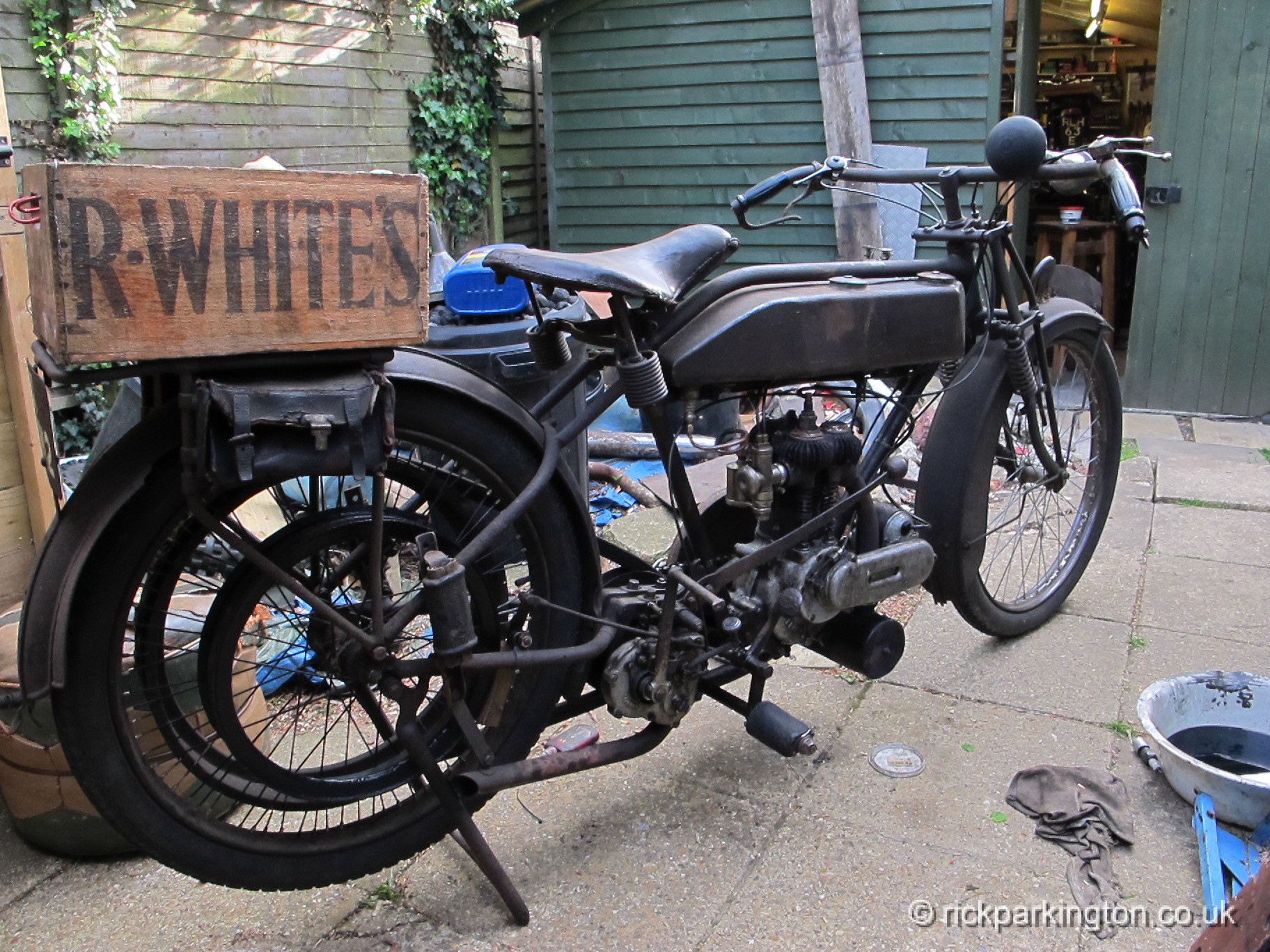
Now I can’t claim this as my idea, my mate Andy Gunn in Edinburgh came up with it first for his 1925 BSA and I have been keeping an eye on the off-licence ever since but these boxes aren’t exactly common nowadays. So I was delighted last year when a load of parts I bought came in a couple of suitable R White’s boxes…
Thus equipped the Blackburne chugged round very well; Judy took her 1928 Scott and won the ‘visitor’s choice’ award, here presented by a member of Ixion’s family, of whom 26 members of all ages were present.
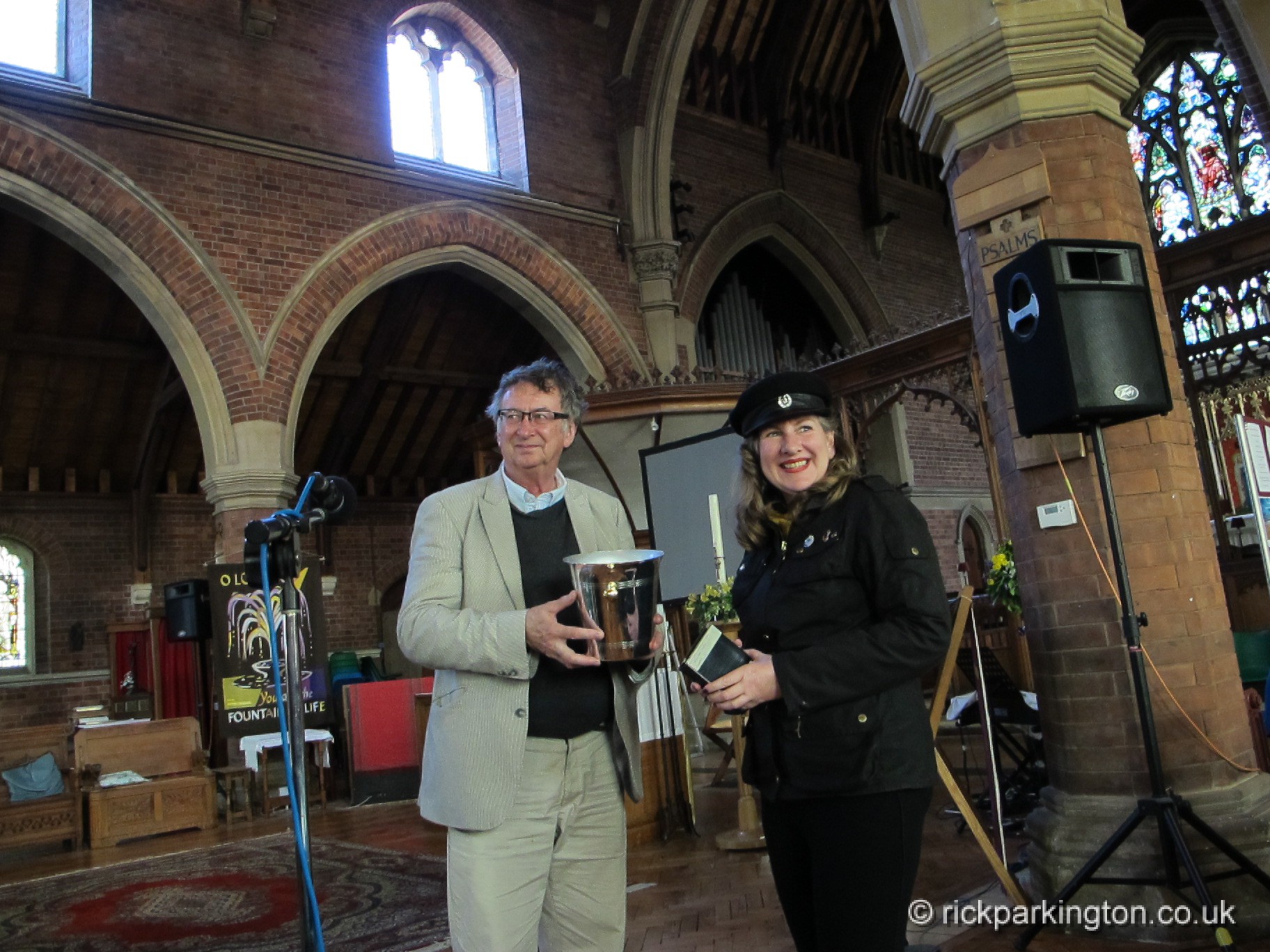
There were a few overseas visitors too this year including Andy Repton from Australia who won the ‘rider’s choice’ trophy for his 1910 Norton. I don’t think he rode it over here, but you can never be completely sure with veteran riders…
Take Nick Jonckheere (left) with his mate Jurgen, from Belgium…
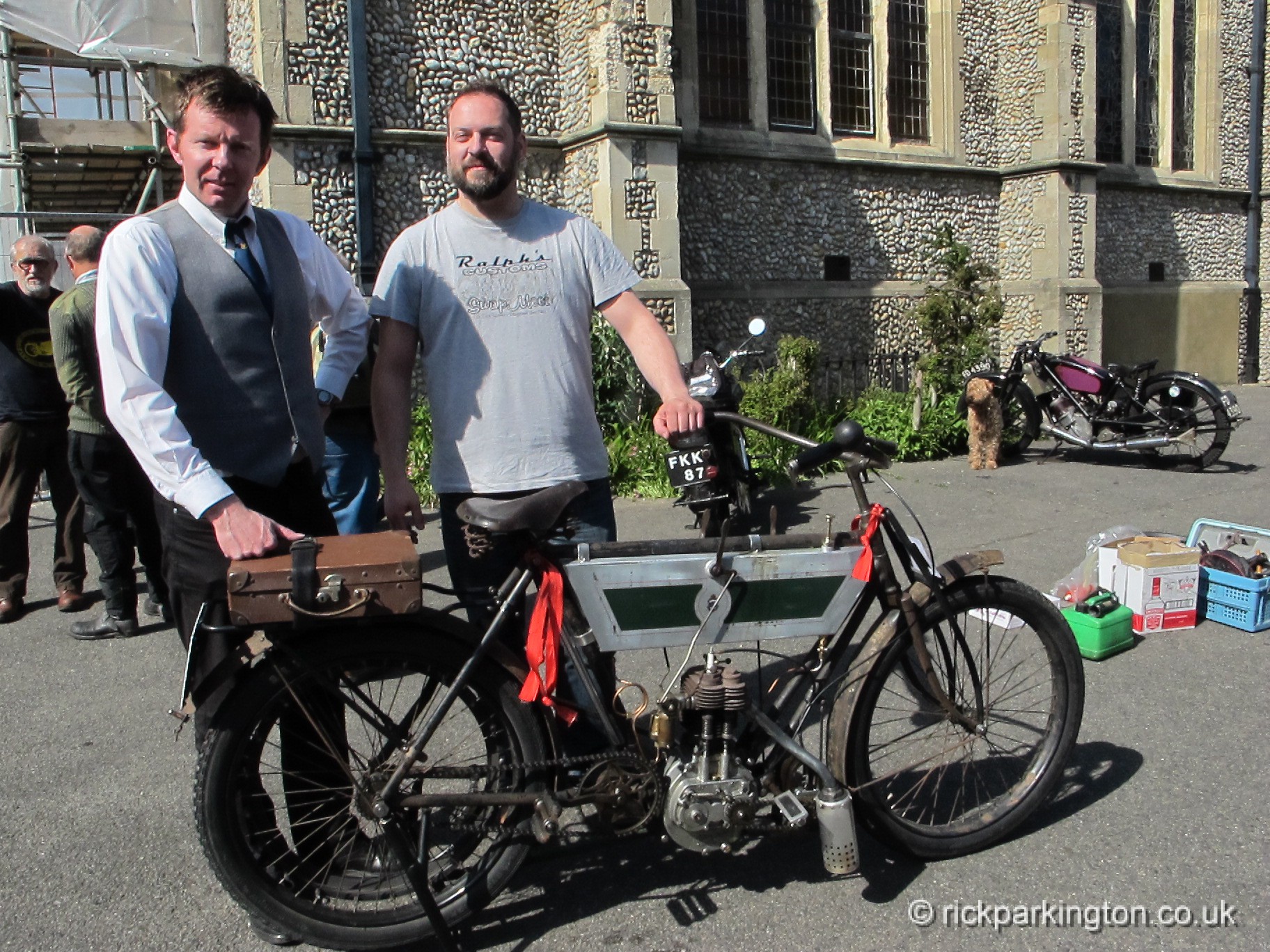
Nick has just finished rebuilding this 1905 Triumph, purchased as a basket case. He’s had to make a lot of it – the only other known survivor is at the National Motorcycle Museum. A man after my own heart, Nick has aged the new parts to match the unrestored whole. On such a model in 1905, Ixion performed an extended reliability test for the manufacturer, carrying out six 200 mile rides on consecutive days, ending with a total of 1,279 miles to prove the reliability of the ‘modern’ motor cycle to a doubting public. Total breakdowns amounted to three failed piston rings ( a ten minute replacement job ) and a puncture. Having proved his machine on the Ixion Run, without recourse to tyre levers or spare piston rings, Nick is planning to re-enact the 1200 miles reliability run later in the year: top fella and good luck, Nick.
So upon my return home, I decided instead of just putting the Blackburne back into the shed, it had earned a bit of a look at. In a lead free world it’s handy to be able to have a look at the valves from time to time and I haven’t had the head off the Blackburne since getting it on the road about five years ago.
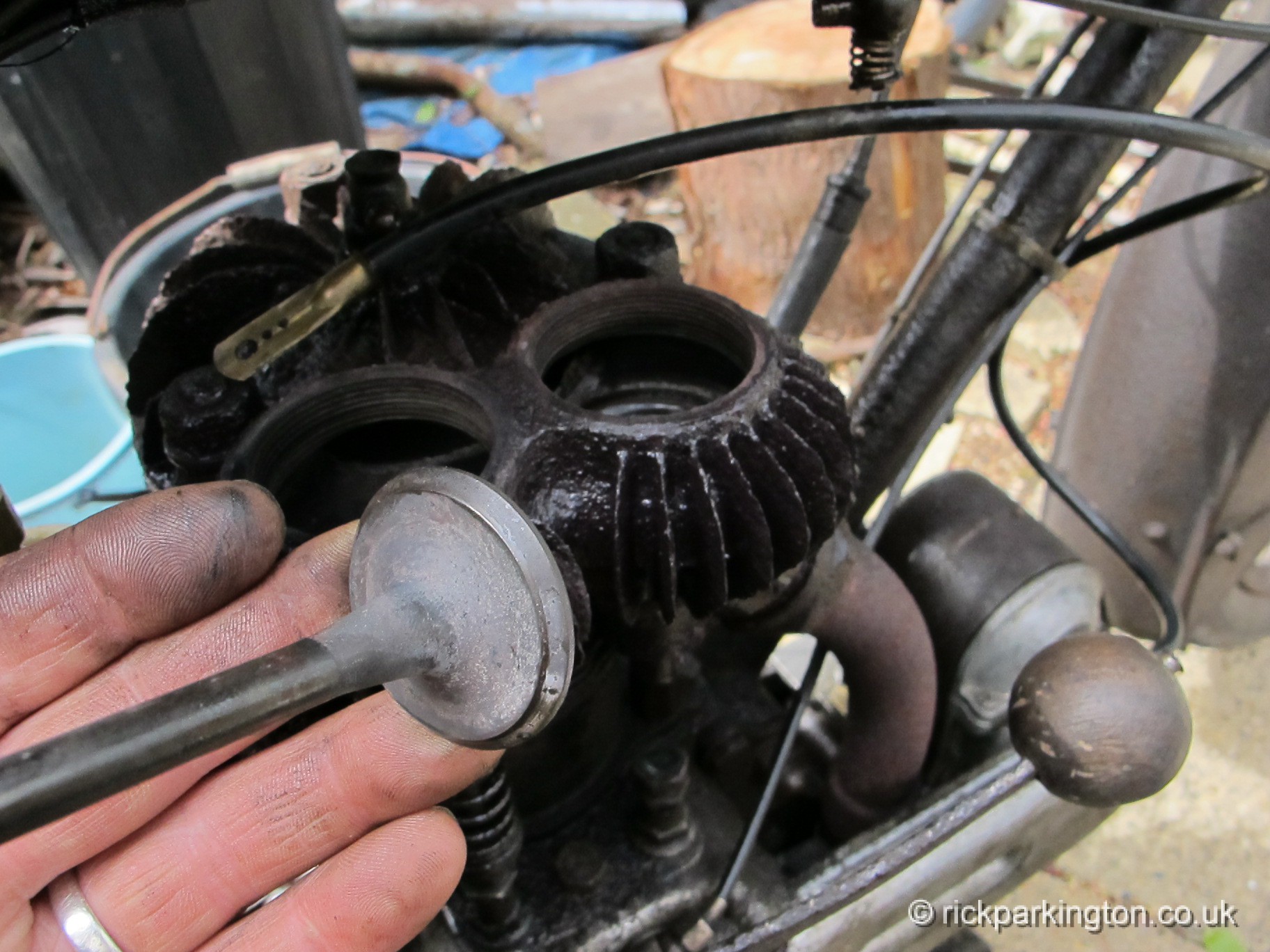
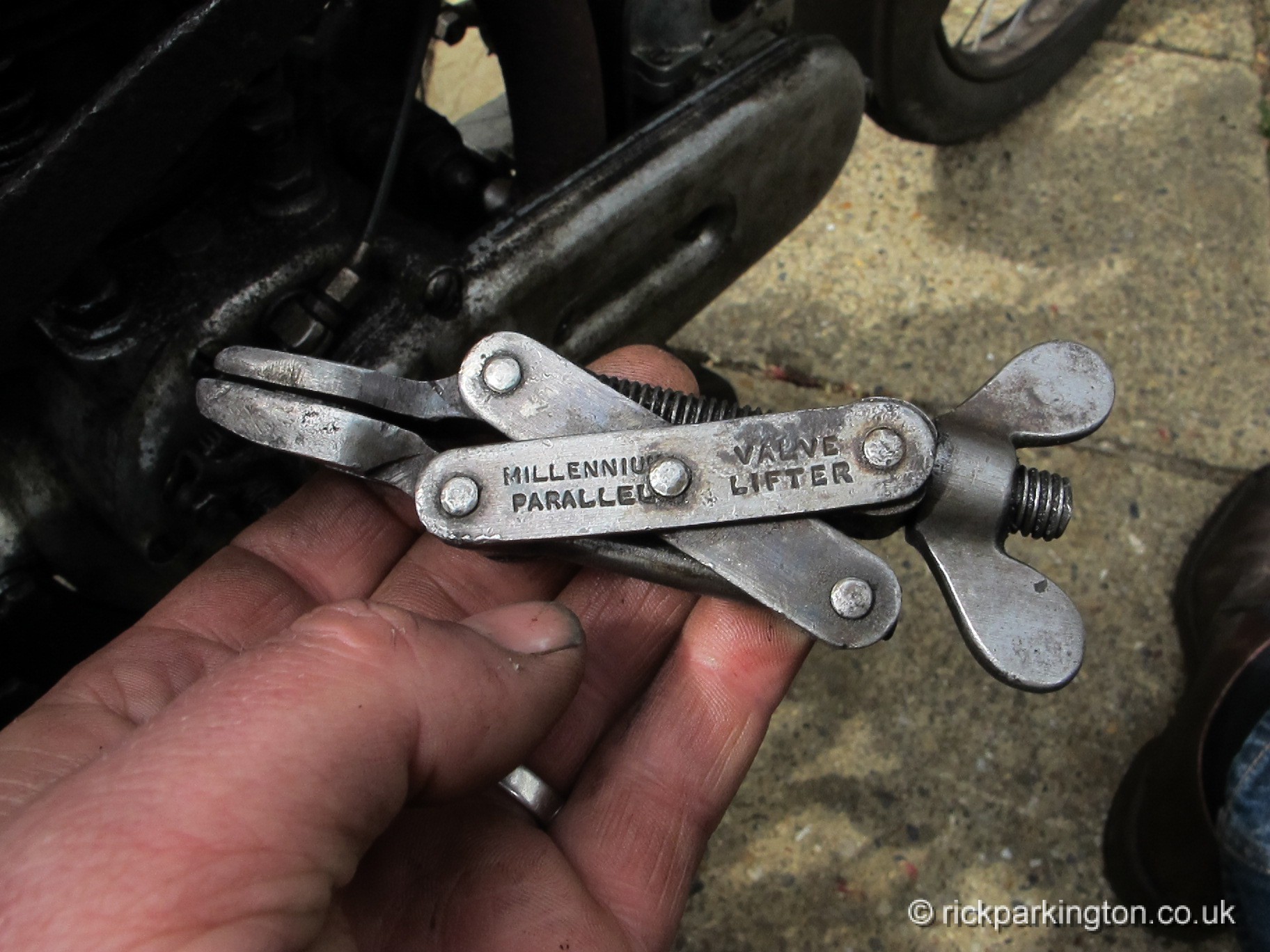
Of course, as with Ixion’s piston ring replacement, nothing on a vintage side-valve is a very long job. Off with the screw-in valve caps and out comes the valve. You can sometimes compress the spring without a compressor and pull out the flat cotter that sits in a slot in the valve stem, but I used my period Milennium tool, which works like a scissor jack and fits neatly in the toolbox…
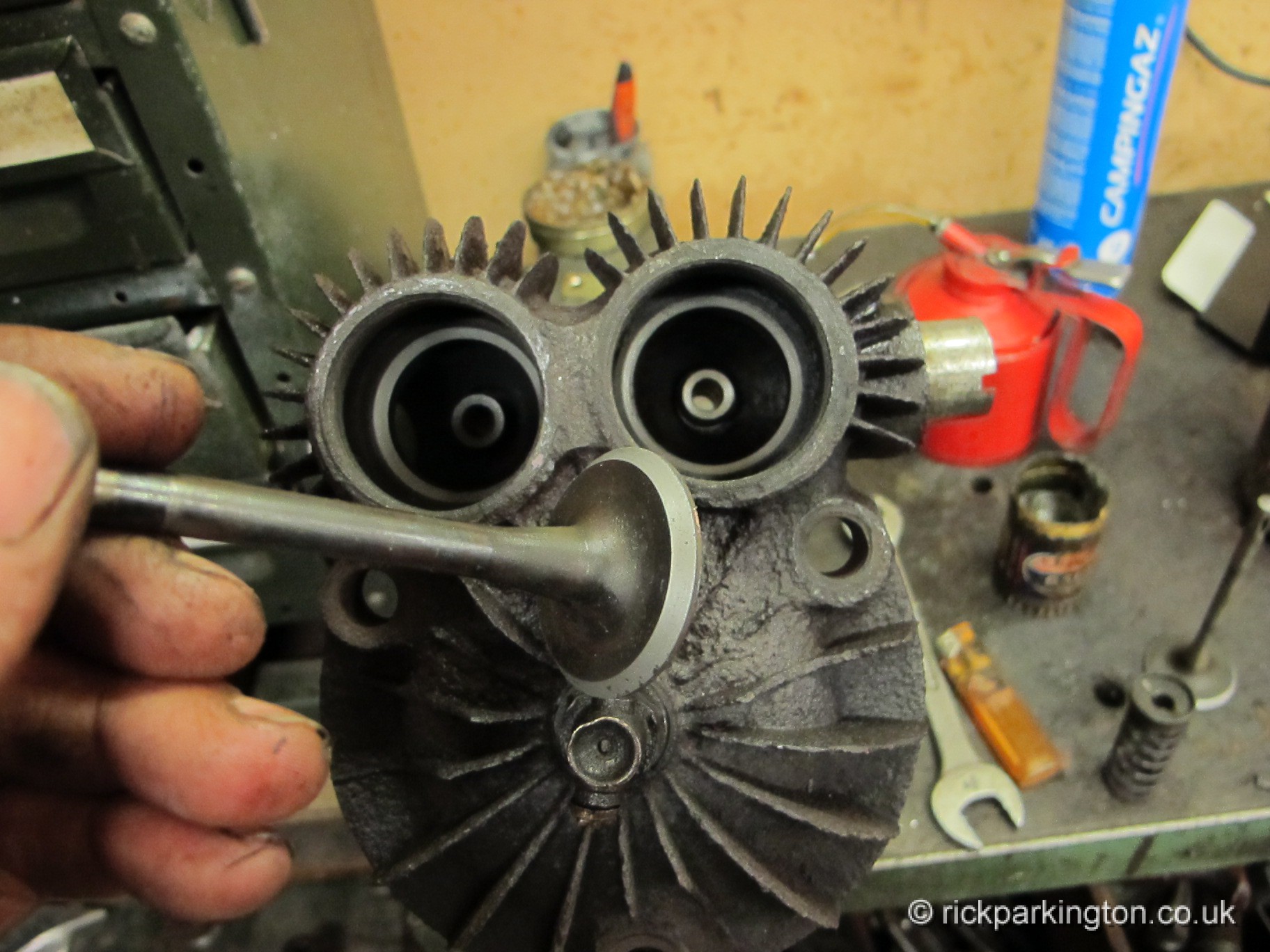
The valves and seat wanted a grind but there was no sign of horror seat recession. Of course it’s worth remembering that when this bike was made there was no lead in petrol anyway and regular grinding was a part of maintenance. The valves are very hard and last fairly well but often the seats have been worn away by years of carborundum paste and a rubber sucker. There’s the thing; the worst thing for valve seat wear is not unleaded petrol but grinding paste. You are far better off giving the valves a light grind every couple of years than waiting until deep pits appear and need a much greater amount of material removal. Pitted valves will burn very quickly.
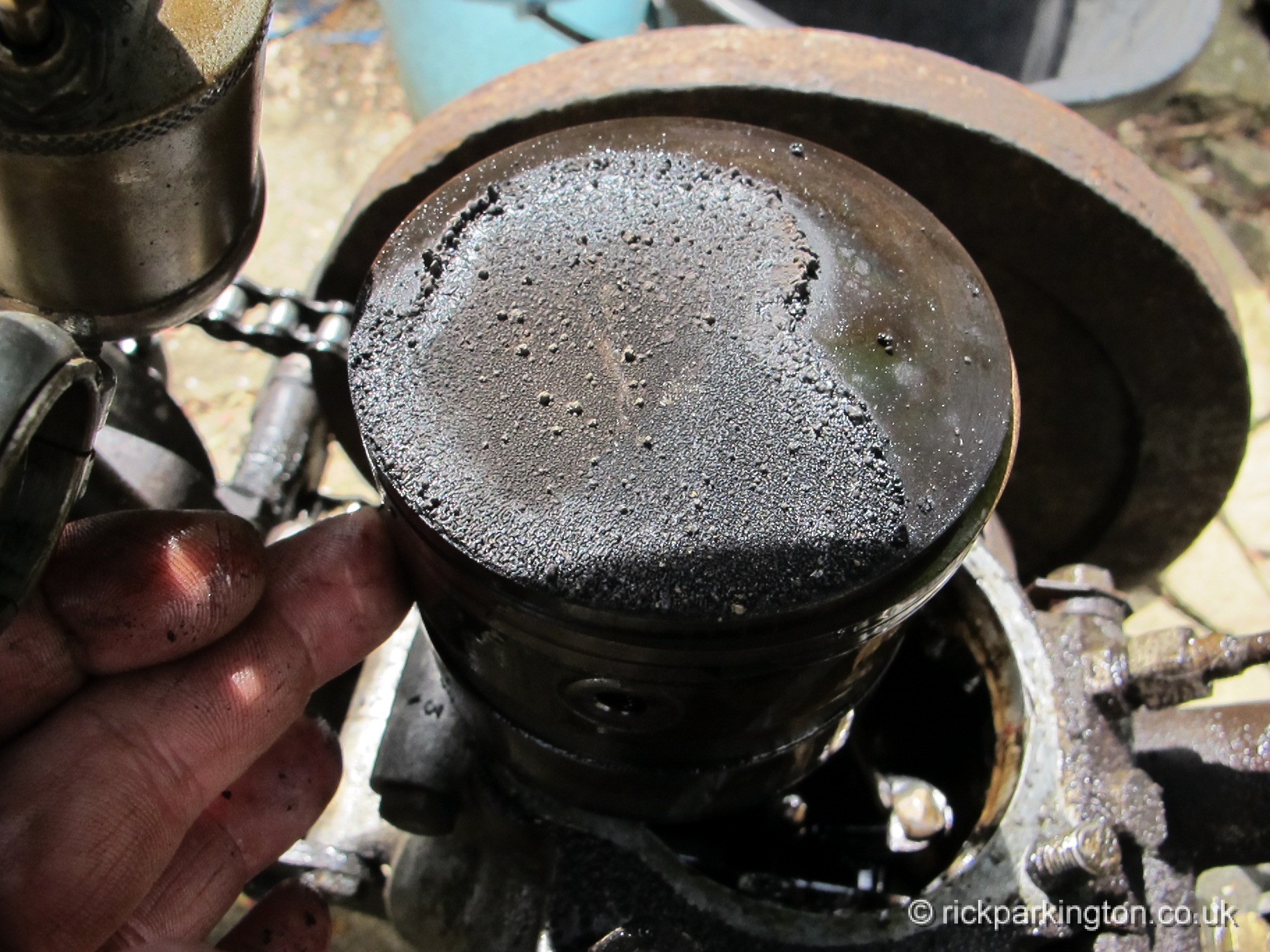
So it was a job worth doing. I lifted the cylinder too, to check the big end, all well there still. On these early Blackburnes it’s a plain bearing; two chunks of bronze bolted together with a con-rod on top. The idea being that when worn, you face down the join between the two blocks and restore fit – ending up eventually with an eliptical bore, but not – if mine’s anything to go by – for the frst 100 years at least…
I also notice the rear brake rim had split in the bottom of the vee again. The brake works by wedging a vee shaped block of retarding material (I’m on oak at the moment) into a similarly profiled rim spoked to the back wheel. Being slightly springy it is also a bit brittle after all these years. Last year I patched over a cracked section, this year I have gone round the entirety, hopefully that will sort it. I can’t say I rely on the brakes all that much but they might as well have some effect.
Interesting to compare the Blackburne with the 1914 BSA I borrowed for the Pioneer Run. It is probable that the Blackburne was actually built in late 1914. The Sturmey Archer CS gearbox was reported in the press in December that year and my gearbox is only the 22nd one made. But the rules of the Pioneer Run state that a Veteran must not be either later than 1914 or a 1914-built 1915 model; the gearbox was only fitted to Blackburne’s 1915 range so my bike cannot compete in the run but it is nonetheless more or less a contemporary of the BSA. What’s interesting is how the Blackburne hates that gearbox. On this run something dislodged leaving me only second and top and apart from using second to pull away a couple of times I just ran it like a single speeder for the whole run and it loved it. Engines of this period – and the BSA is identical – are noticeably different to later motors. They are part statoinary engine and faced with a hill, just settle into a duff-duff-duff that slowly climbs up. If the hill is too steep, fair enough they will falter but they are very hard to stall, retarding the ignition takes the whack out of each power stroke and puts you back in the age of steam. You can’t make the bike go faster with the throttle and in the Blackburne’s case it doesnt feel like it wants you to change down, it just makes a load of unnecessary fuss and you quickly put it back into top. It’s as if the bike is saying ‘leave this to me and don’t meddle with my controls’; a strange but rather pleasing experience. Of the two the BSA feels far more solid than the Blackburne, which I would imagine is considerably lighter, and the BSA is probably a shade faster. But the Blackburne is in essence a 1905 engine design so that’s no surprise.But in these bikes you can see the ancestry of later models like the BSA M21 very clearly. Fascinating stuff…well for me anyway, you probably nodded off hours ago… But before you turn in to bed, there’s one other good reason to visit Bexhill right now.
The DeLaWarr pavillion is hosting an exhibition of original artwork from the educational series of ‘Ladybird’ childrens books.
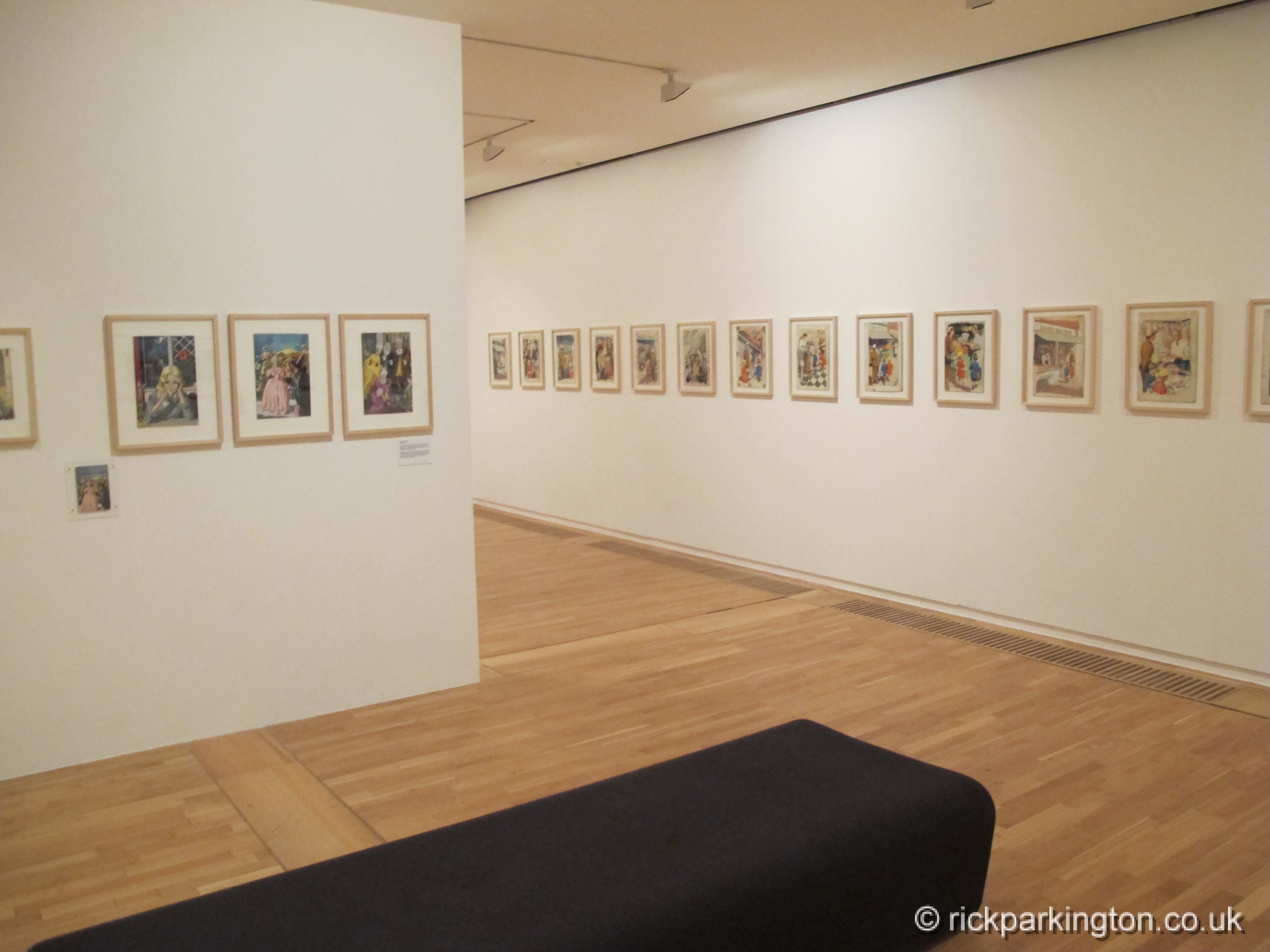
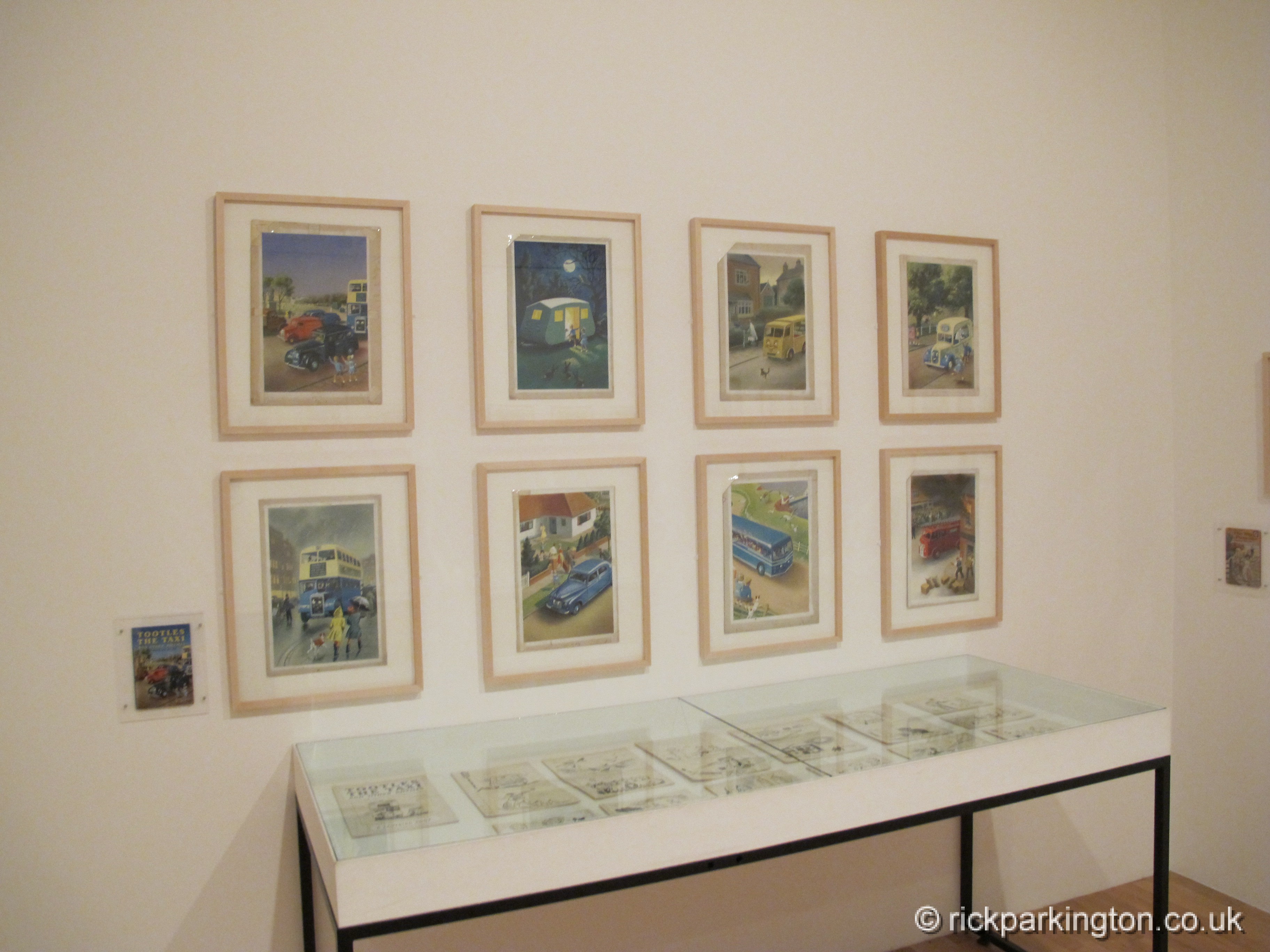
Anyone who grew up in the United Kingdom from the 1950s to date will know them. I still have all of mine in the attic and have been known to refer to them for a concise analysis of various topics. Kings and Queens of England (in two volumes) for example is a great way to work out your Warwick the Kingmaker from your Alfred the Cake Baker and what amuses me is that despite being kids’ books, we are left in no doubt that most of the crowned heads over the years – leaving aside her current Majesty and her immediate ancestors of course – were as dodgy a bunch of sheep stealers as you could hope not to meet… It seems indeed that Ladybird took trouble not only with the beautiful illustrations seen in the exhibition but in getting excellent research and writing skill into their slim volumes. Although I have to say that the way Ancient Man in Britain seems to attribute the entire advancement of humanity in Europe to a troglodyte by the name of ‘Quickfoot’ calls for closer scrutiny and the country cottage garden ‘nest’ of the Bowery Bird in Birds and How they Live turned out to my immense disappointment to be pure fantasy… I also note the exhibition swerved around the shocking 1970’s update of The Policeman, in which the smart copper on the cover, telephoning from his Tardis is replaced by an sleazy individual with a tash and a portable radio (see Blair Peach). I have both original and later versions and the fun really begins inside where the original artwork has been re-touched, to update the pictures. Along with subtleties like the removal of truncheons from a chase scene and the replacement of Speed Twin by Norton Interpol, there’s some more drastic work like turning a Ford 100E into a Bond Bug and adding golden curls to a shady character of the Alfie Bass ‘it’s a fair cop, Guvnah’ – type into something ressembling Rod Stewart in a demob suit…but we’ll forgive them that, after all it was Hell in the ‘seventies. Ladybird is a definitely a great British institution and this display makes a great exhibition..
Cheers RIck
How could you fail to mention Ladybird*s “How it works:The Motorcycle”?
Produced with the help of BSA it’s full of illustrations of Bantams, Starfires and A65s. Well worth a quick scan of charity shop bookshelves to turn that one up.
Just jealous because I never had a copy… But yes, thanks for pointing it out Iain, it certainly deserves a mention!
R
Hi Rick
R Whites boxes should be painted the shade of pea green that is only found in a tin at the back of a shelf in the shed and secured with bailer twine
Ah, I think all of that particular paint was used on the BSA tanks I mentioned before. It will have to remain au naturelle; as to the bailer twine, yes, very remiss of me to overlook that! In my defence, however, I did employ a sheet of proper old brown hessian sackcloth as a tonneau for the box…!
Cheers R
Nice trophy, I hope you & Judy had something appropriate to chill in it.
Well maybe a bottl of R Whites, 1925…? As it happens you don’t get to take the Ixion trophy away (luckily, we havn’t got much room for anything else) but the take away prize was a more compact hip flask that Judy was very pleased with indeed.
Cheers R
Great story, particularly your description of ascending a hill. ‘Leave this to me’, I can picture it!
Lady Bird books were standard fare in New Zealand too. You can’t get much further from the UK, but I was brought up on them.
Thanks Alan, yes the old Blackburne is certainly an interesting thing to ride! And glad the word of Ladybird spans both hemispheres. Trouble is i found myself looking at some in a charity shop today, in case there was an interesting one…Fortunately i snapped out of it just in time and bought a 1969 book on ‘Barnstormers’ instead. Much more respectble!
Cheers R
Hi, Rick,
Oak for brake blocks? Hmmm. Wasn’t poplar the thing in days of yore? Apparently it has the highest coeficient of friction of all woods, or so I’m told. Of course, as as a chippy you probably know that anyway. Love the blog.
Regards
Sandy
Very possible, Sandy. I used ash once which was ok and elm which was too soft. Me? A chippy? No,I just build my own sheds! Thing i Im not really sure where to get unusual wood from. It might be good to try different ones. Then again maybe poplar is for racing and oak is the ABS material! Glad you enjoy the blog!
Cheers Rick