
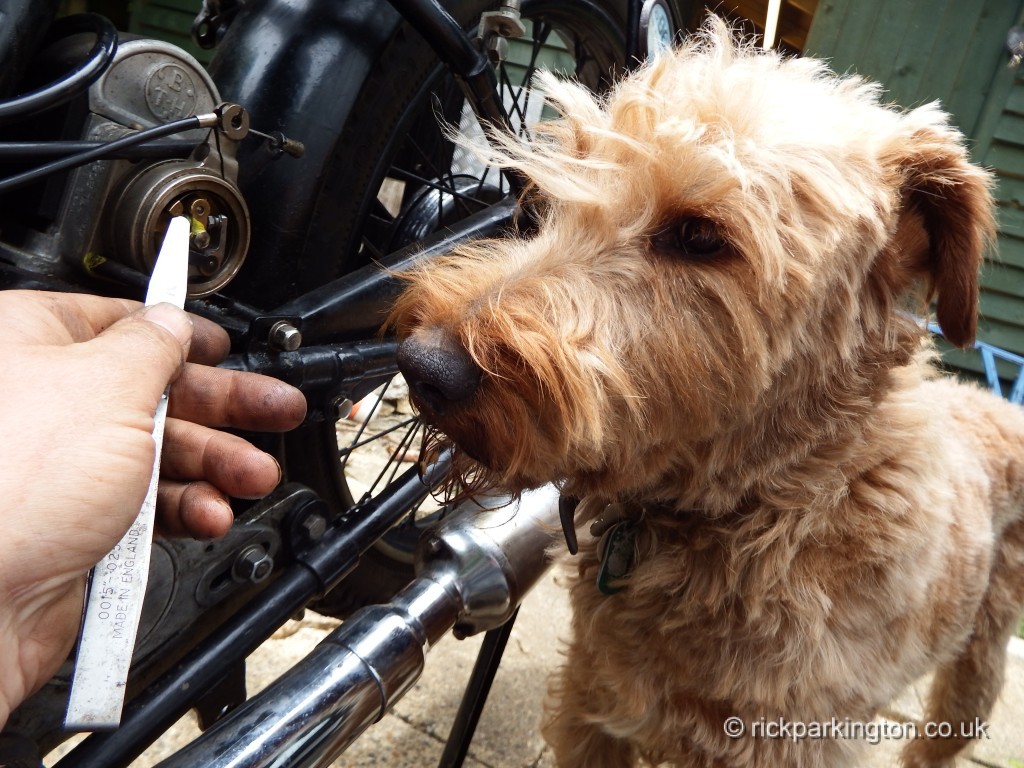
 Scotts are funny beasts…
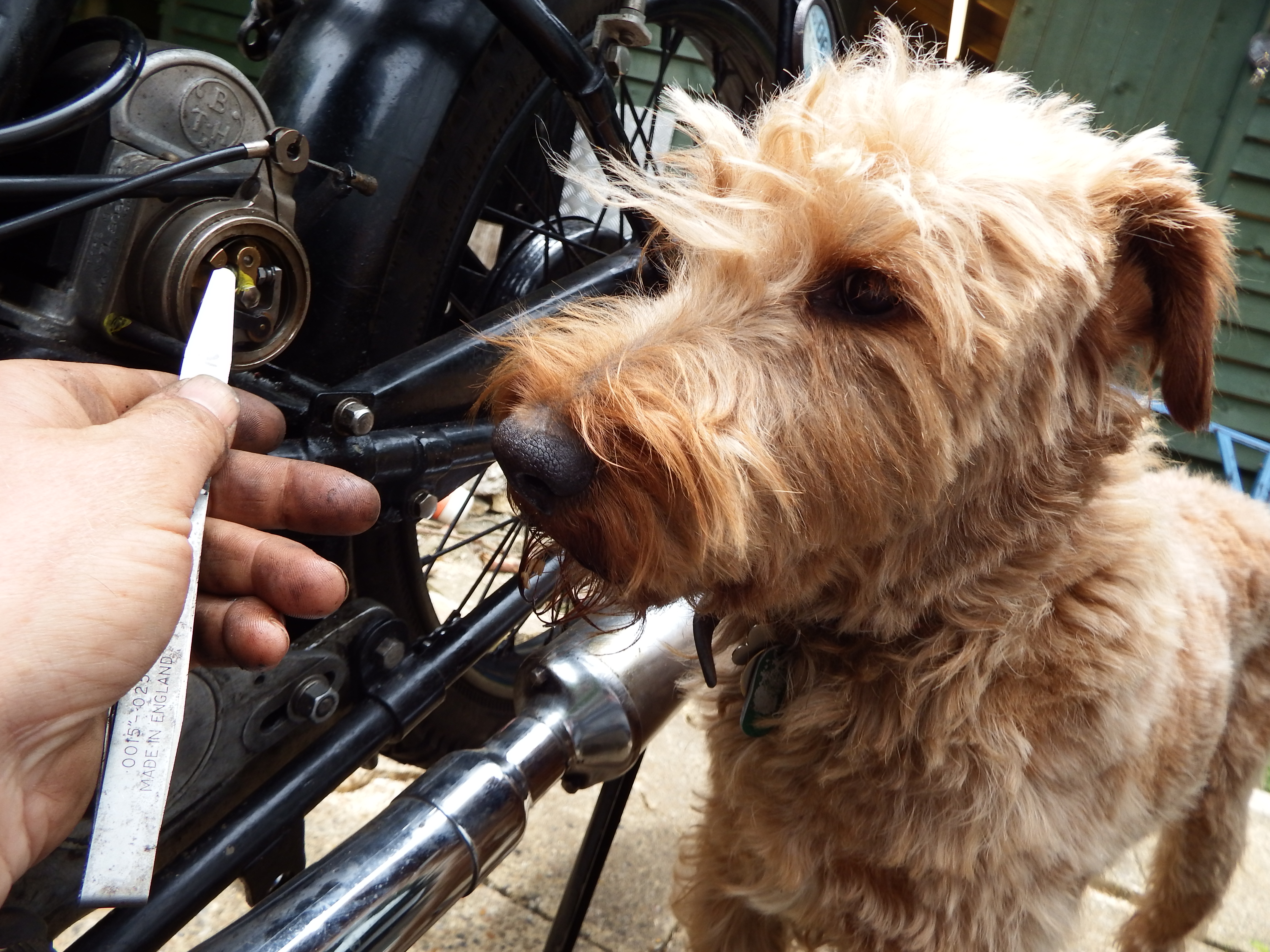
Judy’s ’28 is being a bit of a pain, taking a lot of revs to pull away. It has a close ratio gearbox which may not help but compression feels a bit low on kickover and as any stroker fan knows, a clapped one will deliver as much power as any other at ful bore but will be prety flat at low revs. Still, this is a recent phenomenon, it was alright last year so I decided it was worth checking the ignition timing. It’s simple enough on a Scott; simply get the pistons on top dead centre and the points should break with the ignition lever set to full retard…But as Finbar is keen to point out, first you need to check your points gap.
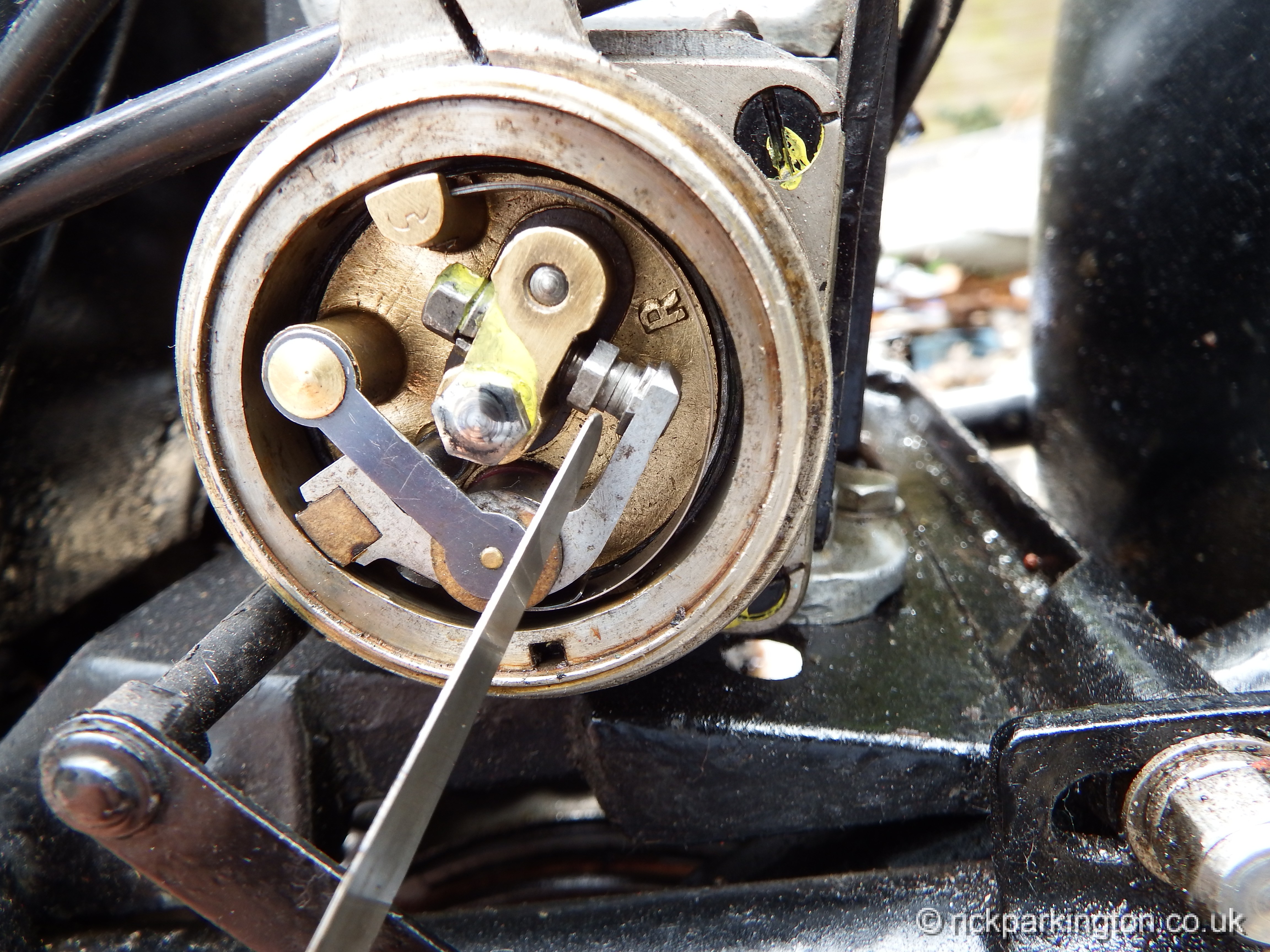
In order for the points to be properly closed when off the opening cam, they only actually touch the cam ring on the raised, ‘lift’ section. If the gap at peak lift is set too wide, the clearance when closed will be less, so the points will contact the lift section sooner and break earlier, advancing the ignition. Similarly a reduced points gap will retard the spark. That’s one reason why a correct points gap is critical. Of course, if you were to set the timing with the wrong points gap, timing wouldn’t be a problem so long as you stuck to the same gap but it’s much simpler to get the gap right before doing anything else. On battery/coil systems the points gap is 0.015″ but on magnetos it is 0.012″, 12 thou. On a twin cylinder magneto it isn’t unusual for the gaps to be different from cylinder to cylinder; if so split the difference – 10 and 15 is better than 12 and 18. This 1928 BTH mag wasn’t too far out. The discrepancy is often blamed on cam ring wear but pause before forking out for a new one. Often it is simply that the magneto is made of mismatched parts or wasn’t that accurate in the first place. The gap here was tight which could be the problem.
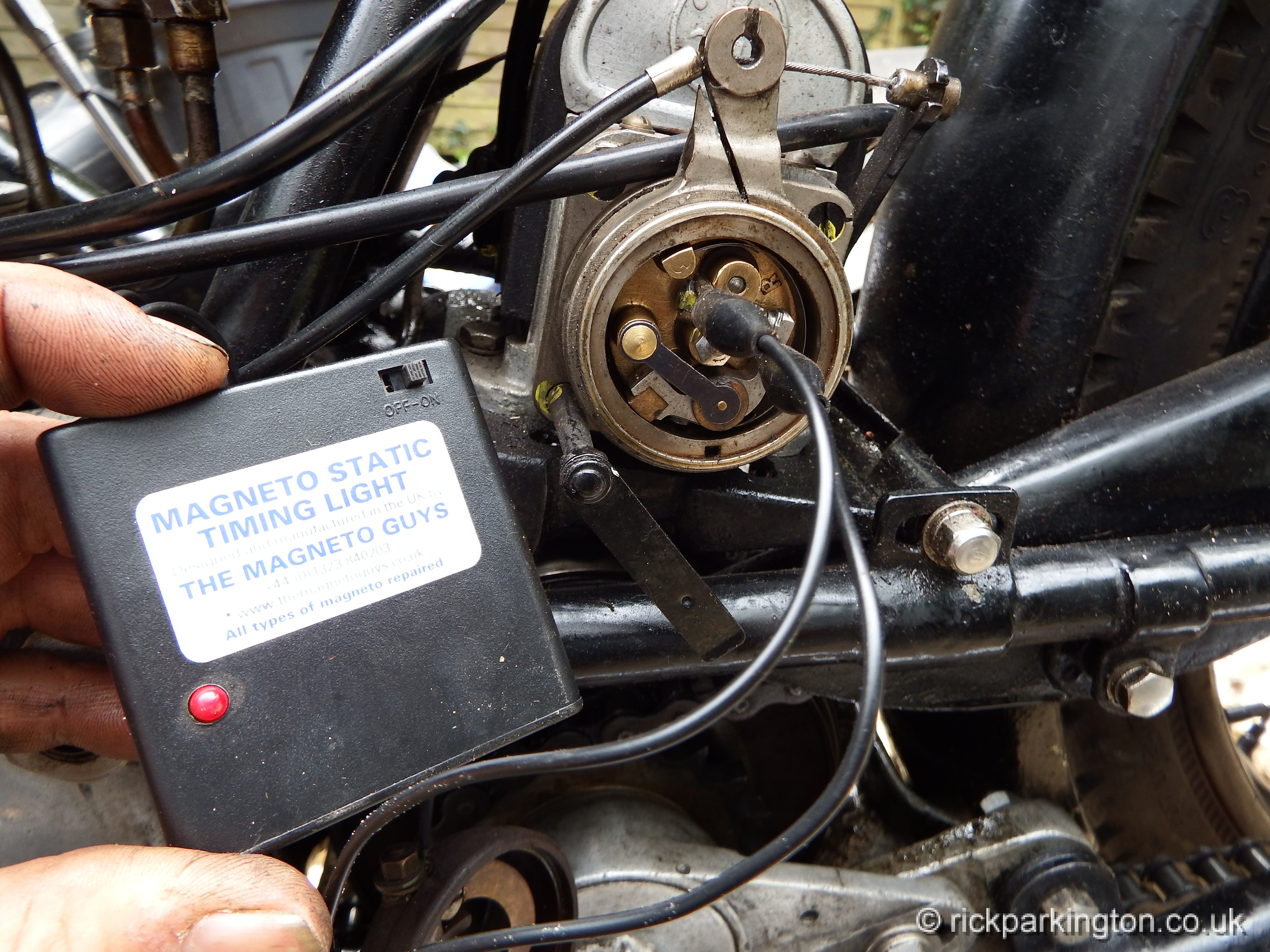
Next step was to attach the Magneto Guys points break indicator. Shameless advertising you might say but after years of using fag papers, it’s a handy bit of kit, espeicially with bikes where you have to be around the other side to tighten the sprocket. Anyway, having connected the indicator, I set the mag to full retard (twist the cam in the direction of rotation so the peak moves away from the direction of travel) and turned the engine to TDC. Bingo, the light came on…however, ther’s a potential problem here. Vintage handbooks were keen on this full retard setting but of course what matters for engine health is the full advance position and if you have a different mag fitted, the advance range might not be the same; setting to retard may leave you dangerously out at full advance. As it happens, on this bike, Judy’s ’28 Flying Squirrel, the factory records show incredibly it still has its original magneto. Even so I decided to check the advance position as per the Scott handbook. Most manufacturers quote crankshaft degrees; none of that nonsense for Scott; surely it’s simpler to examine the big end bearing and check it lines up with the cylinder base stud…sorry; what’s that, engine strip?
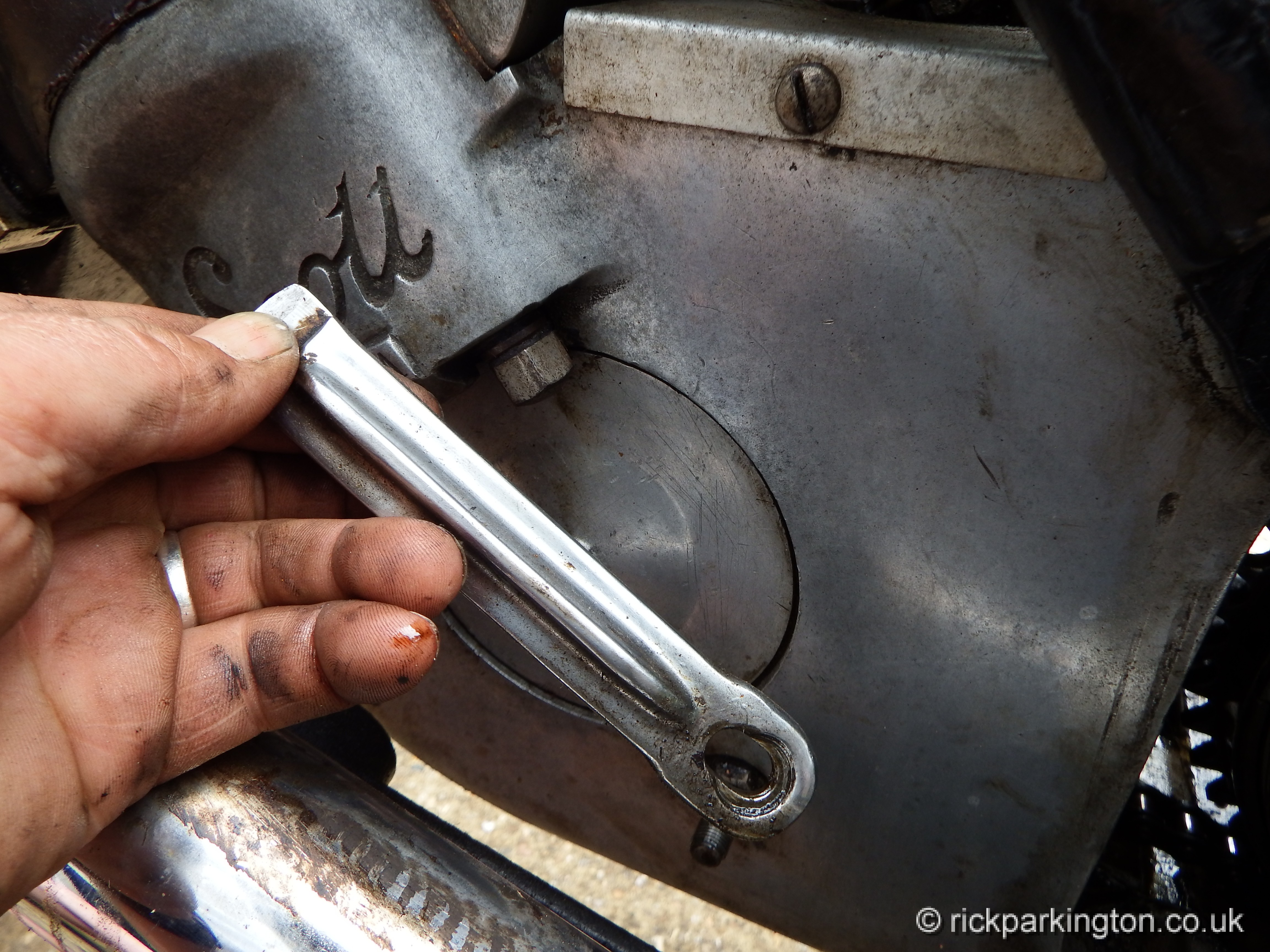 Goodness no, be serious! All you do is undo the nut then remove the locomotive con rod below the barrel. Then you can flip out the ‘crankcase door’ aluminium disc to reveal…
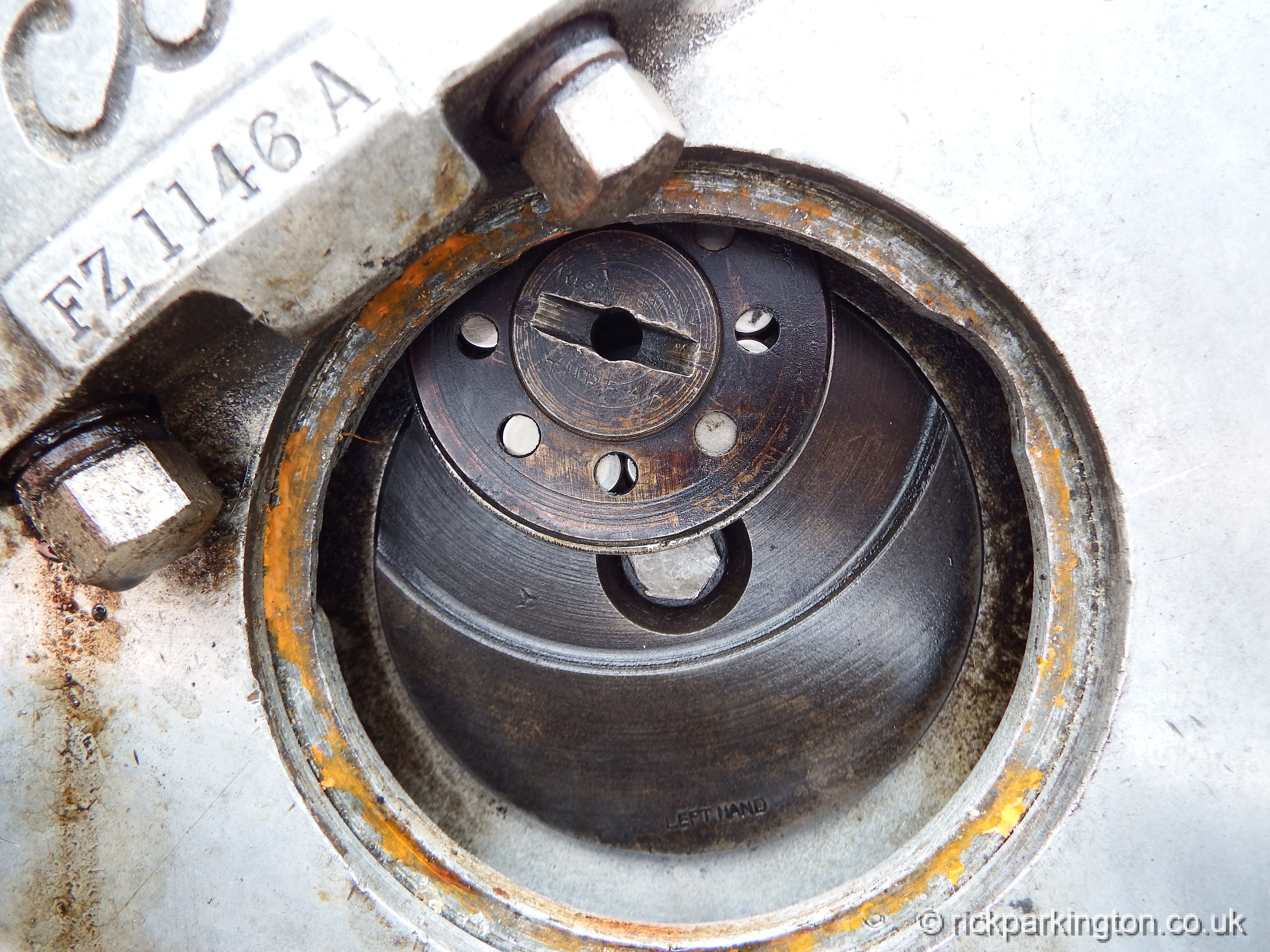 …the big end bearing. There we are, imagine a line between the hex bolt, the slotted big end roller retainer and the cylinder stud, that looks about right for full advance. Better put it back together again. It may not be the greatest selling feature of the Scott but be honest, how many other bikes do you know that can have a change of big end rollers at the roadside?
Anyway, with the timing advanced by opening the points the Scott seems to be pulling better already. Job done.
Cheers Rick
you’re advertising worked… I just bought one
What, a Scott or a Magneto Guys timing light?!
R
haha, timing light, no more fag papers for me 🙂